

Your reps are in the field right now. Whether they’re managing dealer accounts across three states or working a residential neighborhood street by street, the question is the same: do they know exactly where to be — or are they burning windshield time figuring it out?
Nearly a quarter of field sales teams still manage territories with spreadsheets or paper maps, according to SPOTIO’s 2026 State of Field Sales research. That’s not a technology problem. It’s a visibility problem. When you can’t see where your team is working, where coverage is thin, and which neighborhoods have never been touched, you can’t fix any of it. Sales mapping software is what closes that gap.
This guide covers the seven best sales mapping platforms for field teams in 2026 — what each one does well, who it’s actually built for, and how to choose before you buy.
What Is Sales Mapping Software?
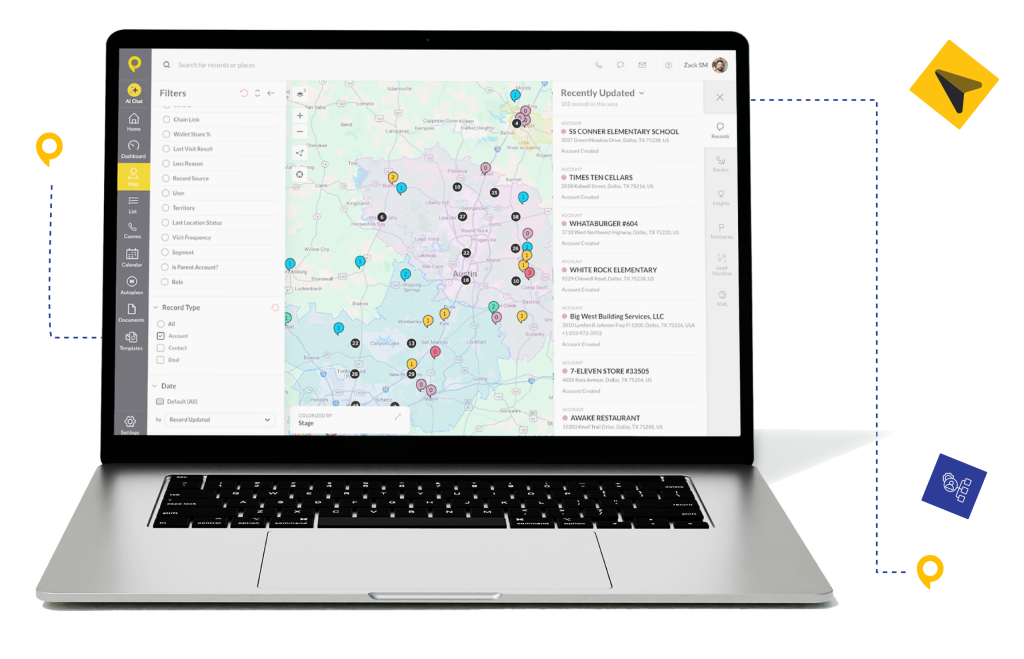
Sales mapping software converts your customer data, prospect lists, and territory assignments into a live, visual map your team can actually act on. At its core, it shows you where your customers and prospects are, where your reps are working, and where coverage is breaking down — in a format that’s actionable in the field, not just in a planning meeting.
The best sales mapping platforms for field teams go a step further and include territory management: assigning defined areas to specific reps, balancing workload across a team, and enforcing boundaries so two reps aren’t working the same block. We’ve included tools that do both in this guide, and noted where a platform is better suited to one or the other.
What actually matters for field teams:
- Territory assignment that balances workload by home count, account density, or revenue potential
- Prospect visualization showing where customers cluster and where coverage is missing
- Route planning that reduces drive time between stops
- Activity logging with location verification — so managers see what’s happening without invasive tracking
- CRM synchronization that keeps pipeline data current without adding rep admin work
Why Google Maps isn’t enough: A roofing company with no territory structure discovered the hard way what happens without it — two reps knocking the same doors on the same day, in the same neighborhood, with homeowners asking why the same company kept showing up. Google Maps navigated both reps there perfectly. It had no idea they were duplicating each other’s work, wasting a day of capacity, and making the company look disorganized in front of potential customers.
That’s the structural problem Google Maps can’t solve:
- It can’t assign territories with logic or enforce boundaries between reps
- It provides no demographic overlays or prospect data
- It offers zero activity tracking — no record of who visited which account, when
- It doesn’t connect to your CRM, so nothing that happens in the field makes it back to your pipeline
The result: unbalanced territories, preventable overlap, and pipeline data that’s always a week behind reality.
A medical services company imported their accounts into SPOTIO during onboarding and had an immediate aha moment: their administrator had never realized that almost all their clinic accounts were clustered in one region of Northern California. Until the accounts were visible on a map, nobody had thought to coordinate visits. That’s what sales mapping software unlocks — not just efficiency, but intelligence you didn’t know you were missing.
What Is CRM Mapping?
CRM mapping is the practice of plotting your CRM data — accounts, contacts, deals, pipeline stages — onto an interactive map so field sales teams can see the geographic dimension of their pipeline. Instead of scrolling list views in Salesforce or HubSpot, reps and managers see where customers cluster, where coverage gaps exist, and which prospects sit closest to today’s route.
The term gets confused with CRM data mapping, which refers to syncing fields between systems during an integration project (mapping “Company Name” in one platform to “Account Name” in another). That’s an IT workflow, not a sales workflow. When field sales teams talk about CRM mapping, they mean turning the data they already have into a visual layer they can act on between stops — territory boundaries, color-coded pipeline stages, and prospect pins they can tap for context before walking to the door.
Most of the sales mapping platforms in this guide include CRM mapping as a core capability. The difference between tools is whether the CRM connection is two-way or requires manual exports. If your team runs on Salesforce, see our Salesforce Maps breakdown for how native and third-party options compare.
For teams that need the analytical layer beyond pin-on-map visualization — heat maps, demographic overlays, and territory performance scoring — see our guide to location analytics tools for field sales.
How to Choose Sales Mapping Software
Before evaluating platforms, get clear on how your team actually sells in the field. A roofing crew canvassing 300-home territories block by block needs something fundamentally different from a B2B rep managing 40 distributor accounts across three states. The features that matter — and the ones you’ll never use — depend entirely on your sales motion.
Three questions to answer before you buy:
1. Is it built for field sales or adapted for it? Some tools on this list were designed specifically for outside sales teams. Others started as logistics or data visualization software and added sales features later. The difference shows up in mobile experience, activity tracking, and whether the tool helps a rep make decisions in the field or requires them to go back to a desktop to plan their day.
2. Does it handle your territory model? Territory management looks different across verticals. Telecom and fiber teams import territory boundaries based on fiber line passings — often as KML or KMZ files — because the sellable area follows infrastructure, not geography. Roofing teams build territories around storm events using hail data integrations. Door-to-door teams work by zip code and extend territory only after an area has been knocked and re-knocked to sufficient penetration. Make sure the platform supports your model, not a generic one.
3. What happens when territories need to change? Territories go stale. Reps leave, markets saturate, gated communities turn out to cover half a territory that looked workable on paper. One distribution company imported their West Coast prospect list and discovered 60–80% of the territory was uninhabited land — their account manager would have been assigned a territory with a fraction of the viable stops they expected. See our sales territory plan guide for how to structure this process before problems emerge.
One question worth settling before you start platform demos: whether a purpose-built SaaS solution makes more sense than building something custom for your team’s specific workflow. The answer is almost always buy, but the cost breakdown is worth reviewing — particularly the compliance and maintenance costs that most teams underestimate when they first run the numbers.
Best Sales Mapping Software for Field Teams in 2026
| Platform | Best For | Starting Price | Territory Management | Activity Tracking | Mobile App | G2 Rating |
|---|---|---|---|---|---|---|
| SPOTIO | Full B2B & B2C field sales execution | Custom pricing | Advanced | Location-verified + DASH AI co-pilot | Native mobile-first | 4.5/5 |
| Badger Maps | Route optimization | $49/user/mo (annual) | Basic | Check-ins | Yes | 4.7/5 |
| Salesforce Maps | Enterprise Salesforce users | $75+/user/mo | Advanced | Yes | Yes | 4.4/5 |
| Maptive | Data visualization | Varies | Basic | Limited | Yes | 4.7/5 |
| Mapline | Scalability & Geo BI | Varies | Advanced | Yes | Yes | 4.7/5 |
| Map My Customers | Small B2B teams | Varies | Basic | Yes | Yes | 4.5/5 |
| Route4Me | High-volume route optimization | Varies | Yes | Yes | Yes | 4.7/5 |
Quick Decision Guide:
- Field sales team of 5+ reps (B2B or B2C)? → SPOTIO for territory execution, activity tracking, and AI
- Solo rep or team of 1–4 focused on routing? → Badger Maps at $49/user/month (annual)
- Enterprise Salesforce shop with dedicated admin resources? → Salesforce Maps
- High stop-count field service or mixed delivery/sales operation? → Route4Me
- Small B2B team needing simple setup? → Map My Customers
SPOTIO — Best for Field Sales Execution at Scale
G2 Rating: 4.5/5
SPOTIO is built for outside sales execution — whether that’s a roofing crew canvassing a storm-hit neighborhood, a telecom team selling fiber door to door, or a B2B rep managing dealer accounts across a three-state territory. It’s the platform field sales managers use when route planning alone isn’t enough and they need full visibility into what’s happening in the field.
Teams looking for a one-time territory rebalancing solution or a lightweight route planner for a solo rep will find SPOTIO’s depth exceeds their immediate need — there are simpler, cheaper point solutions for those specific use cases.
Key Capabilities:
- Territory Assignment: Build territories by home count, zip code, account density, or revenue potential. Assign reps or vendor teams to specific areas with visibility controls that prevent overlap and protect rep turf
- DASH AI Co-Pilot: SPOTIO’s built-in AI assistant gives reps instant access to product specs, pricing, objection responses, and visit prep. DASH IQ answers company and product questions from your knowledge base and SPOTIO data; DASH Actions helps reps create and update records, draft follow-up emails and texts, and complete multi-step workflows through chat or voice — with a confirmation preview before any change is written to SPOTIO; DASH Go reduces in-car typing by letting reps talk to DASH between stops, hearing account summaries and confirming actions with minimal taps when it’s safe
- Lead Machine & Google Places: For B2C prospecting, discover residential leads with 15 data points per record. For B2B, Google Places integration lets reps tap businesses on the map to pull contact information without leaving the app
- AutoPlays: Manually enroll prospects in AutoPlays — multi-step sequences that guide reps through each next action: calls to make, emails to send, doors to knock. Essential for both long B2B cycles and high-volume residential follow-up
- Location-Verified Activity Logging: When a rep logs a visit with one tap, GPS coordinates are attached to that activity. Managers see field coverage through location-verified check-ins — accountability without live rep tracking throughout the day
- CRM Sync: Real-time, bi-directional sync with Salesforce and HubSpot, and other leading CRMs, or use SPOTIO as your standalone field CRM
Implementation: Most teams reach full productivity within the first two weeks with minimal IT involvement.
Best for: B2C teams in roofing, storm restoration, telecom, home services, home improvement, and security; B2B teams managing dealer networks, distributors, or commercial accounts; any outside sales operation with 5+ reps that needs territory management, rep accountability, and field data that actually flows into the CRM.
Field Results: A consumer finance company managing indirect auto lending across dealer territories achieved 4x sales growth in eight months after implementing SPOTIO’s territory optimization and GPS-verified activity tracking. A telecom team saw a 309% increase in territory visits during fiber expansion.
Badger Maps — Best for Route Optimization
G2 Rating: 4.7/5
Badger Maps is the go-to tool for individual field reps and small teams who need to pack more stops into a day. Its route optimization is its flagship feature, and for a rep managing their own territory with an existing CRM, it delivers real value at an accessible price point.
Key Capabilities:
- Multi-stop route optimization handling up to 120 stops — calculates the most efficient sequence so reps spend less time driving and more time in front of customers
- Lasso tool to draw around a target area on the map and instantly pull nearby accounts into a route
- Check-in tracking with notes that sync back to connected CRMs including Salesforce and HubSpot
- Territory visualization with color-coded accounts and filter options
Pricing: $49/user/month billed annually (monthly billing runs higher). Badger self-reports users drive 20% less and sell 22% more — these are vendor-reported figures.
Best for: Solo reps or teams of 1–4 who need route efficiency and basic account visibility. Teams of 5+ reps that need territory balancing, manager dashboards, AI capabilities, or automated follow-up sequences will quickly find Badger’s feature set too narrow.
Salesforce Maps — Best for Enterprise Salesforce Users
G2 Rating: 4.4/5
If your organization runs on Salesforce and has dedicated admin resources, Salesforce Maps is the most integrated territory and mapping solution available. It pulls directly from your Salesforce data — accounts, opportunities, contacts — and visualizes everything on a map without requiring data exports or syncs.
Key Capabilities:
- Native Salesforce integration — no sync lag, no duplicate records, no manual imports
- Weighted territory balancing by account value, opportunity size, or visit frequency
- Demographic data overlay for market analysis and territory design
- Advanced reporting that ties field activity directly to Salesforce pipeline data
Pricing: Starting at $75+/user/month — verify current pricing before purchasing as Salesforce adjusts tiers periodically.
Best for: Large enterprises fully committed to the Salesforce ecosystem with IT resources to support implementation and ongoing administration. Implementation typically requires longer timelines and dedicated Salesforce admin support — user-reported experiences suggest weeks to months for full deployment vs. days for field-first platforms.
Maptive — Best for Data Visualization
G2 Rating: 4.7/5
Maptive is built on Google Maps and focuses on turning spreadsheet data into rich, layered visual maps. It excels at geographic analysis — heat maps, demographic overlays, drive-time radius calculations — making it useful for territory planning projects and executive presentations.
Key Capabilities:
- Custom map creation from Excel or CSV uploads with color-coded pin types
- Heat maps and demographic overlays for market analysis
- Drive-time radius calculations to visualize coverage areas
- Territory boundaries with basic assignment tools
Best for: Teams that need sophisticated data visualization for territory planning analysis or leadership presentations rather than daily field sales operations. Limited activity tracking makes it a planning tool rather than a field execution platform.
Mapline — Best for Scalability and Geo Analytics
G2 Rating: 4.7/5
Mapline combines territory management with built-in Geo BI (geographic business intelligence) — analytics layered directly into the map view rather than requiring exports to separate dashboards. For growing organizations that need maps, analytics, and territory management in one platform, it’s a capable option.
Key Capabilities:
- Unlimited location support without the pin caps or row limits that constrain other platforms at scale
- Advanced routing algorithms with no artificial stop limits
- Built-in Geo BI combining maps, KPIs, and performance data in a single view
- CRM integration with major platforms
Best for: Growing teams that need enterprise-scale data handling and advanced analytics alongside territory management. The feature depth can exceed the needs of teams whose primary requirement is territory balance and activity tracking.
Map My Customers — Best for Solo Reps or Micro B2B Teams
G2 Rating: 4.5/5 (139 reviews)
Map My Customers offers a straightforward setup and an intuitive mobile experience for small B2B field teams. It handles the core use case — visualize your accounts on a map, plan visits, log activity, sync to CRM — without the complexity of enterprise platforms.
Key Capabilities:
- Simple territory management with account assignment and basic boundary tools
- Mobile-first design for rep use in the field
- CRM sync with Salesforce, HubSpot, and others
- Visit logging and contact management
Best for: Solo reps or micro-teams of 2–3 reps in B2B field sales with straightforward account management needs. Teams of 5+ reps needing territory balancing sophistication, AI guidance, automated follow-up sequences, or manager-level visibility will outgrow it quickly.
Route4Me — Best for High-Volume Route Optimization
G2 Rating: 4.7/5 (118+ reviews)
Route4Me is purpose-built for operations that need to optimize complex, high-stop-count routes at scale — field sales teams with large daily visit counts, mixed field sales and service operations, or organizations managing routes across multiple drivers and vehicles. With 40,000+ customers and over 2 million mobile app downloads, it’s one of the most widely deployed route optimization platforms available.
Key Capabilities:
- High-volume route optimization handling hundreds of stops per route — built for operations that exceed the stop limits of simpler tools
- Dynamic rerouting that adjusts to traffic and schedule changes in real time
- Territory management with performance dashboards and rep assignment
- Telematics integrations with Verizon Connect, Geotab, Samsara, and others — useful for organizations tracking vehicles alongside sales routes
- Mobile app with built-in navigation, dispatching, and driver communication
Best for: Organizations with high daily stop counts, mixed field service and sales operations, or logistics-adjacent field teams that need enterprise-grade route complexity. If your primary need is territory management, rep accountability, and CRM data quality — rather than high-stop-count logistics routing — SPOTIO or Badger Maps will be a closer fit for how field sales actually works.
Sales Mapping Software ROI
The ROI of sales mapping software starts with miles. Every unoptimized route is money leaving the business — in reimbursements, in fuel, in time behind the wheel instead of in front of a customer.
The IRS set the 2026 business mileage rate at 72.5 cents per mile. A rep driving 400 miles per week costs roughly $290 per week in mileage reimbursement — $14,500 per year. Route optimization typically reduces mileage by 15–20% across a team. On those same numbers, a 20% reduction saves $2,900 per rep annually. For a 10-rep team, that’s $29,000 in reimbursement savings before you’ve counted a single hour of selling time recovered.
How to calculate total ROI before you buy:
- Mileage savings: Weekly miles per rep × $0.725 × 50 weeks × 15–20% reduction × number of reps
- Visit capacity gained: Additional visits per day × working days per year × average deal value or appointment conversion rate
- Admin time recovered: Hours per week lost to manual data entry and territory planning × loaded hourly rate × 50 weeks × number of reps
Compare the total against annual software cost. For most teams of 10 or more reps, the mileage and visit gains alone — before the admin savings — cover the software investment.
Nearly a quarter of field sales teams are still running territories on spreadsheets in 2026. For every rep driving an unoptimized route through a territory that was drawn without data, you’re paying full selling compensation for a fraction of the coverage you could be getting.s its own cost: every week spent onboarding a new tool is a week your team isn’t using it.
Why Field Sales Teams Choose SPOTIO
Better routing also means more visits. When reps aren’t backtracking across a territory, most teams add one to two customer visits per day through tighter sequencing alone. At any reasonable close rate, that compounds quickly across a full year.
Territory Execution, Not Just Territory Planning
Most mapping tools on this list help you design territories. SPOTIO helps you execute inside them — every day, rep by rep. The distinction matters because the hard part of territory management isn’t drawing the boundaries. It’s ensuring reps work the territory to full density, managers can see coverage in real time, and the data flows back to the CRM without requiring anyone to type it in manually.
SPOTIO’s 2026 State of Field Sales research found that 71% of field reps spend five or more hours per week on manual CRM data entry alone — before you add manual territory planning, route guessing, and end-of-day catch-up admin. If even half of that time is recoverable through one-tap logging and automated CRM sync, a 10-rep team gains 25+ selling hours per week without adding headcount. When a rep logs a visit with one tap, GPS coordinates are attached to that activity and the data syncs to connected CRMs through SPOTIO’s bi-directional integration.
A roofing team experiencing rep overlap — two reps knocking the same doors on the same day, making the company look disorganized in front of homeowners — can solve that with SPOTIO’s territory visibility settings and boundary enforcement. A fiber team that needs to import territory boundaries from KML files based on where fiber lines run can do that too. The platform handles the full range of how field sales teams actually structure their work.
DASH AI Works in the Field, Not Just at a Desk
33% of field sales teams use no AI at all, per SPOTIO’s 2026 research — and the gap isn’t because field reps don’t want help. It’s that most AI tools were designed for inside sales workflows: stable internet, desktop access, structured CRM data. They don’t work in a truck between stops.
DASH is SPOTIO’s AI co-pilot built specifically for field conditions. DASH IQ answers company and product questions from your knowledge base and SPOTIO data — product specs, pricing, objection responses — before a rep walks to the door. DASH Go reduces in-car typing by letting reps talk to DASH between stops, hearing account summaries and confirming actions with minimal taps when it’s safe to do so. DASH Actions drafts follow-up emails and texts, updates records, and completes multi-step workflows through chat or voice — but nothing is written automatically. Every action shows a confirmation preview the rep approves before anything is saved in SPOTIO.
DASH is a co-pilot, not autopilot. It reduces the cognitive load of field work without removing the rep from the process.
Neighbor Visibility Turns Prospects Into Conversations
When a rep is prospecting a neighborhood, SPOTIO shows existing customers on the same map. A rep working a block can see that a current customer lives three houses down — and open the next conversation with that neighbor’s name. It’s not a feature most reps think to ask for. It’s one that changes how they approach every door.
Frequently Asked Questions
Sales mapping software helps field sales teams visualize territory assignments, track rep activity, plan routes, and manage prospect data on an interactive map. Unlike a basic navigation tool, it assigns territories with logic, prevents rep overlap, logs field activity with location verification, and syncs data to your CRM. Platforms range from lightweight route planners for solo reps to full execution platforms for teams of 50+. The right choice depends on your team size, sales model, and whether you need daily execution tools or primarily territory planning.
Yes — purpose-built platforms like SPOTIO provide territory management, rep activity tracking, and CRM integration that Google Maps can’t. Google Maps works for basic navigation but can’t assign territories, prevent two reps from covering the same area, log field activity, or send data to your pipeline. For a solo rep doing simple route planning, Google Maps plus a CRM may be enough. For teams of 5+ managing defined territories and rep accountability, a dedicated platform will pay for itself quickly.
Pricing varies widely by team size and feature depth. Route optimization tools start at $49/user/month (billed annually). Enterprise platforms like Salesforce Maps start at $75+/user/month. Full field execution platforms with territory management, AI, and activity tracking use custom pricing based on team size and needs. When comparing costs, factor in the productivity return: reps losing 5+ hours per week to manual data entry and territory inefficiency represent significant selling capacity you’re already paying for but not getting.
Most leading platforms offer Salesforce integration, but the quality varies. Native integrations — like Salesforce Maps, which runs inside Salesforce — eliminate sync issues entirely but require longer setup and dedicated Salesforce admin resources. Bi-directional integrations sync field activity to Salesforce in real time, keeping pipeline data current without manual entry. When evaluating any integration, confirm whether sync is real-time or batch-processed, and whether it flows both directions — one-way sync still leaves data gaps on one side.
Implementation time ranges from a few days to several months depending on platform complexity and your existing tech stack. Lightweight tools can be up and running in hours. Purpose-built field sales platforms typically reach full team productivity within the first two weeks. Enterprise platforms like Salesforce Maps can take weeks to months and require dedicated admin resources. The implementation timeline has a direct cost — every week spent configuring a tool is a week your team isn’t using it.
Offline capability varies by platform. SPOTIO’s Download My Day feature lets reps pre-download their territory and work offline for up to 24 hours, logging visits and accessing prospect data in areas with poor connectivity, with automatic sync when connectivity returns. Badger Maps also offers offline access for planned routes. If your team works in rural areas or any environment with inconsistent cell coverage, confirm offline functionality before committing to a platform — and test it on the specific device your reps use in the field.
The terms overlap but describe different scopes. Territory management software focuses on designing, assigning, and balancing territories — typically a planning exercise done by sales ops, often quarterly or annually. Sales mapping software covers daily execution: route planning, activity logging, prospect visualization, and CRM sync for reps in the field. Some platforms do both — handling territory design and daily rep execution in one system. Others specialize in one or the other, which is worth clarifying before you evaluate. See our sales territory plan guide for how to approach territory design independently of platform selection.
Sales mapping software is the difference between a field team that works hard and a field team that works the right areas, in the right order, with the data to prove it. The tools exist. The question is whether yours are built for how field sales actually works — in a truck, between stops, with a phone and a territory to cover.

Krystal brings a rare combination of direct sales, TV/media, and B2B SaaS marketing expertise to her writing. With 10+ years leading integrated marketing campaigns for global organizations, she knows how to build scalable marketing engines that drive real revenue — not just impressions. Her background in direct sales gives her a grounded, practical perspective on what it actually takes to close deals and connect with customers.