
Here’s something most sales coaching guides won’t tell you: the biggest obstacle to coaching field reps isn’t a lack of frameworks. It’s a lack of time — and the wrong kind of data.
In SPOTIO’s 2026 State of Field Sales survey, just one in three field sales pros reported that more than 70% of their team consistently hits quota. Meanwhile, teams with low turnover are more than twice as likely to have high quota attainment compared to teams losing reps at 30%+ per year. The connection between investing in your people and keeping your numbers isn’t theoretical. It’s measurable.
This playbook is built specifically for managers who coach reps in the field — not on Zoom calls. If your team sells face-to-face, knocks doors, or covers a territory out of a truck, the models, questions, and cadences below are designed for how you actually work. If that sounds familiar, you’re not alone — and you don’t need another generic coaching framework to fix it.
What Field Sales Coaching Is
Sales coaching is the ongoing process of working one-on-one with reps to improve their skills, decision-making, and results. It’s not training — training teaches the playbook. Coaching helps a rep execute it under pressure at the door, in the lobby, or across the territory.
The distinction matters more in field sales than anywhere else. Inside sales managers can listen to calls in real time, pull up CRM activity dashboards, and debrief the same afternoon. Field sales managers are often coaching from a distance, working with partial information, and competing with windshield time for every minute of a rep’s attention.
That’s why field coaching requires a different toolkit: activity data instead of call recordings, ride-along observations instead of screen shares, and a cadence built around the realities of territory coverage — not a standing Tuesday Zoom.
Why Most Coaching Falls Short
The problem isn’t that managers don’t want to coach. It’s that most don’t have the time, the data, or the structure to do it well.
The Coaching Time Deficit
SPOTIO’s survey found that roughly four in ten managers spend fewer than three hours per week on coaching. On a team of 10, if each rep gets 20 minutes per week, that’s already 3.3 hours — meaning most managers can’t even give every rep a single weekly session. When you’re also managing territories, running pipeline reviews, handling escalations, and onboarding new hires, dedicated coaching time gets squeezed first.
The research on training retention makes this worse. Studies on the forgetting curve show that reps lose the majority of what they learned in training within 30 days without reinforcement. Coaching is that reinforcement — and without it, your training investment depreciates fast.
The Quota Attainment Gap
The same SPOTIO survey revealed a stark split. Among low-turnover teams (under 30% annual attrition), 53% reported that more than 70% of their reps hit quota. Among high-turnover teams, that number dropped to 22%.
Coaching alone doesn’t explain the entire gap, but it’s the connective tissue. Teams that invest in rep development retain more reps, and retained reps perform better because they’ve had time to build skills, relationships, and territory knowledge.
The Turnover Tax
In B2C field sales, 68% of teams report annual turnover of 30% or higher. Nearly half of all teams take three or more months to get new reps fully ramped. Every rep who leaves takes institutional knowledge — territory history, customer relationships, objection-handling instincts — out the door.
Coaching is the highest-leverage retention tool a manager has. It signals to reps that their growth matters, that someone is paying attention, and that there’s a path forward beyond just hitting this month’s number.
Proven Sales Coaching Models
You don’t need five coaching frameworks. You need one or two that fit your context, applied consistently. Here are the models that translate best to field sales.
The GROW Model
GROW — Goal, Reality, Options, Way Forward — works well in a structured one-on-one because it keeps the conversation focused and forward-looking. The framework is widely used, but what makes it effective for field sales is how you prepare for each step:
- Goal: Not “sell more” — something like “increase close rate on first-visit appointments from 15% to 22% this quarter.” Tie goals to a single metric you can track in your activity dashboards.
- Reality: Pull the rep’s activity logs and territory coverage map before the conversation. What does the data actually show — not what the rep thinks it shows?
- Options: Maybe they’re skipping follow-up visits, or their qualifying questions aren’t filtering out low-intent prospects. Let the data narrow the options.
- Way Forward: Agree on one or two specific actions — not a laundry list — and set a check-in date.
The key with GROW in field sales: let the rep talk. Your job is to ask the right questions and use data to ground the conversation, not to lecture.
The Ride-Along Framework
No coaching model beats direct observation. A joint field visit gives you something no dashboard can: the chance to see how a rep reads a prospect, handles objections, and recovers from a “no” in real time.
Structure your ride-alongs around three phases:
- Pre-visit: Review the rep’s plan for the day. Which accounts are they hitting? What’s the goal for each stop? What do they know about each prospect?
- During: Observe, don’t intervene (unless asked or unless the deal is at risk). Take mental notes on body language, pacing, qualifying questions, and how they handle the handoff if there is one.
- Debrief: This is where the coaching happens. Ask the rep to self-assess first — “How do you think that went?” — before offering your observations. Focus on one thing to reinforce and one thing to adjust.
One common anti-pattern: managers who only ride along when numbers are down. That turns observation into surveillance. The best field managers ride along with their top performers too — it reinforces good habits and gives you coaching insights you can share across the team.
Data-Driven vs. Observation-Based
Both approaches have tradeoffs. Activity data — visits logged, emails sent, pipeline movement — shows patterns over time and removes guesswork. But it can’t tell you why a rep’s close rate is dropping. Ride-alongs reveal the why, but they don’t scale across a team of ten.
The best field managers combine both: use activity data to identify who needs attention and what to focus on, then use ride-alongs and one-on-ones to dig into root causes and coach on specifics.
From the Field: On the From the Field podcast, SPOTIO CEO Trey Gibson sat down with Sebastian Jimenez, CEO of Rilla, to break down how talk ratios, pitch pacing, and rep observation translate to coaching outcomes for field and D2D teams. If you want to go deeper on using conversation data in your coaching program, listen to the full episode on Spotify.
Sales Coaching Questions That Work
The right question in a one-on-one is worth more than a 30-minute lecture. Below are field-specific coaching questions organized by scenario — not generic icebreakers.
After a Ride-Along or Joint Visit
- Walk me through your approach on that last door. What were you trying to accomplish in the first 30 seconds?
- What signal told you that prospect was or wasn’t interested?
- If you could rerun that visit, what’s the one thing you’d change?
- How did your pre-visit prep match what you actually encountered?
For a Rep Missing Numbers
- Let’s look at your activity from the last two weeks. What jumps out to you?
- Are you spending time in the right parts of your territory, or are there areas you’ve been avoiding?
- What’s happening between the first visit and the close? Where are deals stalling?
- When you lose a deal, what’s the most common reason you hear?
- What does your follow-up cadence look like for prospects who didn’t say yes on the first visit?
For Your Top Performers
- What’s working right now that wasn’t working six months ago?
- Is there anything about your territory or workload that’s making it harder to sustain this pace?
- If you were coaching a new rep, what’s the first thing you’d teach them?
- What’s one skill you want to sharpen even though you’re already performing well?
For New Reps in Ramp
- What’s been the hardest adjustment from training to actually being in the field?
- Which part of the pitch feels most natural? Which part feels forced?
- How are you planning your day — are you grouping stops geographically or by priority?
- What’s something you’ve seen a tenured rep do that you want to try?
For more frameworks and tools to structure your coaching, see our complete guide to sales coaching tools.
Building a Field Coaching Cadence
Consistency beats intensity. A 20-minute weekly one-on-one that actually happens is worth more than a monthly two-hour session that gets canceled half the time.
Weekly One-on-Ones: What to Cover
Keep it tight. Every weekly check-in should touch three things:
- Activity review: What does the data say? Visits made, follow-ups completed, pipeline movement. This takes five minutes if you’ve prepped.
- One coaching focus: Pick one skill or behavior to work on. Not three. One. “This week, let’s focus on your qualifying questions for first visits.”
- Commitments: What’s the rep going to do differently this week, and how will you both know if it worked?
How to Use Activity Data in Coaching
Activity data is only useful if you know what to look for. Before a one-on-one, review:
- Visit frequency vs. close rate: Is the rep making enough attempts, or are they visiting the right prospects but not enough of them?
- Territory coverage: Are there pockets of the territory that aren’t getting touched? Patterns in coverage often explain patterns in results.
- Follow-up timing: How quickly is the rep getting back to warm prospects? Deals that stall in field sales usually stall because the follow-up window closed.
The goal isn’t to micromanage. It’s to walk into the conversation with a hypothesis — “I noticed your follow-up visits dropped by 40% in the last two weeks” — so the rep doesn’t have to guess what you want to talk about.
Coaching Distributed and Remote Field Teams
Not every manager can ride along every week, especially with teams spread across multiple markets. Async coaching tools help fill the gap.
- Activity dashboards in SPOTIO give you on-demand visibility into rep performance — no need to wait for a scheduled call to see what’s happening in the field. If something looks off, you can reach out proactively.
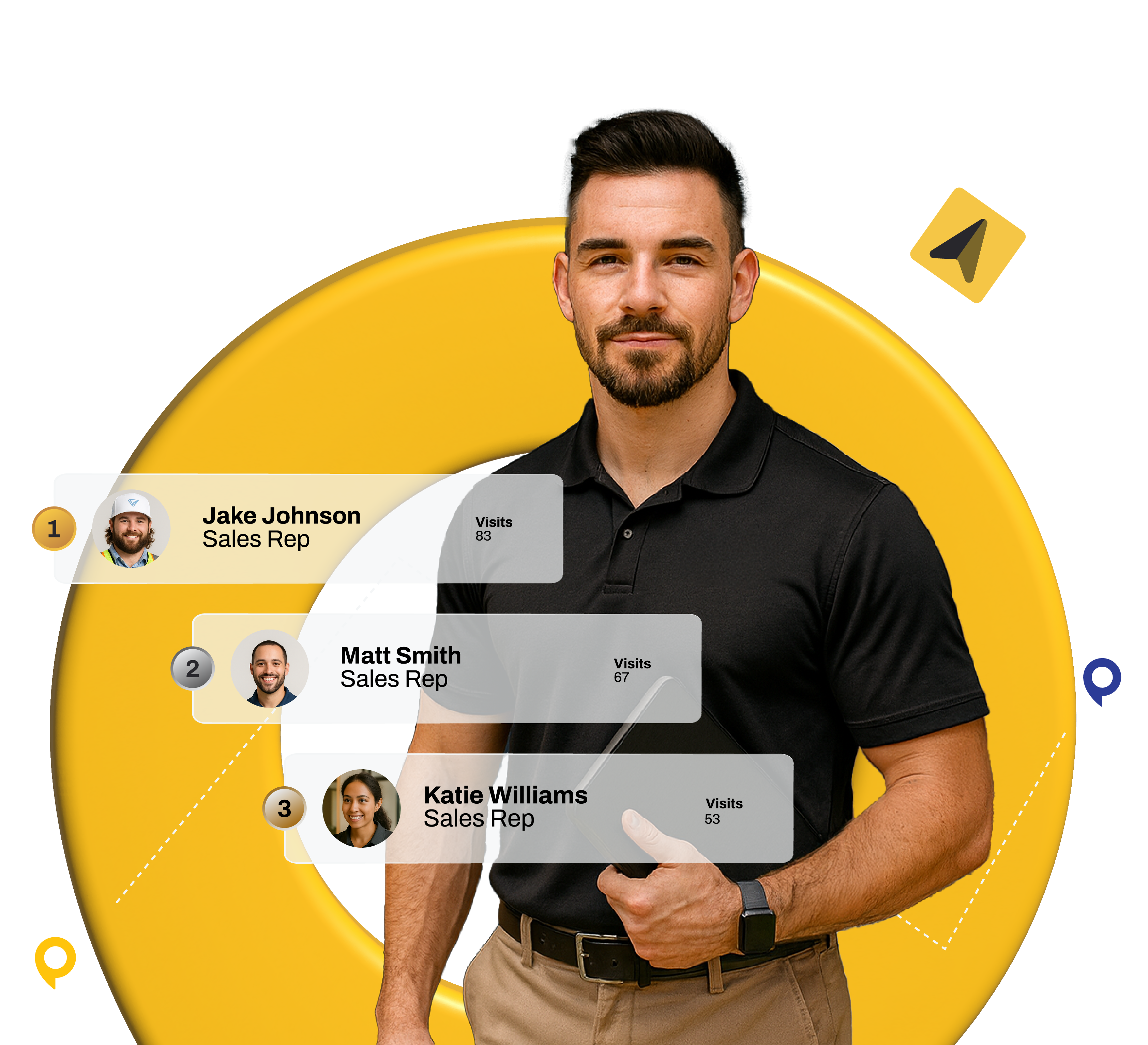
- Leaderboards create peer accountability and make coaching visible across the team. When reps see top performers highlighted for follow-up cadence or visit volume, it reinforces the behaviors you’re coaching in one-on-ones.
- With DASH Go, reps can use voice input between stops to draft visit notes and hear account summaries — then confirm with a tap, so they capture observations while they’re fresh without sitting down at a laptop. Some of the best coaching conversations start with a rep’s own field notes about what worked and what didn’t.
Tools for Field Sales Coaching
Coaching frameworks and questions are only part of the equation. The right tools give you the data layer that turns gut-feel coaching into evidence-based coaching.
For field sales, look for tools that provide:
- Location-verified activity data — reps log visits with one tap, and GPS coordinates confirm where and when the activity happened
- Territory and coverage visualization to spot imbalances and whitespace in rep assignments
- Performance dashboards that surface leading indicators (visits, follow-ups, pipeline stage velocity) alongside lagging indicators (revenue, close rate)
- Leaderboards and gamification to reinforce coaching-driven behaviors across the team
SPOTIO is built for this exact workflow. Managers can pull a rep’s activity history and territory coverage map in SPOTIO’s performance dashboards, identifying coaching priorities before the one-on-one starts. DASH IQ gives reps a 10-second brief on any account’s recent activity and history — and managers can use the same summaries to review rep account context before coaching conversations.
For teams that want to go deeper on conversation-level coaching for D2D and field pitches, Rilla provides speech analytics specifically designed for in-person sales interactions — a complementary layer to activity-based coaching.
For a full breakdown of coaching-specific software options, see our complete guide to sales coaching tools.
Frequently Asked Questions
Sales coaching is the ongoing, one-on-one process of helping individual reps improve their skills, decision-making, and performance. Unlike training, which teaches standardized processes, coaching is personalized — it’s based on each rep’s specific strengths, gaps, and territory context. Effective coaching is data-informed, consistent, and focused on one improvement at a time.
Weekly is the minimum cadence that produces results. A focused 15–20 minute one-on-one each week outperforms infrequent hour-long sessions. The key is consistency — coaching that happens reliably every week builds habits and accountability. Review activity data before each session so the conversation starts with facts, not feelings.
Training teaches reps the standard skills and processes they need — product knowledge, CRM usage, pitch structure. Coaching helps them apply those skills in real scenarios. Think of training as the playbook and coaching as the film review. In field sales, coaching is especially critical because reps encounter unpredictable situations at every door that training alone can’t prepare them for.
SPOTIO’s 2026 survey of 336 sales leaders found that low-turnover teams — where coaching and development investment tends to be higher — are more than twice as likely to have 70%+ of reps hitting quota compared to high-turnover teams. Coaching strengthens retention, retention preserves skills and territory knowledge, and experienced reps close more consistently.
The best coaching questions are specific, data-informed, and open-ended. Instead of “How’s it going?” try “Walk me through your last three visits — what objection came up most?” or “Your follow-up visits dropped 40% last week. What happened?” Questions that tie to observable activity give reps something concrete to reflect on.
Field sales managers need tools that capture activity data without relying on self-reporting. Look for platforms that provide location-verified visit logs, territory coverage maps, performance dashboards, and leaderboards. For conversation-level coaching, speech analytics tools designed for in-person sales add a layer that traditional CRM data can’t provide.
Start with the data, not the narrative. Pull activity logs and territory coverage to see whether the problem is effort (not enough visits), strategy (wrong prospects), or execution (visits happening but not converting). Then focus coaching on one area at a time. A rep who’s struggling in three areas won’t improve if you try to fix all three at once — pick the highest-leverage issue and build from there. For more on structuring your overall approach, see our guide to the sales management process.
Sales coaching isn’t about having the perfect framework — it’s about showing up consistently with the right data and the right questions. For field sales managers, that means building a coaching cadence around the realities of territory coverage, not borrowing models designed for inside sales teams staring at screens all day.
SPOTIO gives field sales managers the activity data, territory visibility, and performance dashboards to coach with evidence, not guesswork. See how it works →