
Your reps know the catalog. They can quote prices from memory and rattle off lead times without checking the system. But when a customer asks why they should keep buying from you instead of placing the same order online, your team goes quiet.
That silence is the gap distributor sales training is supposed to close — and for most distribution teams, it hasn’t. According to SPOTIO’s 2026 State of Field Sales report, field reps spend just 43% of their time actually selling (37% in-person and 6% on phone or video). Another 21% goes to admin tasks and data entry. When reps get so little face time with customers, every conversation has to count. Generic “Selling 101” training doesn’t prepare them for that reality.
This guide covers how to build a distributor sales training program around the way your team actually sells — a specialized extension of your broader field sales training strategy, with territory-specific scenarios, data-driven coaching, and field tools that reinforce skills between formal training sessions.
Why Generic Sales Training Fails Distributors
Most sales training programs are built for SaaS teams or general B2B — linear pipelines, single-threaded deals, and clean CRM data. Distribution selling doesn’t work that way, and your reps feel that disconnect every time they sit through another workshop on “discovery questions” that ignores the realities of their day. The National Association of Wholesaler-Distributors has called this the defining challenge for the industry — reps stuck in transactional mode while buyers expect consultative value.
The Order-Taker Trap
Here’s what happens when training doesn’t match the job: reps default to the path of least resistance. They take inbound orders. They quote what the customer asks for without suggesting alternatives. They protect relationships by avoiding hard conversations about pricing, switching costs, or consolidation opportunities.
This isn’t a motivation problem — it’s a skills gap. Reps who’ve only been trained on product features and objection scripts don’t have the tools to sell on value. They can’t articulate why buying from your distribution team is worth a premium over placing the same order through a digital procurement platform. And the longer they operate as order-takers, the harder it is to shift.
One more thing worth acknowledging: skill gaps aren’t the only reason reps default to order-taking. If your commission structure pays the same margin percentage for a passive reorder as it does for a new high-margin product push, your reps are being rational — not lazy. Training has to be paired with incentives that reward the behaviors you’re asking for.
What Distribution Selling Actually Looks Like
Distribution sales teams deal with complexity that generic training ignores entirely:
- Reorder cycles — customers buy on irregular schedules driven by project timelines, seasonal demand, or inventory depletion, not a predictable sales funnel
- Multi-stakeholder relationships — a single account might involve a purchasing manager, a site supervisor, and an operations director, each with different priorities
- Margin pressure — competitors undercut on price constantly; reps need to sell total cost of ownership, not line-item pricing
- Territory density — some reps cover a tight urban area with 200 accounts, others drive hours between stops in rural markets
- Inventory-dependent quoting — a rep who quotes a product that’s backordered loses credibility fast
- Multi-channel coordination — field reps rarely sell alone; they coordinate quotes with inside sales, verify stock with branch managers, and co-sell technical product lines alongside manufacturer reps
Any training program that doesn’t address these realities will get ignored by your reps within a week of returning to the field.
Want the full framework? The Manufacturing & Distribution Sales Playbook covers territory design, rep coaching, and pipeline management for distribution field teams. Download the playbook →
Core Distribution Sales Training Skills
Industry publications like Modern Distribution Management have identified seven-plus skill gaps distribution teams need to close. These four are the ones that matter most for field teams selling on the ground.
Value-Based Selling Over Price
When a customer says “your competitor is $2 cheaper per unit,” an untrained rep panics and asks their manager for a discount. A trained rep shifts the conversation.
Teach your reps to sell total cost of ownership (TCO) instead of unit price. That means quantifying the value of things your competitors can’t match: reliable delivery windows that prevent costly downtime, consolidated invoicing that simplifies procurement, dedicated account management that catches problems before they escalate, and territory coverage that ensures a rep is always nearby when something goes wrong.
The skill here isn’t just “sell on value” — it’s knowing how to calculate that value for each account using real data. A rep who can walk into a meeting and say, “switching to us on this product line would save your team 12 hours a month in procurement overhead” has an unfair advantage over one who simply says, “we have great service.”
Needs Discovery Using Sales Data
The best distributor reps don’t wait for a customer to call with a reorder. They study the account’s buying patterns and show up with a recommendation before the customer realizes they need one.
This requires training reps to use CRM and order data as a pre-call research tool. Before visiting an account, a rep should know the customer’s last three orders, their typical reorder timing, which product categories they’ve stopped purchasing, and whether any open quotes have gone stale. This only works if reps can actually access that data in the field. In most distribution companies, purchase history, backorder statuses, and pricing matrices live inside an ERP — Epicor, Prophet 21, Infor, SAP — not in a CRM notes field. Your field tools need to bridge that gap so reps aren’t digging through spreadsheets in the cab of their truck before a meeting.
Train your team to ask questions that go beyond “what do you need this week?” — questions like: “Your Q2 orders for [product category] dropped 40% compared to last year. Did you switch suppliers, or is demand shifting?” That kind of question positions your rep as a field sales intelligence resource, not just a catalog on legs.
Territory and Account Prioritization
Not every account deserves equal attention, and not every territory is designed well enough for reps to figure that out on their own.
One distribution company we spoke with discovered that 60–80% of a rep’s assigned territory was uninhabited land — the rep was spending hours driving through empty areas to reach a handful of accounts clustered in one corner. Another found that reps were unknowingly knocking the same doors because territories overlapped and nobody had visibility into who was going where.
These are territory design problems, but they’re also training problems. Reps need to learn how to read a territory map, identify their highest-value accounts, plan efficient routes between stops, and flag coverage gaps to their managers. Without that skill, even a well-designed territory gets worked unevenly.
Consultative Objection Handling
The most common objection in distribution has changed. It used to be “your competitor is cheaper.” Now it’s “I can just order this online myself.”
Train your reps to agree and pivot. The right response isn’t to fight the objection — it’s to validate it and redirect toward the complexity a digital platform can’t handle. Something like: “You absolutely should use our portal for routine reorders. But for your facility expansion next quarter, let’s talk about how we can stage deliveries, coordinate with your GC, and make sure nothing shows up before the site is ready.”
The skill is recognizing which problems require a human and pivoting the conversation toward those problems — not trying to convince a customer that they shouldn’t use self-service for simple transactions.
How to Structure a Distributor Training Program
Knowing what to teach matters. But so does how you deliver it, how you pace it, and how you make it stick long after the formal session ends.
Start With a Skills Gap Assessment
Don’t build a generic curriculum and hope it fits. Pull your team’s performance data first. Look at individual rep metrics: conversion rates, average deal size, follow-up cadence, territory coverage percentage, and quota attainment. The patterns will tell you exactly where training is needed.
If half your team has strong close rates but low territory coverage, the gap is prospecting and route planning — not objection handling. If reps are visiting plenty of accounts but average deal size is declining, the gap is value selling and cross-sell skills. Let the data design the curriculum.
Design Modules Around Your Selling Scenarios
The fastest way to make training irrelevant is to use generic examples. Instead, build modules from your own team’s wins and losses.
Pull real scenarios from your CRM:
- A rep who lost a long-standing account because they missed three consecutive reorder windows
- An upsell that worked because the rep noticed a customer was buying two complementary products from separate suppliers
- A territory that improved after the rep started prioritizing accounts by annual revenue instead of geography
- A deal that stalled because the rep quoted a backordered product without checking inventory
These are the situations your team actually faces. Train on them, and the lessons transfer to the field the same day.
Blend Field Coaching With Bite-Sized Digital Modules
Distribution reps can’t disappear from their territory for a three-day workshop. The accounts won’t wait.
Use a blended approach: short digital modules (10–15 minutes) that reps complete between appointments, paired with weekly or biweekly coaching sessions where managers review real deals in progress. The digital modules build knowledge. The coaching sessions build application.
The key is making training accessible where reps actually work — on their phones, between stops, without needing a laptop or a conference room. If a rep has 20 minutes between a morning delivery check and an afternoon sales call, that’s a training window. Don’t waste it.
Using Technology to Reinforce Distribution Sales Training
A training program that lives in a binder or an LMS nobody opens is a sunk cost. The programs that actually change behavior are the ones embedded in the tools reps use every day.
Embed Training in Daily Workflows
The most effective training reinforcement doesn’t feel like training. It feels like the tool doing its job. That said, the biggest adoption hurdle usually isn’t budget or features — it’s your veteran reps. A rep who has worked the same territory for 15 years already knows their accounts and sees any new tool as extra admin, not a shortcut. The path forward is showing them the trade-off: one tap to log a visit now eliminates 30 minutes of data entry at the end of the day. When the tool visibly gives time back, resistance drops. For a deeper look at how to navigate this, see our guide on CRM adoption for field sales teams.
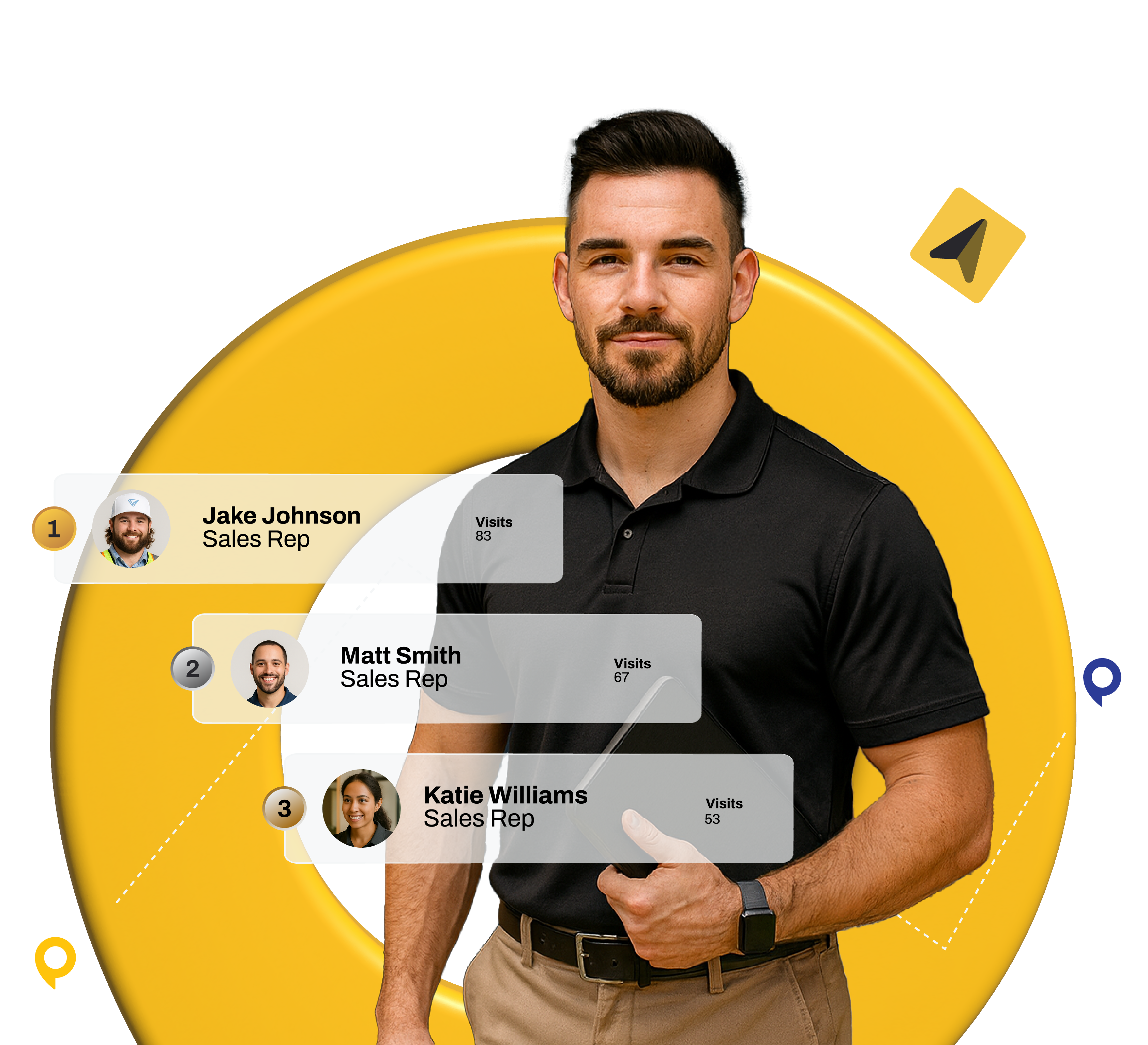
When a rep logs a visit and the system prompts them to record the outcome and next step, that’s reinforcing good activity tracking habits. When a manager pulls a dashboard showing which reps haven’t touched their top 10 accounts in 30 days, that’s data-driven coaching in action. When a rep sees their visit count and pipeline value alongside their peers, that’s accountability built into the workflow.
Field sales platforms like SPOTIO make this possible by connecting one-tap activity logging with GPS verification to the metrics managers actually care about. Reps log visits, calls, and notes in the field — or use voice-to-CRM with AI-assisted entry while driving between stops. Managers see which activities reps have logged and which they haven’t, without waiting for a weekly report.
Mobile-First Access for Distributed Teams
Your reps aren’t sitting at desks. Their training tools shouldn’t assume they are.
Mobile access matters for two reasons: first, reps can review training content during natural downtime (waiting for a delivery, sitting in a parking lot before a meeting). Second, managers can push coaching reminders and performance nudges directly to the rep’s phone.
For distribution teams spread across large geographies, offline capability is essential. SPOTIO’s Download My Day feature gives reps up to 24 hours of offline access to their territory data, so even reps working in areas with poor cell coverage can access the information they need to sell effectively.
Using AI to Guide Next Actions
AI doesn’t replace training — it extends it. Instead of relying on a rep to remember everything from a workshop three months ago, an AI co-pilot can surface the right recommendation at the right moment.
SPOTIO’s Next Best Action feature uses 42+ signals from each customer’s own data to recommend what a rep should do next — visit, call, text, or email — with a plain-language explanation of why. Every recommendation shows a confirmation preview before writing to the system, so the rep stays in control. It’s predictive and prescriptive: the system identifies which accounts need attention and tells the rep exactly how to engage.
This is where training and technology converge. A rep who was trained on needs discovery gets a 10-second account brief before their next visit showing the account’s buying patterns, recent activity, and open tasks. The training gave them the skill. The AI gives them the context to use it.
Measuring Distribution Sales Training Impact
If you can’t connect training to outcomes, you’ll never get budget for the next round. Track both leading indicators (the behaviors training is supposed to change) and lagging metrics (the revenue impact of those changes).
Leading Indicators vs. Lagging Metrics
| Type | Metric | What It Tells You |
|---|---|---|
| Leading | Follow-up speed (days between visit and next action) | Are reps applying what they learned about cadence? |
| Leading | Territory coverage (% of assigned accounts visited per month) | Are reps prioritizing effectively? |
| Leading | Activity volume (visits, calls, quotes per week) | Is effort increasing post-training? |
| Lagging | Average deal size | Are reps cross-selling and selling value? |
| Lagging | Conversion rate (quote to close) | Are reps qualifying better and handling objections? |
| Lagging | Ramp time for new hires | Is onboarding getting more effective? |
| Lagging | Quota attainment | Are more reps consistently hitting target? |
Just one in three field sales teams report that more than 70% of their reps are consistently hitting quota. If your team is in the other two-thirds, the gap between where you are and where you need to be is almost certainly a combination of training, tooling, and coaching cadence — not raw effort.
Building a Coaching Feedback Loop
Training isn’t a one-time event. It’s a cycle: train → observe behavior in the field → identify gaps → coach on the gap → train again on what’s still not sticking.
The managers who make this work are the ones using sales activity data to drive coaching conversations. Instead of asking “how are things going?” in a weekly 1:1, they pull the numbers: “You visited 22 accounts last week but only logged follow-up notes on 8. What happened with the other 14?” That’s a specific, data-driven coaching moment that ties directly back to training on follow-up discipline.
Frequently Asked Questions
Distributor sales training is a structured program designed to help reps who sell through wholesale or distribution channels develop skills specific to their selling environment — including value-based selling, reorder cycle management, territory coverage, and consultative relationship building. Unlike generic sales training, it accounts for the margin pressure, inventory complexity, and multi-stakeholder relationships that define distribution sales.
Standard B2B training focuses on linear sales funnels and single-threaded deals. Distribution training addresses irregular buying cycles, inventory-dependent quoting, territory density challenges, and the shift from transactional order-taking to consultative selling. It also emphasizes using CRM and order history data for pre-call research — a skill most generic programs skip entirely.
Initial skill-building should span 4–6 weeks of blended learning — short digital modules paired with weekly coaching sessions. But the program should never truly end. The best distribution teams treat training as ongoing, using field data to identify new skill gaps and coaching on them continuously. Annual refreshers aren’t enough in a market that shifts quarterly.
Field sales execution platforms, CRM systems with mobile access, and AI-powered coaching tools all play a role. The critical requirements for distribution teams are mobile-first design, offline access for reps in low-coverage areas, GPS-verified activity logging, and territory mapping. These tools make training stick by reinforcing the right behaviors in the rep’s daily workflow, not just in a classroom.
Track leading indicators (follow-up speed, territory coverage, activity volume) alongside lagging metrics (deal size, conversion rate, quota attainment, ramp time). Compare rep performance before and after training at the individual level. If reps are engaging more accounts, closing at higher rates, and hitting quota more consistently, training is working.
Build a Training Program That Sticks
The distributor training programs that actually change results share three things: they’re built around distribution-specific scenarios, they’re reinforced by the tools reps use every day, and they’re coached continuously using field data.
SPOTIO gives distribution sales teams the foundation to make all three happen — territory mapping to ensure reps are covering the right accounts, one-tap activity logging to track behavior in the field, and AI-powered Next Best Action to guide reps between coaching sessions. Distribution teams like Hadco Metal Trading use SPOTIO to connect daily field activity to the metrics that matter.
See how SPOTIO works for distribution teams →

Trey Gibson is the founder and CEO of SPOTIO, where he helps sales leaders build more efficient, high-performing field sales teams. With a background in entrepreneurship and as the founder of a roofing company, Trey brings hands-on experience leading door-to-door and B2B sales organizations. He combines real-world sales leadership with a passion for technology and operational efficiency to help teams scale, perform, and win more deals.
Research and drafting assisted by AI tools; all content is reviewed, fact-checked, and approved by Trey and the SPOTIO editorial team.