
You know the math doesn’t add up. Your team’s overall revenue looks fine — maybe even growing — but half your reps are missing quota and your best territory is carrying everyone else. The other territories? One’s overloaded, two are underworked, and somebody just quit, which means 200 accounts aren’t getting touched until you backfill.
That’s a territory management problem. And until you fix it, no amount of hiring or motivational tactics will close the gap.
SPOTIO’s 2026 State of Field Sales survey makes the gap painfully clear: 73% of field sales organizations grew revenue in the past year, but only about 35% have 70% or more of their reps consistently hitting quota. Revenue is growing despite how most teams manage territories, not because of it. When the market tightens, that gap catches up fast.
This playbook covers what territory management actually is, why it matters more than most leaders think, and how to build and manage a territory plan that holds up in field sales; not just on a slide deck. We’ll also cover what top teams do differently, the mistakes that sink everyone else, and how to evaluate software that supports all of it.
Go deeper on any subtopic:
- How to Build a Sales Territory Plan
- Sales Territory Mapping: The Complete Guide
- Sales Territory Design: 10 Steps to Higher Productivity
- Sales Territory Alignment: When and How to Realign
- Sales Territory Optimization: A 5-Step Framework
- Territory and Quota Planning for Field Sales Teams
- Territory Sales Manager: Role, Skills, and Success
What Is Sales Territory Management?
Sales territory management is how you divide your market into defined segments — by geography, industry, account size, product line, or a combination — and assign those segments to specific reps so every account gets coverage and every rep has a realistic path to quota.
But the definition undersells the work. In practice, territory management is the set of daily decisions that determine which doors get knocked, which accounts get follow-up, which reps see which leads, and whether leadership has any visibility into what’s happening in the field. It touches routing, workload, data capture, coaching, and retention, not just the boundaries drawn on a map.
Here’s the distinction that matters: territory design is the one-time act of drawing boundaries and assigning reps. Territory management is the ongoing discipline of executing against that design, monitoring performance, and adjusting when the data says something isn’t working. Most guides conflate the two. This one won’t.
Why Territory Management Matters
The Revenue-Quota Paradox
SPOTIO’s 2026 State of Field Sales survey found that 73% of field sales organizations grew revenue in the past year. But only about 35% have 70% or more of their reps consistently hitting quota.
The gap between those two numbers is a territory management problem. When territories aren’t balanced, some reps have more opportunity than they can work while others are set up to fail. Revenue can still grow in a favorable market — but it’s growing despite your execution, not because of it.
Harvard Business Review found that territory design alone can lift revenue 2–7% without changing strategy or adding headcount. The Alexander Group puts the productivity gain from territory optimization at 10–20%. These aren’t marginal improvements — for a $10M sales org, that’s $200K to $2M in recovered revenue from fixing how work is distributed.

Get the full picture. We’re publishing the complete findings in two dedicated reports — one for B2B field sales teams, one for B2C.
Download the B2B Report
Download the B2C Report
The Turnover Cost
In the survey, roughly two-thirds of field sales organizations reported losing more than 30% of their sales force every year. The cost isn’t just recruiting and ramp time: it’s a territory coverage cost. Every departure means accounts go unworked, pipeline stalls, and remaining reps absorb extra load, which accelerates the next departure.
Unbalanced territories are a direct contributor. When one rep is drowning in accounts and another is coasting, the rep who’s drowning burns out and leaves. The rep who’s coasting never builds the urgency to perform. Neither situation leads to retention.
On a small team of five reps, losing one top performer isn’t just a 20% headcount reduction. It can mean a far larger revenue hit when that rep was carrying a disproportionate share of the team’s pipeline.
The Visibility Gap
When reps enter data at the end of the day — or worse, at the end of the week — managers can’t see that a territory is underperforming until it’s too late to course correct. Among struggling B2C teams in SPOTIO’s survey, 60% rely on manual end-of-day data capture. Among top-performing teams, only 33% do.
The teams that solve territory management also solve the visibility problem, because digital territory tools reduce data capture to a single tap during the rep’s normal workflow, not a separate chore at the end of the day. That shift gives managers a real-time view of which territories are being worked, which are idle, and where coverage is falling short.
Types of Sales Territories
Your territory structure should reflect what actually drives revenue in your business. Most field sales organizations use one of these approaches, or a combination of them.
| Territory Type | Best For | Example | Field Sales Reality |
|---|---|---|---|
| Geographic | Physical presence drives the sale | Roofing, storm restoration, industrial distribution | The default for field teams because your reps have to physically get there. But ZIP code boundaries mean nothing if half the addresses are gated or vacant. |
| Industry-based | Product knowledge or regulations vary by vertical | Healthcare IT, manufacturing equipment | Works when vertical expertise closes deals. Falls apart when territories cross geographies and reps can’t physically cover them. |
| Account-based | Strategic value varies by customer size | Enterprise vs. SMB segmentation | Great for matching rep skill to deal complexity. Watch workload — 15 enterprise accounts and 40 SMB accounts are not the same job. |
| Product-based | Portfolio too complex for one rep | Multi-line insurance, telecommunications | Reduces context-switching but creates coordination headaches when two reps visit the same customer for different products. |
| Channel | Multiple go-to-market paths | Direct + dealer/distributor hybrid | Common in B2B manufacturing. Requires clear rules on who owns the customer relationship. See our distributor territory management guide. |
| Hybrid | Most mature field sales orgs | Geographic base + industry or account-size overlay | Where most teams end up. Start with geography (because drive time is real), then overlay what matters most to your business. |
For a deep dive on mapping approaches, see our complete guide to sales territory mapping. If you’re entering a new market from scratch, see how to attack a new sales territory.
How to Build a Territory Plan
Territory planning should be a quarterly discipline, not a once-a-year exercise. But the initial plan follows a consistent five-step framework.
1. Analyze your market data. Pull CRM data on customer locations, deal sizes, purchase frequency, and competitive density. Look for where revenue clusters, which segments have the highest close rates, and where white space exists. In B2B, overlay firmographic data; in B2C, overlay household data relevant to your offer.
For field sales specifically, add a layer most guides skip: physical viability. Not every address on a lead list is accessible. Gated communities, secured office parks, vacant lots, and seasonal residences create phantom territories that look full on paper but can’t be worked in practice. One of our CX team’s most common onboarding discoveries is reps assigned 200 leads where half are in a gated community they can’t access. Build your territory model around accounts your reps can actually reach.
2. Evaluate your team. Match rep strengths to territory needs. Your top closer might handle 15 high-value accounts with long sales cycles while a newer rep manages 40 smaller accounts with faster turns. Balance by revenue opportunity, not headcount.
3. Define boundaries and ownership rules. Set clear limits: geographic, industry-based, account-size thresholds, or a combination. Then document the rules that prevent conflict: who owns inbound leads in each territory? What happens with multi-location accounts? How are referrals across territory lines handled? Fuzzy boundaries guarantee disputes.
4. Set measurable goals per territory. Monthly revenue targets, weekly visit or activity minimums, conversion rate benchmarks, new account acquisition numbers. Align these to the actual revenue potential in each territory, not to a flat number divided equally across all reps.
5. Plan routes and schedules. Calculate optimal routes that minimize drive time and cluster visits geographically. Route optimization can free up time for additional customer meetings every day. Some SPOTIO customers report fitting two or more extra visits into their daily route. Build routes that prioritize high-value visits and account for appointment windows.
See how Hadco streamlined territory planning with SPOTIO.
How to Manage Territories Day-to-Day
Building the plan is the starting point. The harder part — and where most teams lose ground — is the daily and weekly discipline of managing against that plan. This is the difference between territory design and territory management.
The Weekly Territory Review
Block 30 minutes every Monday to review three things across your territories:
- Coverage heat map: Which territories were actively worked last week? Which ones went dark? If a territory shows zero visits for five or more consecutive days, something is wrong: the rep may be avoiding difficult accounts, dealing with access issues, or simply not following the route plan.
- Activity-to-conversion ratio: High activity with low conversion in a specific territory signals a targeting or messaging problem, not an effort problem. Low activity with high conversion may mean the territory is under-resourced and leaving money on the table.
- Pipeline movement: Are deals advancing in every territory, or are some territories generating first visits but stalling at follow-up? Stalled pipelines often point to territories that are too large for one rep to work consistently.
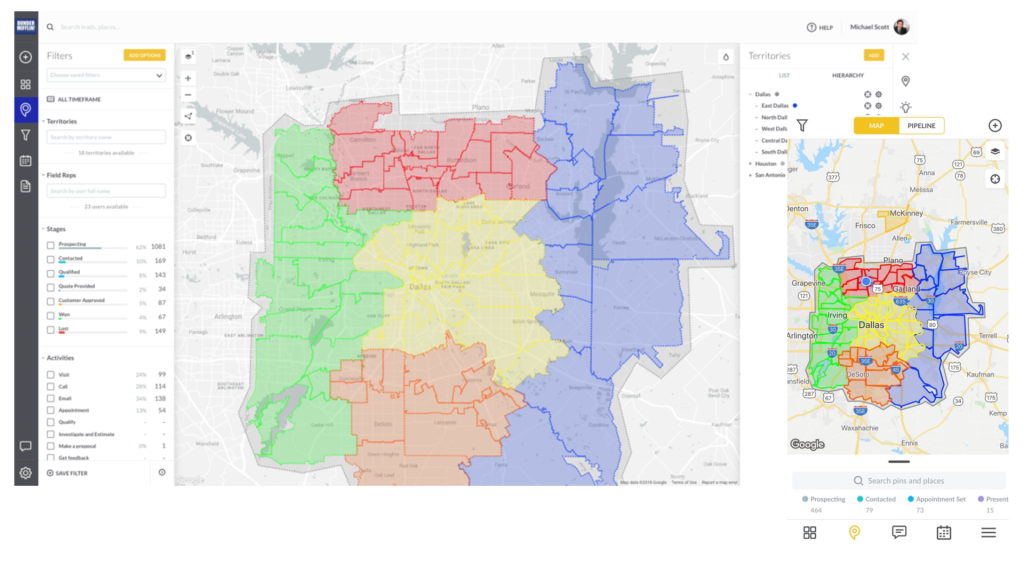
SPOTIO’s territory view shows coverage boundaries, pipeline stages, and activity breakdown across every territory — on desktop and mobile.
Spotting Underperforming Zones
Don’t wait for the quarterly review to catch problems. These five signals tell you a territory needs attention now:
- Visit frequency has dropped two or more weeks in a row with no explanation
- Conversion rate is declining while activity stays flat — the rep is working but the territory isn’t responding
- The rep is consistently routing around a specific area — often a sign of access issues or demoralized prospecting
- New lead generation has flatlined even though the territory has untapped accounts
- Customer complaints or “you were just here” feedback from prospects (overlap with another territory)
When you see these patterns, investigate before you restructure. The fix might be a route adjustment, lead list refresh, or coaching rather than a full territory rebalance.
Mid-Quarter Adjustments
Sometimes you can’t wait for the quarterly review. Common triggers for mid-quarter territory changes:
- A rep leaves and their territory needs interim coverage
- A new rep joins and needs a carved-out starter territory
- A weather event or market shift changes the viability of a specific area (storm restoration teams deal with this constantly — see our storm territory management playbook)
- Data shows a territory is severely over- or under-penetrated
Leader’s Pro Tip — the “Grandfather Clause”: When realigning territories, the fastest way to lose a top rep is to take away a closing deal. Use a 90-day Grandfather Clause: if a deal is in Stage 4 or later, the original rep keeps it for 90 days. After that, it transfers to the new territory owner. This prevents reps from “hiding” leads to avoid losing them during a shift. — From SPOTIO’s CX team, based on patterns across hundreds of field sales implementations.
Territory Management Best Practices
Go Digital or Fall Behind
Manual processes that work for a team of five break down past 20 reps. Spreadsheets can’t show coverage gaps in real time, can’t prevent two reps from working the same lead, and don’t sync with your CRM or mobile devices. SPOTIO’s survey data confirms the gap: 83% of top-performing B2C teams use digital territory tools, compared to 57% of lower-performing teams.
One caveat: if all you need is a one-time territory rebalancing, there are simpler point solutions. SPOTIO is built for the ongoing work: daily field execution, real-time visibility, territory performance tracking over time. Know which problem you’re solving before you evaluate tools.
Standardize Naming and Hierarchy
Naming conventions rarely make anyone’s priority list — until a new VP tries to pull a territory performance report and discovers every team named their territories differently.
A telecom company managing a large 1099 contractor workforce had massive inconsistency across vendor teams: random naming, no hierarchy, lists impossible for anyone outside the creator to navigate. Leadership couldn’t pull reports or deploy vendors effectively. After rebuilding with parent/child hierarchies and standardized naming, they gained regional visibility for the first time.
One detail that catches teams off guard: territory hierarchy often isn’t visible in mobile apps the way it appears on desktop. On mobile, reps see a flat, searchable list. Your naming conventions need to make sense at the individual territory level, not just in a tree view only managers see.
Balance by Revenue, Not Account Count
Two reps with 50 accounts each aren’t balanced if one covers enterprise clients with $100K deals and the other handles residential customers with $5K deals. Balance by total addressable revenue, not account count.
Calculate the revenue potential in each territory. Factor in deal size, sales cycle length, market penetration, and route density. Then adjust boundaries so each rep has a realistic path to quota. This also affects retention — design territories that survive personnel changes, not territories built around one person’s relationships.
For a detailed breakdown, see our territory design guide.
Automate Field Data Capture
Every hour a rep spends on manual data entry is an hour they’re not in front of a customer. Reclaiming just 5 percentage points of admin time — about 2 hours per week per rep — increases a team’s total selling capacity by roughly 12%, with no additional headcount. For a 10-person team, that’s the equivalent of adding more than one full-time seller.
The best territory data is a byproduct of the rep’s daily work, not an extra chore. Mobile tools that let reps log activities with one tap — with GPS coordinates attached to each logged activity — and sync to the CRM in real time give managers territory visibility without end-of-day paperwork. For a closer look at how those one-tap workflows fit into a rep’s full day, see our field sales workflow automation playbook.
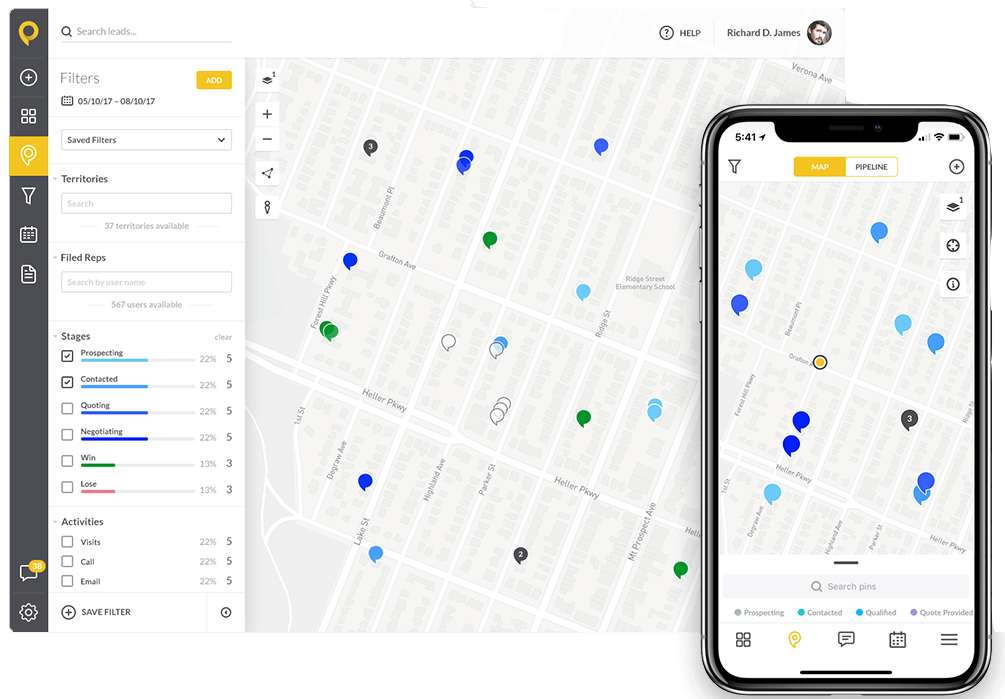
Reps see their territory on mobile; managers see every activity on desktop — same data, no end-of-day paperwork
Use AI to Work Smarter
AI-assisted territory management is moving from novelty to necessity. McKinsey research shows that sales teams empowered with technology and automation report consistent efficiency gains of 10–15%, and Gartner found that reps who effectively partner with AI are 3.7x more likely to meet quota.
In practice, this means tools like SPOTIO’s DASH AI that let reps prep for visits in seconds by pulling up account summaries, log activities through voice between stops (confirming each with a tap), and draft follow-up emails and texts using SPOTIO data for reps to review and send. No manual typing required. For managers, SPOTIO’s Next Best Action engine surfaces territory health signals throughout the day, flagging coverage gaps, at-risk accounts, and zones where activity is trending down so you catch problems before the weekly review, not after.
The field sales teams that gain ground over the next two years won’t be the ones with the most reps. They’ll be the ones whose reps spend the highest percentage of their time actually selling.
Review and Realign Quarterly
Territories drift out of balance faster than most leaders expect. Accounts churn, new leads enter the pipeline, reps develop new skills or leave, and customer buying behavior shifts. SPOTIO’s survey identified this as the top external challenge across both B2B and B2C organizations.
Build a quarterly review cadence with defined triggers for realignment: territory saturation, hiring or losing a rep, entering a new market, discovering non-viable areas, or sustained underperformance in a specific region.
Stop coaching from gut feel (“I think Dave’s territory is struggling”). Start coaching from the data (“Dave’s territory is 30% below penetration target in the north quadrant — let’s look at why”). Bring data to these reviews, not opinions.
For the full realignment process, see our territory alignment guide.
Handle Referrals with a Play Clock
Referrals create a specific conflict point that territory rules don’t always anticipate: a rep earns a referral in their territory, but the referred prospect is in someone else’s patch.
A clean referral policy has three components:
- The rep who earns it works it. A rep who closes a deal and generates a referral should work that lead regardless of where it falls geographically — assuming they want it. If they pass, it routes to the territory owner.
- Document it immediately. The moment a rep gets a referral, it goes into the CRM — name, phone, email, date, location. A date-stamped entry is the proof of record if a dispute arises. If it isn’t logged, it doesn’t count.
- Set a play clock. Give the earning rep five to seven business days to make first contact. If first contact hasn’t happened within that window, the lead transfers to the territory owner. Referrals are your highest-converting lead source — they shouldn’t sit idle.
Common Territory Mistakes
Letting Reps Overlap
When territory boundaries aren’t clear — or aren’t enforced digitally — reps end up working the same prospects. A roofing and storm restoration company discovered this across their entire team. Homeowners were telling reps “you were just here five minutes ago.” Every duplicated visit wasted selling time and damaged credibility.
The fix is two-sided: set clear digital boundaries so every address falls inside exactly one territory, then configure visibility controls so reps only see leads in their own territory. This gives leaders more visibility into field activity while restricting rep access so no one cherry-picks from a neighbor’s patch.
Leader’s Pro Tip — the “No-Fight” Rules: Maps have lines, but deals can be messy. What happens when a customer has an office in one territory but the project is in another? Or if a lead pops up right on the border? Decide now who gets the credit in gray areas. Writing these rules down saves you from playing referee every Friday. — From SPOTIO’s CX team.
Assigning Territories That Can’t Be Worked
A beverage distribution company built territories by city boundaries for their West Coast retail accounts. After mapping those territories against actual account locations, they discovered 60–80% of some territories were uninhabited land — mountains, farmland, nature preserves. Reps had been assigned territories with almost no viable accounts.
This shows up in residential sales too. A vendor gets 200 leads in a territory, and half are in a gated community they can’t access. The fix: map territories against actual account or household density, not just geographic boundaries. Validate that addresses are reachable and match your ICP before you assign a rep.
Running “Set It and Forget It” Plans
A territory plan that hasn’t been reviewed in two quarters is almost certainly out of balance. Some teams currently hitting quota but experiencing high turnover might look healthy on the surface — but they’re one or two departures from sliding into crisis. Stale territory assignments are often the underlying cause.
Treat your territory plan as a living system, not a static document.
Scaling Before Standardizing
This is often the most expensive mistake — because by the time you see it, you’re already too big to fix it cheaply.
B2B teams in the 6–15 rep range hit 0% elite quota attainment in SPOTIO’s survey, with 59% experiencing turnover above 30%. This is the “Professionalization Trap”: the stage where informal territory assignments that worked for five reps collapse under the weight of fifteen. Adding headcount to a broken process doesn’t solve the problem. It multiplies it.
Document your territory assignment process, naming conventions, ownership rules, and routing standards before you grow past 10 reps. It’s far cheaper to build the right processes for a small team than to untangle the habits of a large one.
Territory and quota planning are inseparable at this stage. Quotas that aren’t connected to territory potential create the exact imbalance that drives turnover.
How to Choose Territory Management Software
Once you’ve decided to move past spreadsheets, the evaluation process matters. Not every territory tool solves the same problem. Here’s what to look for, and what to ask during a demo.
Visual territory mapping. Can you draw boundaries, assign reps, and see coverage gaps on an interactive map? Support for ZIP code, county, and custom-drawn territories is table stakes. Demo question: “Show me how you’d split a territory when I hire a new rep.”
Mobile-first design. Field reps work from phones, not desks. The tool must work in the field — including offline through features like Download My Day, which lets reps pre-download their daily route and work without cell signal. If the mobile experience feels bolted on, adoption will be too. Demo question: “Can a rep log a visit with no cell signal?”
Real-time CRM sync. Bi-directional integration with Salesforce, HubSpot, or your CRM. Updates in the field should appear in the CRM immediately. No end-of-day batch uploads. Demo question: “How fast does a field update appear in Salesforce?”
Route optimization. Efficient route calculation between appointments, integrated with territory boundaries so reps stay in their zones while minimizing drive time. Demo question: “How many stops can your route handle, and does it hand off to Google Maps or Waze?”
Activity tracking with location-verified activities. One-tap activity logging with GPS coordinates attached so managers see what’s actually happening — not what reps remember to type hours later. Demo question: “Show me the manager’s view of today’s field activity across all territories.”
Prospect discovery. For B2B, the ability to find businesses on the map and pull contact data. For B2C, tools that filter residential prospects by data points matching your ICP. Reps should find new opportunities without leaving the territory view. Demo question: “How does a rep find their next prospect while they’re already in the field?”
Follow-up sequences. Guided next actions after each interaction — send a proposal, schedule a follow-up, update deal stage — so nothing falls through the cracks.
Scalable territory hierarchy. Parent/child structures that let regional managers oversee multiple teams without losing detail. If you’re growing, your territory structure needs to grow with you.
Red Flags
Watch out for tools that only handle one-time territory design with no ongoing execution features. Be cautious of platforms with no mobile app, no real-time sync, or one-directional integrations.
Pipeline visibility isn’t territory visibility. If a platform tracks deals through stages but can’t show you which physical territories are being worked, which are idle, and where reps are actually spending their time — it’s a CRM feature, not a territory management solution.
SPOTIO for Territory Management
SPOTIO is a field sales execution platform built for teams with 5 or more reps. It connects territory mapping, route optimization, activity tracking with location-verified activities, and CRM sync into a single mobile-first platform — so the territory plan you build is the same system your reps execute against every day.
Teams using SPOTIO see an average 46% boost in rep productivity and 23% increase in sales revenue. See how it works →
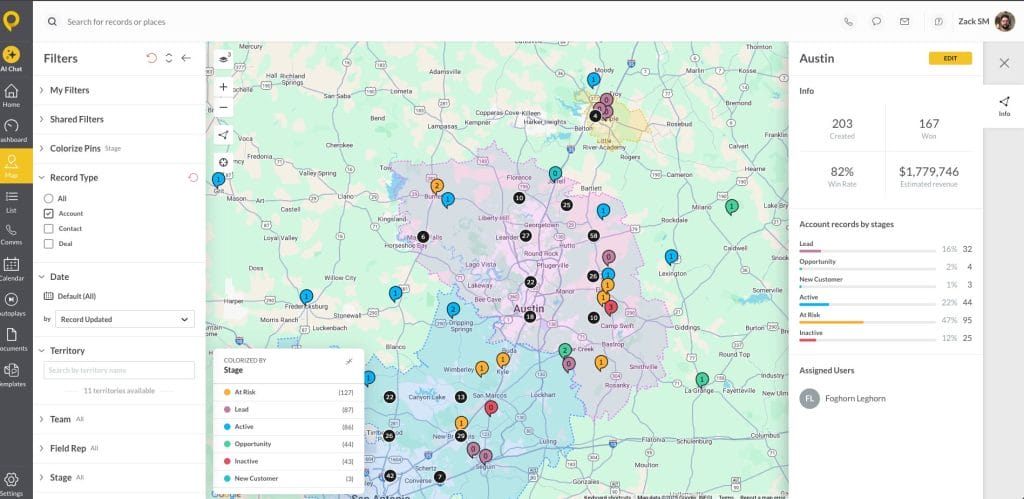
SPOTIO’s map view lets managers see every account in a territory, color-coded by pipeline stage, with performance metrics in a single glance.
Frequently Asked Questions
Start with geographic boundaries based on customer density and realistic drive time — for field sales, geography is always the foundation because your reps have to physically get there. Then overlay account size, industry, or revenue potential so each territory offers comparable earning opportunity, not just similar account counts. Review and adjust quarterly as conditions change.
Document clear ownership rules before conflicts happen: who owns inbound leads, how multi-location accounts are handled, how cross-territory referrals get credited. Use digital territory mapping with visual boundaries so every rep knows where their coverage starts and stops. When disputes arise, CRM data (date-stamped entries, location-verified activities) settles them faster than he-said-she-said.
Revenue per territory, customer visit frequency, lead-to-close conversion rate, cost-to-serve (travel expenses relative to deal size), and market penetration (what percentage of addressable accounts are active customers). The most actionable metric is penetration rate — a territory with 200 accounts and 8% penetration tells a very different story than one with 50 accounts and 40% penetration.
Quarterly, using performance data — not opinions. Common triggers for mid-quarter adjustments include hiring or losing a rep, entering a new market, discovering non-viable territory areas, or sustained underperformance. Document every change and communicate the reasoning to the team.
Territory mapping is one component of territory management — it’s the act of visualizing customer locations, drawing boundaries, and assigning reps. Territory management is the broader discipline: mapping plus ongoing execution, performance tracking, data visibility, boundary adjustments, and accountability.
Harvard Business Review found that territory design alone can lift revenue 2–7% without changing strategy or resources. The Alexander Group puts the productivity gain at 10–20%. Teams using SPOTIO report an average 46% boost in rep productivity and 23% increase in sales revenue — driven by reduced windshield time, better coverage, and real-time performance visibility.
Take Control of Your Territories
The math is simple: fix how work is distributed, and quota attainment follows. The teams pulling ahead aren’t working harder — they’ve moved from spreadsheets to real-time digital territory management, standardized their processes before scaling, and built a quarterly review discipline that catches problems before they become crises.
For more benchmarks, see our collection of 140+ field sales statistics updated for 2026.
SPOTIO brings territory mapping, route optimization, activity tracking, and CRM sync together in a single mobile-first platform built for field sales teams. Schedule a demo to see how it works for your team.

Trey Gibson is the founder and CEO of SPOTIO, where he helps sales leaders build more efficient, high-performing field sales teams. With a background in entrepreneurship and as the founder of a roofing company, Trey brings hands-on experience leading door-to-door and B2B sales organizations. He combines real-world sales leadership with a passion for technology and operational efficiency to help teams scale, perform, and win more deals.