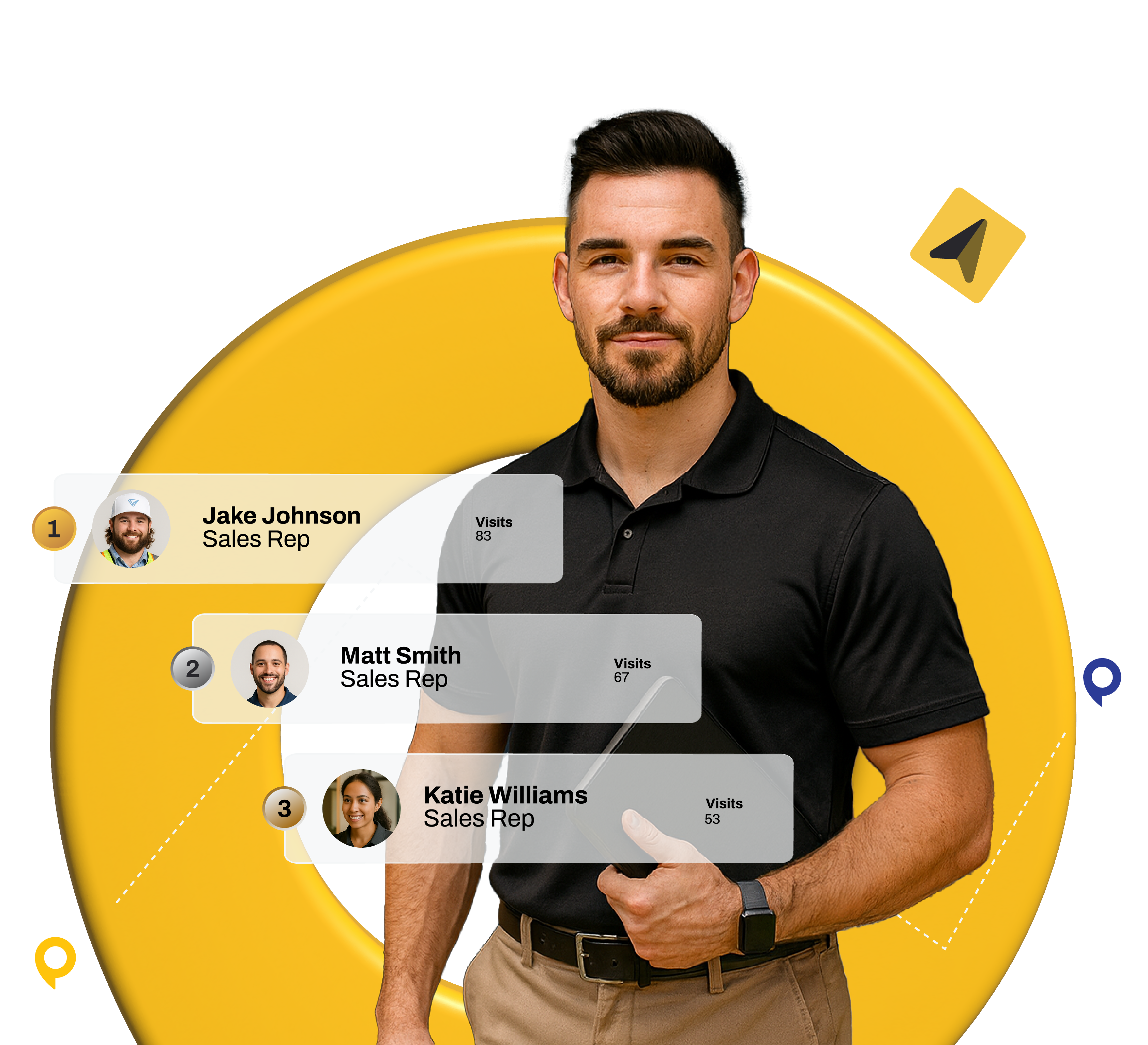

Your canvasser knocks 40 doors in a new neighborhood after a hailstorm. He captures names, photos, damage notes, and sets three appointments. Then he hands those leads off to your closer — and half of them evaporate. No context. No notes. No accountability for what happens next.
That’s not a people problem. It’s a systems problem. And it’s exactly what the right roofing CRM is built to solve.
A roofing CRM centralizes your leads, connects your field team to your office, and gives you visibility from the first contact to the signed contract. But “roofing CRM” means different things to different vendors — some are field sales execution platforms, some are project management tools with a CRM bolted on, and some are full job-lifecycle systems built from the ground up for contractors. Picking the wrong one costs you leads, reps, and margin.
We reviewed nine platforms based on G2 ratings and review volume, field sales capabilities, roofing-specific integrations, pricing transparency, and mobile app quality. See how they compare.
What Is a Roofing CRM?
A CRM for roofing companies is software that helps you track leads, manage your sales pipeline, and connect what’s happening in the field to what’s happening in the office. It replaces the spreadsheets, sticky notes, and group texts that most roofing operations outgrow around the five-rep mark.
Most CRMs are built for inside sales teams — they track email sequences and deal stages in a pipeline. Roofing is different. Your reps are in trucks, on roofs, and canvassing neighborhoods after a storm. The CRM you choose needs to work on a phone, in the field, in real time.
There’s also a meaningful difference between a field sales execution platform (like SPOTIO) and a roofing-native CRM (like AccuLynx or JobNimbus). Roofing-native CRMs manage the full job lifecycle — from estimate to material order to invoice. Field sales platforms focus on the pre-sale motion: territory coverage, rep activity, lead capture, and the handoff between canvassers and closers. Many fast-growing roofing companies run both, with SPOTIO handling field execution and AccuLynx or JobNimbus handling production.
Benefits of a Roofing CRM
Faster lead response after storm events. When hail hits, every roofer in the county is working the same neighborhoods. A CRM with territory mapping and storm data integration lets your team build territories around the impact zone within hours — and track every contact so no prospect gets approached twice by different reps.
A canvasser-to-closer handoff that actually works. When a canvasser sets an appointment, the closer needs all the context — damage notes, photos, homeowner concerns, preferred contact time. A good CRM carries that package across without losing anything.
Manager visibility without micromanaging. You can see which reps are active, which territories are getting covered, and which leads have gone cold — without calling anyone. That’s how you coach performance instead of chasing it.
Rep accountability that shows up in numbers. When reps log every visit with a one-tap activity entry, the data creates a natural accountability loop. You’re not watching every move — you’re reading a daily summary that tells you exactly where to focus your coaching.
Pipeline data tied to territory outcomes. Pull a conversion report by rep, by territory, by lead source. Know whether your storm canvassing outperforms your referral pipeline by neighborhood. Make decisions with numbers, not gut feel.
What to Look For in a Roofing CRM
Mobile-First Field Usability
Your reps aren’t at desks. The CRM needs to work on a phone, load fast on spotty cell service, and let reps log visits, add notes, and set follow-ups in under 30 seconds at the door. If it takes more than three taps to record a contact, your reps won’t use it consistently.
The Canvasser-to-Closer Handoff
This is where most roofing companies leak revenue. Look for a platform where a canvasser can capture photos, notes, and homeowner details in the field — then assign the lead to the closer so they have full context before the appointment. The closer should see everything before they arrive: damage type, conversation history, homeowner name, and the appointment time the canvasser set.
SPOTIO handles this handoff natively. The canvasser logs the interaction and assigns the lead to the closer — who sees the full activity record, notes, and photos inside the lead detail before heading to the appointment.
Roofing-Specific Integrations
A general CRM won’t know what AccuLynx is. Look for platforms that connect to the tools roofing companies actually use: AccuLynx, JobNimbus, HailTrace for storm territory data, EagleView for aerial measurements, and QuickBooks for accounting. The best setups use a field sales platform for canvassing and lead capture, then pass qualified leads into a production CRM without double entry.
Rep Accountability and Activity Tracking
You need to know what your reps are doing — not by asking them, but by reading the data. Look for one-tap activity logging with location-verified check-ins, individual rep dashboards, and custom reporting by territory or time period. If a rep is underperforming, the data should tell you whether they need more activity volume, better targeting, or additional coaching on their approach in the field.
Reporting That Answers Real Questions
“How many contacts did we make this week in the NW territory?” “What’s our canvass-to-appointment rate by rep?” “Which storm neighborhoods converted at the highest rate last season?” If your CRM can’t answer questions like those, your reporting is decorative, not operational.
9 Best Roofing CRM Platforms in 2026
Tool ratings and pricing verified June 2026.
Disclosure: SPOTIO is our product and appears at the top of this list. We’ve applied the same evaluation criteria — G2 ratings, feature depth, and field sales use case fit — to every tool, including our own.
How We Selected These Tools: We evaluated these nine platforms across five criteria: feature depth for roofing field sales use cases (canvassing, territory management, rep accountability), G2 or Capterra ratings and review volume, integration compatibility with roofing-specific tools like AccuLynx and HailTrace, pricing transparency, and real user feedback from verified reviews.
| Tool | Best For | G2 Rating | Pricing |
|---|---|---|---|
| SPOTIO | Field sales execution + canvassing | 4.5/5 (387 reviews) | Contact for pricing |
| AccuLynx | Full roofing job lifecycle | 4.2/5 (36 reviews) | From $250/mo |
| JobNimbus | Flexibility + retail/restoration mix | 4.6/5 (81 reviews) | $25–$75/user/mo |
| Leap | In-home sales + digital proposals | 4.3/5 (154 reviews) | ~$149/user/mo |
| Roofr | Measurement-to-proposal flow | 4.57/5 on Capterra (101 reviews) | Free tier available |
| HubSpot | Budget-conscious, non-roofing teams | 4.4/5 (Sales Hub) | Free–$90+/user/mo |
| iRoofing | Aerial measurement + estimation | Insufficient reviews | Contact for pricing |
| RoofSnap | Fast measurement and estimation | Insufficient reviews | Contact for pricing |
| ServiceTitan | Large enterprise operations | 4.4/5 | Enterprise pricing |
1. SPOTIO
Best for: Roofing sales teams running canvassing operations, managing distributed reps across storm territories, or needing a field execution layer that connects to their existing production CRM.
G2 Rating: 4.5/5 stars (387 reviews)
Pricing: Contact SPOTIO for pricing. Minimum 5 users.
SPOTIO is a field sales execution platform built for distributed teams doing territory-based field selling. For roofing companies, that means canvassing storm neighborhoods, managing territory coverage, tracking rep activity in the field, and handing qualified leads off to closers — all from a mobile app that works where your reps work.
What separates SPOTIO from roofing-native CRMs is where it focuses: the pre-sale field motion, not the production pipeline. Territory mapping, prospect pinning, one-tap activity logging, and the lead handoff from canvassers to closers are core to the product — not add-ons. SPOTIO also integrates with AccuLynx, so leads captured in the field transfer into your production CRM without manual import.
Key Capabilities:
- Territory mapping and storm response: Map prospects and customers, build territories by geography, and use the HailTrace integration to create storm-event territories — overlaying hail impact data on your map so your team can build targeted territories and load prospects in affected areas faster than the competition. One roofing company in our customer base uses this workflow to build storm-event territories within hours of a hail event, load prospects into affected areas, and track revenue by storm.
- Canvasser-to-closer handoff: Canvassers log damage notes, photos, and appointment details in the field, then assign the lead to the closer directly in the app — the closer immediately sees all notes, photos, and activity history on the record before the appointment.
- One-tap activity logging: Reps log visits, calls, and appointments with a single tap and GPS-verified location. Managers see what’s happening in the field without asking.
- Lead Machine prospecting: Filter residential prospects using 15 data points per prospect to target homeowners in the neighborhoods your team is working.
- AutoPlays for follow-up: AutoPlays guide reps through multi-channel follow-up sequences — reps enroll prospects manually, receive prompts for each next action, and review drafted emails and texts before sending. Nothing goes out automatically.
- Custom reporting dashboards: Build reports by rep, territory, or time period. Track the KPIs that matter to a roofing sales manager: visits logged, appointments set, conversion rate by territory.
- AccuLynx integration: Leads, documents, and photos captured in SPOTIO transfer to AccuLynx via configurable stage-based triggers — so qualified leads flow from field execution into your production system without manual import or double entry.
SPOTIO + AccuLynx: Many roofing companies use SPOTIO for field execution and AccuLynx for production management. SPOTIO captures the lead in the field; AccuLynx handles it from estimate to invoice. The integration connects both systems without rip-and-replace — your field reps keep working in SPOTIO; your production team works in AccuLynx.
✅ What we like: Territory management depth is genuinely differentiated — the HailTrace integration and storm-event territory workflow has no equivalent in roofing-native CRMs. The lead handoff from canvassers to closers is native, not a workaround. AccuLynx integration means SPOTIO complements rather than replaces your production system.
⚠️ Watch out for: Minimum 5-user requirement makes it a poor fit for solo reps or very small crews.
SPOTIO has been a game-changer for our roofing company. It is a mobile-first field sales app that helps our outside sales teams manage territories, generate leads, optimize routes, track activities, and sync with our CRM—all in real time. It automates so many manual tasks like logging visits, capturing customer data, and managing follow-ups, while giving our managers live dashboards, leaderboards, and performance analytics. This has dramatically improved our productivity, accountability, and sales efficiency in the field. — 5-star Google Review
2. AccuLynx
Best for: Established roofing contractors who need an all-in-one system managing sales, production, material ordering, and invoicing — especially insurance restoration operations.
G2 Rating: 4.2/5 stars (36 reviews)
Pricing: From $250/month for core tools; additional features priced as add-ons. No free trial — demo required.
AccuLynx is one of the longest-established roofing-specific CRMs on the market and the deepest on production-side workflows. It connects estimating, crew scheduling, material ordering (directly through ABC Supply, SRS Distribution, and QXO), and job tracking in a single platform. For high-volume restoration contractors, the direct Xactimate integration and aerial measurement connections to EagleView are significant time-savers.
The tradeoff is price and a steeper learning curve. AccuLynx uses per-user pricing that climbs fast as you add staff, and users consistently note that newer features come with additional monthly fees.
Key Capabilities:
- Roofing estimating: Build estimates using live material pricing from major suppliers, aerial measurements from EagleView, and customizable proposal templates — directly from the job file
- Insurance restoration workflow: Multi-stage job pipeline tracks adjuster appointments, supplement approvals, and claim status
- Material ordering: Create and send material orders to ABC Supply, SRS Distribution, and others without leaving the platform
- Production board: Visual job management across all active jobs — crew assignments, delivery status, inspection schedules
- AccuPay and QuickBooks sync: Integrated invoicing and payment processing with accounting sync
✅ What we like: Deepest supplier integration in the category — direct material ordering from within AccuLynx is a genuine workflow advantage for high-volume operations. Insurance restoration workflow is the most purpose-built in this comparison.
⚠️ Watch out for: Per-user pricing adds up fast as teams grow. Users report QuickBooks Online sync issues on complex invoices. Mobile app has improved but still receives lower marks than the desktop experience. Every added feature (SmartDocs, texting, customer portal) carries an additional cost.
Good fit for project managers and contractors in need of tracking expenses, allocating resources and monitoring budgets easily alongside schedules and tasks. — Verified Capterra reviewer
3. JobNimbus
Best for: Growing roofing companies that want flexibility, a strong mobile app, and a platform that can be configured to match their existing workflow without a steep learning curve.
G2 Rating: 4.6/5 stars (81 reviews)
Pricing: $25–$75/user/month; transparent pricing published on their website. 14-day free trial available.
JobNimbus is the most commonly recommended starting point for growing roofing contractors. Its Kanban-style pipeline boards are highly customizable, the mobile app carries a 4.8-star rating on the App Store, and the open API lets it connect to almost any tool in a contractor’s existing stack. It doesn’t go as deep on roofing-specific production workflows as AccuLynx, but it adapts well to how most small and mid-size operations actually run.
Key Capabilities:
- Customizable pipeline boards: Drag-and-drop Kanban boards for both sales and production — configure stages to match your exact workflow
- Good/Better/Best estimating: Build tiered proposals with financing options and e-signature capability
- Mobile-first execution: Field crews can upload photos, update job status, communicate, and collect signatures from the app
- QuickBooks integration: Well-regarded by users for reliability, especially on standard residential invoices
- Open API: Connects to nearly any third-party tool via Zapier or native integration
✅ What we like: Best mobile app in this comparison by user review volume. Transparent pricing makes it easy to budget. Open API means you’re not locked into their ecosystem. Strong fit for retail roofing and mixed restoration/retail operations.
⚠️ Watch out for: Not built for commercial roofing: users confirm it lacks job costing and vendor portals needed for complex commercial work. Some users note email reliability issues that can create gaps in adjuster communication. Less deep than AccuLynx on roofing-specific supplier connections.
JobNimbus has helped us centralize nearly every aspect of our business into one system. Before using it, information was scattered between spreadsheets, emails, paper files, calendars, and multiple software platforms. JobNimbus allows us to manage leads, estimates, contracts, production schedules, change orders, customer communications, photos, documents, invoices, and payments all in one place. — Verified G2 reviewer
4. Leap
Best for: Roofing sales teams focused on improving close rates at the in-home appointment — digital proposals, material visualizers, and financing at the kitchen table.
G2 Rating: 4.3/5 stars (500+ reviews)
Pricing: From $79/month (Essential) or $298/month (Team); additional users $99/user/month. One-year contract required. 14-day free trial available on the Essential plan.
Leap is purpose-built for the sales side of exterior contracting. Where AccuLynx and JobNimbus are production-heavy platforms, Leap is built around the moment a rep is standing in front of a homeowner with a tablet. Its digital proposal flow — including material visualizers that show homeowners how different shingle colors look on their roof — is the strongest in-home closing tool in this comparison.
Leap doesn’t replace a production CRM. Most teams that use Leap pair it with AccuLynx or JobNimbus for job management.
Key Capabilities:
- Digital proposals with material visualizers: Show homeowners how different shingle colors look on their roof before they commit — directly on a tablet at the appointment
- In-home financing: Integrated financing options let reps offer payment plans at the door
- E-signature: Close contracts on the spot without returning to the office
- Measurement integration: Connects to EagleView and other aerial measurement providers
✅ What we like: Nothing else in this comparison matches Leap’s in-home closing capability. If your biggest bottleneck is the appointment-to-signed-contract conversion rate, Leap directly addresses it.
⚠️ Watch out for: Not a production or operations platform — you’ll need a separate tool for job management. Per-seat pricing means a 5-rep sales team pays roughly $750/month for Leap alone. Not built for insurance restoration workflows.
We’ve been using JobProgress/Leap for about 5 years and love the customizable workflow, Quickbooks Desktop integration and Google Drive integrations. This makes tracking our job flow, estimating and accounting seamless for each division in our business. The email automations make communication with our clients easy, and internal messaging/tasks help our team see everything we need to know about a particular job/project. — Verified G2 review
5. Roofr
Best for: Small to mid-size roofing companies that want to go from roof measurement to signed proposal faster — with a free entry point.
G2 Rating: 4.9/5 (40 reviews).
Pricing: Free tier available (includes CRM and job tracking). Paid plans from ~$89/month for measurement reports and advanced features. Verify current pricing at Roofr’s website.
Roofr is a measurement-to-proposal platform with a CRM built in. Its free CRM tier includes a job tracking dashboard and pipeline management — unusual in a category where most tools start at $25/user/month and up. Roofr’s strongest feature is speed: order a roof measurement, convert it to a proposal, collect an e-signature, and send a material order — all without leaving the platform.
The tradeoff is post-sale depth. Roofr excels at pre-sale workflows and has limited features for job scheduling, crew management, and production tracking. Teams using Roofr typically need to add a production tool as they scale.
Key Capabilities:
- Built-in roof measurements: Order aerial measurements from within Roofr and convert them directly to proposals
- Free CRM tier: Drag-and-drop job pipeline at no cost — a genuine differentiator for budget-conscious teams
- Proposal builder: Professional, branded proposals with Good/Better/Best pricing and real-time proposal tracking
- E-signature and invoicing: Close contracts and send invoices without switching platforms
✅ What we like: Free entry point lowers the barrier to CRM adoption for smaller operations. The measurement-to-proposal flow is the fastest in this comparison. High Capterra satisfaction scores from real contractors.
⚠️ Watch out for: Limited post-sale features — not a production management tool. Teams processing high job volumes will outgrow it and need to migrate. No Xactimate integration.
Roofr solves the biggest time and coordination problems in roofing — accurate measurements, fast proposals, and clear client tracking. Instead of juggling separate tools, I can handle everything from the client’s address to a signed proposal in one place. — Verified G2 review
6. HubSpot
Best for: Roofing companies on a tight budget that want a free CRM to manage contacts and a basic sales pipeline — and don’t need roofing-specific features.
G2 Rating: 4.4/5 stars (Sales Hub)
Pricing: Free CRM available. Paid Sales Hub plans from $90/user/month.
HubSpot is a general-purpose sales and marketing platform, not a roofing tool. It doesn’t connect to AccuLynx, EagleView, or HailTrace. It doesn’t understand storm restoration workflows. What it does offer is a free CRM tier that tracks contacts, visualizes a pipeline, and logs email and call activity — which is more than many small roofing operations have today.
If you have fewer than five reps, aren’t running canvassing operations, and need a zero-cost place to start organizing your leads, HubSpot is a reasonable on-ramp. Most teams that use it for roofing eventually outgrow it.
Key Capabilities:
- Free CRM: Contact management, deal pipeline, and basic activity tracking at no cost
- Pipeline visualization: Drag-and-drop deal stages with revenue forecasting
- Email and call tracking: Log communications per contact and build custom reports
✅ What we like: Free entry point is genuinely useful for small operations. Strong email marketing features if you have a customer re-engagement strategy.
⚠️ Watch out for: Zero roofing-specific functionality. No field sales features. No integrations with roofing tools. The gap between free and useful paid features is significant.
HubSpot Sales Hub helps me keep all my sales activities organized in one place. Instead of switching between different tools or tracking information manually, I can manage contacts, monitor deals, and keep track of customer interactions more efficiently. — Verified G2 review
7. iRoofing
Best for: Contractors who need fast aerial measurement and a roof simulator — not a full CRM.
G2 Rating: Insufficient reviews for statistically meaningful guidance.
Pricing: Contact iRoofing for pricing.
iRoofing is a mobile-first measurement and estimation tool with basic CRM features. Its standout capability is the roof simulator — which lets reps show homeowners how different materials and colors look before a contract is signed. It connects to multiple manufacturers and allows material ordering from within the app. As a standalone CRM for managing a sales team, it’s limited. Think of it as a closing tool, not a pipeline management system.
Key Capabilities:
- Roof simulator: Visualize materials and colors on the homeowner’s actual roof
- Aerial measurement: Measure roofs in minutes from the app
- Customer database: Track prospects and schedule appointments in the field
- In-app material ordering: Order from your supplier without leaving iRoofing
✅ What we like: Roof simulator is a differentiated closing tool for in-home presentations.
⚠️ Watch out for: Too limited as a primary CRM for any team with more than a few reps. G2 rating is based on too few reviews to be reliable buying guidance.
8. RoofSnap
Best for: Contractors who need fast, accurate aerial measurement and professional estimates — and are willing to use a separate tool for CRM and production management.
G2 Rating: Insufficient reviews for statistically meaningful guidance.
Pricing: Contact RoofSnap for current pricing.
RoofSnap uses aerial, drone, and blueprint imagery to deliver precise roof measurements without a site visit. Its Sketch Ordering Service (SketchOS) provides on-demand professional measurement reports. It’s a strong measurement tool with basic CRM features — not a full sales management platform.
Key Capabilities:
- Aerial measurement: High-definition imagery with auto-generated roof dimensions
- Professional proposals: Branded estimates and proposals with e-signature capability
- SketchOS: On-demand professional measurement reports
- Mobile + web access: Field teams can measure, estimate, and manage jobs on-site or remotely
✅ What we like: Measurement accuracy and the SketchOS on-demand service are genuine differentiators for high-estimate-volume operations.
⚠️ Watch out for: Not a full CRM — needs to be paired with a pipeline management tool. G2 rating is based on two reviews; treat with caution as buying guidance.
9. ServiceTitan
Best for: Large roofing enterprises with 20+ crews, a dedicated back-office team, and the budget and runway to implement enterprise software.
G2 Rating: 4.4/5 (327 reviews)
Pricing: Enterprise pricing — significant monthly commitment plus implementation fees. Contact ServiceTitan for a quote.
ServiceTitan is the enterprise-grade option in this comparison. It centralizes CRM, scheduling, invoicing, reporting, and marketing automation into one platform with the depth to support multi-location operations at scale. For most roofing companies, the cost, implementation timeline, and operational complexity make it overkill. For a well-staffed operation doing $5M+ in revenue with dedicated admin resources, the capability justifies the investment.
Key Capabilities:
- Enterprise-scale operations: Multi-crew, multi-location visibility across sales, production, and finance
- AI call summaries: Useful for documenting adjuster conversations and coaching reps
- Marketing automation: Integrated marketing tools beyond what most roofing-native CRMs offer
- Custom workflow configuration: Highly configurable — though configuration requires time and expertise
✅ What we like: Unmatched operational depth for large-scale operations. AI call summaries are useful for storm restoration teams managing heavy adjuster communication.
⚠️ Watch out for: High cost and lengthy implementation are real barriers. For most roofing companies under $5M in revenue, JobNimbus or AccuLynx is a smarter starting point.
ServiceTitan is a powerful field service management platform for the trades. It centralizes almost every part of our business – scheduling and dispatching, customer relationship management, invoicing and payments, and much more! — Verified G2 review
How to Choose the Right Roofing CRM
Match the Tool to Your Sales Motion
Running canvassing teams after storms? You need a field sales execution platform first — SPOTIO for territory coverage, rep activity tracking, and the canvasser-to-closer handoff — paired with AccuLynx or JobNimbus for production. These aren’t competing tools; they solve different parts of the same problem. For a deeper look at how these stacks work, see our guide to roofing software for 2026.
Retail replacement, one rep at a time? Leap’s in-home proposal capabilities and JobNimbus’s flexible pipeline management are the natural fit. You don’t need SPOTIO’s territory depth if you’re not running distributed canvassing teams.
Small operation, tight budget? Start with Roofr’s free CRM tier or HubSpot’s free plan. Get your pipeline organized before you invest in field execution tooling.
Scaling past 20 reps or multiple locations? AccuLynx for restoration-heavy operations, JobNimbus for retail or mixed-revenue businesses. Evaluate both during a free trial period and test the QuickBooks integration with your actual invoices before committing.
Five Questions to Ask Before You Buy
- Does it work the way my reps actually work? A mobile app that’s hard to navigate means reps won’t log visits consistently. Ask for a field demo, not just an office demo.
- Does it connect to the tools I already use? AccuLynx, HailTrace, EagleView, QuickBooks — verify the integration actually works before you sign.
- What does it cost when my team grows? Per-user pricing that feels reasonable at 5 reps gets painful at 25. Map out the cost at 2x your current team size.
- Can I see what my reps are doing in the field? Activity tracking, location-verified check-ins, and territory coverage reports are non-negotiable for any team running field operations.
- What happens to my data if I leave? Confirm you can export your full data set — contacts, notes, activity history — before you commit.
Frequently Asked Questions
There’s no single answer — it depends on your sales motion. For canvassing and field sales teams, SPOTIO is the strongest option for rep management, territory coverage, and the canvasser-to-closer handoff. For full job lifecycle management, AccuLynx is the deepest roofing-native option. JobNimbus is the best starting point for most growing operations that want flexibility without a steep learning curve.
Roofing CRMs like AccuLynx and JobNimbus manage the full job lifecycle — from estimate to material order to invoice. Field sales platforms like SPOTIO focus on the pre-sale motion: territory coverage, rep activity, lead capture, and the handoff between canvassers and closers. Many roofing companies run both, using SPOTIO for field execution and a roofing CRM for production management.
Yes — but not all of them. SPOTIO’s HailTrace integration lets managers overlay hail impact data on their territory map, build storm-event territories, load prospects in affected areas, and track revenue by storm. AccuLynx has strong insurance restoration workflow features. JobNimbus handles storm-chaser workflows well. General-purpose CRMs like HubSpot have no storm-specific capability. For a complete storm territory setup guide, see our storm territory management playbook.
JobNimbus receives the highest verified user ratings for mobile app quality — 4.8 stars on the App Store across 3,500+ ratings. SPOTIO’s mobile app is purpose-built for field use and includes Download My Day offline functionality for use in low-connectivity areas. AccuLynx’s mobile app has improved but still receives lower marks than its desktop experience.
Yes. SPOTIO’s AccuLynx integration transfers leads, documents, and photos from the field into AccuLynx via configurable stage-based triggers. Custom field mapping, lead source tracking, and job milestone visibility are all part of the integration — eliminating the double data entry that slows down roofing sales teams.
Roofr offers a free CRM tier that includes a job tracking dashboard and basic pipeline management. HubSpot also offers a free CRM, though it has no roofing-specific features. Both are reasonable starting points for small operations, but most growing teams will need paid functionality within the first year.
Prioritize mobile usability, one-tap activity logging, territory mapping, and a structured lead handoff from canvassers to closers. Your canvassers need to capture leads quickly in the field; your closers need full context before the appointment. A CRM that doesn’t handle this transfer cleanly will cost you jobs regardless of how good everything else is. For tips on improving what happens after the handoff, see our roofing sales playbook.
See How SPOTIO Works Alongside Your Roofing CRM
The right roofing CRM stack for a growing canvassing team usually isn’t a single tool — it’s SPOTIO for field execution paired with AccuLynx or JobNimbus for production. SPOTIO handles territory coverage, rep accountability, and the lead handoff from canvassers to closers. Your production CRM handles estimates, materials, and invoicing. Together they cover the full pipeline without gaps. And if you’re building toward a future exit, that clean data layer is exactly what PE buyers look for when evaluating a roofing business.
Request a SPOTIO demo and see how field teams use it to mobilize faster after storm events, track every contact made in a territory, and close the lead handoff gap that most roofing operations lose revenue through.

Trey Gibson is the founder and CEO of SPOTIO, where he helps sales leaders build more efficient, high-performing field sales teams. With a background in entrepreneurship and as the founder of a roofing company, Trey brings hands-on experience leading door-to-door and B2B sales organizations. He combines real-world sales leadership with a passion for technology and operational efficiency to help teams scale, perform, and win more deals.
Research and drafting assisted by AI tools; all content is reviewed, fact-checked, and approved by Trey and the SPOTIO editorial team.