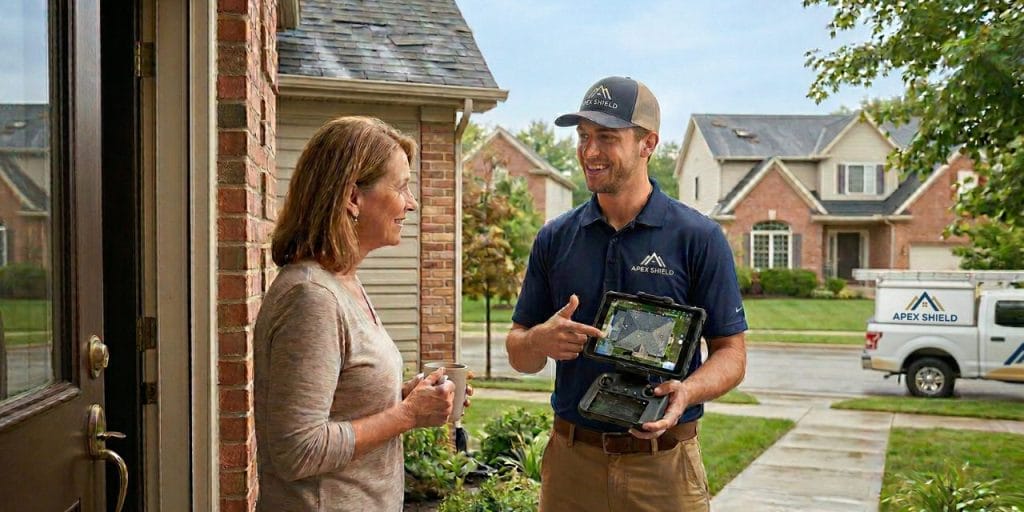

You’ve had that day where you knock until dark, your shirt’s stuck to your back, and you’ve got two shaky “maybe”s to show for it. It’s not that there aren’t enough doors. It’s that too many of those doors never turn into real inspections or signed contracts.
If that’s you or your team, you’re not alone. Across hundreds of roofing reps and managers, the pattern is the same: the top performers don’t just “hustle harder.” They run a tight, simple sales process that turns storms, neighborhoods, and referrals into a predictable number of jobs each week.
This playbook breaks that process down step by step—from the first knock and at‑the‑door hook, to on‑roof inspections, proposals, and follow‑up. Use it to coach new reps, sharpen veterans, and give your team a system they can run from the truck every day.
Know Your Roofing Buyer
Homeowners don’t wake up excited to buy a new roof. They wake up wanting to protect their home, control their budget, and avoid getting burned by a contractor. Your job is to sell that outcome, not just shingles and labor.
Most residential roofing buyers today:
- Research contractors online before they commit.
- Ask friends and neighbors who they used after a storm.
- Take at least one or two bids, even when insurance is paying.
If your pitch sounds like everyone else’s (“free inspection,” “we’ll work with your insurance,” “we’ve been in business X years”), you’ll blend into the noise. Reps who win more roofs understand the psychology behind the purchase and speak directly to risk, trust, and convenience.
For newer reps who also sell other services, SPOTIO’s door to door sales guide is a useful high‑level companion.
Build A Simple Sales Process
High‑earning roofing reps don’t just “go sell.” They run the same few steps over and over again and pay attention to how many people move from one step to the next.
A simple residential roofing sales process usually looks like this:
- Lead comes in (storm maps, canvassing, referrals, web leads).
- First contact at the door or by phone.
- On‑site inspection and photos.
- Proposal and insurance conversation.
- Follow‑up and close.
Put those stages on a board, in a spreadsheet, or in your app—whatever you actually look at every day. The goal is that every lead in your world sits in one of those buckets: not contacted, hooked, inspected, proposed, or closed.
Once you track it this way, you can stop telling reps “just knock more” and start saying things like: “At your close rate, you need 30 inspections this month. Let’s work backward to how many doors that really is.”
To help reps with objections once they’re deeper in the process, point them to SPOTIO’s roofing sales tips article on overcoming common homeowner pushback.
Set the Hook at the Door
The first 30–60 seconds at the door determine everything. Most roofing reps either talk too much or ask weak yes/no questions that make it easy for homeowners to shut them down. If your team is doing a lot of door‑to‑door roofing sales, this is where you’ll see the biggest gains.
What “set the hook” really means
The number one reason canvassers and salespeople fail at the door is they don’t “set the hook.” Rookie canvassers think, “All I have to do is be myself and start a conversation,” while rookie salespeople think, “I’ll just close them.” In reality, opening and closing are two different jobs that require different techniques.
At the door, you’re not “landing the fish.” You’re just setting the hook so you can land it later at the kitchen table. “Setting the hook” is effectively engaging the prospect in dialogue at the door—keeping them in front of you long enough to earn an inspection or follow‑up conversation.
Needs vs. desires on the doorstep
Pro tip: think in terms of needs and desires when you knock.
Needs and desires are very different:
- A need is an objective experience: for example, a flat tire or a storm‑damaged roof.
- A desire is what drives the buying decision and is typically emotional: wanting someone to come to you quickly, handle the hassle, and do it affordably.
Sales trainer Adam Bensman (known on YouTube as The Roof Strategist) shared this analogy years ago on the SPOTIO blog: if you’ve got a flat tire on your car, you don’t just need your tire changed; you desire roadside assistance that comes to you. That instantly narrows their options to the business that can fulfill both the need and the desire at the same time.
When your pitch speaks only to the roof, you’re selling a need; when you speak to hassle, risk, and peace of mind, you’re selling the desire that actually wins the job.
Use open‑ended questions, not dead‑end ones
The key to effectively setting the hook is ending your pitch with an open‑ended question.
Closed‑ended questions make it too easy for the homeowner to bail:
- “Would you like a free estimate?”
- “Is your roof okay after the storm?”
- “Do you want a free inspection?”
These invite one‑word answers like “yes” or “no,” which often turn into a quick “no” and a door in your face.
Open‑ended questions require the prospect to think and engage:
- “Why is protecting your home from storm damage important to you?”
- “How has the insurance process been for you so far?”
- “How confident do you feel about your roof after last week’s hail?”
Ending your pitch with an open‑ended question keeps the homeowner in front of you, piques their interest, and makes it much harder to just say “no” and walk away. For more examples of effective questions you can use across your sales motion, see SPOTIO’s guide to open‑ended sales questions.
Field‑tested storm‑damage script
Here’s Adam’s original flat tire example, adapted for roofing canvassing in a storm‑hit market:
“We help Denver homeowners replace storm‑damaged roofs within about 10 days using a price‑lock guarantee. About 90% of the homeowners we’ve been serving have had underpaid claims before we worked for them. How has the insurance process been for you?”
Why this works:
- It ends with an open‑ended question that forces the homeowner to think about their situation.
- It intrigues them about how you can help with underpaid or confusing claims.
- It’s tough for them to slam the door, because you’ve made their current process the focus.
- It effectively sets the hook so you can earn the inspection and later closing conversation.
You can build a few local versions off this structure—for older roofs, retail work, or wind damage—but always keep that open‑ended question at the end.
Run Trust-Building Inspections
Once you’ve earned the right to inspect, the goal isn’t just to “find damage.” It’s to make the homeowner feel informed, in control, and confident choosing you.
A tight inspection process usually includes:
- Quick exterior walk‑around to note obvious issues.
- On‑roof inspection with consistent checks (shingles, flashing, vents, gutters).
- Clear photo and video documentation of anything you’d want an adjuster to see.
Before you go up, explain exactly what you’ll do and how long it will take. When you come back down, don’t just say “you’ve got damage.” Walk the homeowner through 6–12 photos, flipping between wide shots and close‑ups so they understand what they’re seeing.
You want them thinking, “This rep knows their stuff and is on my side,” not “I have no idea what’s going on, but they say I need a new roof.”
Present a Clear Proposal
Too many roofing quotes look like random numbers on a one‑page PDF. Your proposal should make it obvious:
- What you’re recommending.
- How much it will cost.
- What the insurance, deductibles, and any financing actually mean for their out‑of‑pocket.
Break the proposal into plain‑language chunks:
- Scope: what’s being replaced and what’s not.
- Materials: clear options if your business model supports good / better / best.
- Price: total job cost and the part the homeowner is responsible for.
- Timeline: when work starts and how long it takes.
Use the same photos from your inspection in the proposal review and tie each major recommendation back to something they saw on the roof. This makes your bid feel like a logical extension of the inspection, not a mysterious number pulled from thin air.
When insurance is involved, stay in your lane. You can explain typical next steps and how you’ll meet the adjuster, but avoid promising specific claim outcomes you can’t control.
Follow Up and Close Deals
Most reps follow up until they get a “yes,” “no,” or silence. The best roofing teams treat follow‑up like part of the job, not an afterthought.
Here’s a simple follow‑up schedule any rep can run after an inspection or proposal:
- Day 1: Same‑day text: “Thanks again for having me out. Here’s the link to your photos/proposal—happy to answer questions.”
- Day 2–3: Call to answer questions and clarify insurance steps. Leave a short voicemail if they don’t pick up.
- Day 5–7: Quick check‑in: “Have you had a chance to compare bids yet? Anything not clear on ours?”
- Day 10+: Occasional touch with a new angle (schedule filling up, weather risk, neighbor job you just completed).
Every touchpoint should give them something useful, not just “checking in.” That might be new photos from a neighbor’s roof, a reminder about potential leaks if they delay, or clarity on what happens if they switch insurers mid‑process.
Reps who close more roofs don’t always follow up more often. They follow up with a clear plan and a reason every time they reach out.
For managers designing training around this, SPOTIO’s roofing sales training resources can help you turn these ideas into a repeatable onboarding plan.
Track Roofing Sales Metrics
If you can’t see your numbers, you can’t fix them. At a minimum, every roofing sales org should be tracking:
- Knocks or first contacts per day.
- Inspections set and completed.
- Proposals delivered.
- Contracts signed.
From there, calculate simple conversion rates:
- Knock → inspection.
- Inspection → proposal.
- Proposal → close.
Use these numbers to coach with your reps in the truck or back at the office. If a rep’s knock‑to‑inspection rate is low, you have a hook problem. If their inspection‑to‑proposal rate is low, it’s an on‑roof or explanation problem. If proposals aren’t closing, it’s a follow‑up or competitive positioning issue.
One roofing team we work with realized their issue wasn’t leads—it was getting inspections on the calendar. After tightening their at‑the‑door hook and cleaning up how reps logged and followed up on inspections, they saw roughly a 4x lift in appointments set in about two months.
Instead of telling reps “do more,” you can point to the step that’s leaking and work that one problem first.
Use Roofing Sales Tools
You don’t need a big, fancy tech stack to sell more roofs. You do need a couple of tools that match how your team actually works in the field.
Most successful storm restoration and roofing companies end up with three basic pieces:
- A way to see where to go and track what happens at each door.
- A system to build estimates, track jobs, and keep production on schedule.
- A storm data or mapping tool to tell you which neighborhoods actually took hail or wind.
On a real storm day, that might look like:
- Checking a hail map in the morning to see where you’re focusing.
- Lining up a list of streets and doors so reps aren’t wandering.
- Logging knocks, inspections, and proposals from the truck so nothing falls through the cracks.
- Handing signed jobs off cleanly so production can move fast.
One roofing company that put a basic system in place to track doors and rep activity didn’t change their market—just how they worked it. As more reps actually used the system, total doors knocked climbed by more than 20%, and average doors per rep went from the hundreds into the thousands over a season.
If you’re trying to decide which tools to add or replace, SPOTIO’s deep dive on roofing software compares options like Acculynx, JobNimbus, Hail Trace, and SPOTIO and shows how they fit into different roofing setups.
If you’re If you’re focused specifically on the CRM layer — pipeline, lead management, and the canvasser-to-closer handoff — see our breakdown of the best roofing CRM software.
For reps who live on their phones between stops, SPOTIO’s guide to choosing a door knocking app is another practical resource.
Put This to Work in 6 Weeks
You don’t have to blow up your whole sales process to use this playbook. Roll it in over a few weeks.
Week 1–2: Get your map and numbers straight
- Map territories and recent storm paths so everyone knows where to knock.
- Make sure every rep has a dead‑simple way to log knocks, inspections, and proposals from their phone.
- Agree on the five stages (lead, contact, inspection, proposal, close) and what counts for each.
Week 3–4: Fix the hook and the inspection
- Train reps on the needs vs. desires framework and open‑ended hook questions.
- Role‑play the 60‑second door pitch and the storm‑damage script in meetings and ride‑alongs.
- Standardize your inspection checklist and photo requirements, then spot‑check a few jobs.
Week 5–6: Tighten proposals and follow‑up
- Refresh proposal templates to include photos and clear breakdowns a homeowner can actually understand.
- Write a simple follow‑up schedule like the one above and get it into calendars or reminders.
- Start weekly reviews of conversion numbers and coach each rep on their weakest stage.
In a couple of months, you’ll have a team that sells roofs with intention instead of hope.
Frequently Asked Questions
Start by acknowledging the storm or condition that prompted you to knock, then quickly shift to the homeowner’s risk and peace of mind. Use open‑ended questions like “How confident do you feel about your roof after last week’s hail?” instead of yes/no traps. Offer a short, clearly defined inspection and a next step that feels safe, like a 15‑minute photo walkthrough, rather than pushing a contract on the doorstep.
You sell more roofs in storm season by pairing smart territory planning with a tight door pitch and fast follow‑up. Prioritize blocks based on storm intensity and roof age, then run a consistent hook at the door that leads naturally to inspections. Log every conversation, inspection, and proposal so you can circle back quickly with photos, insurance guidance, and neighbor proof before competitors crowd the neighborhood.
The best roofing sales pitches are short, specific, and focused on clarity for the homeowner. A strong pitch names the recent storm or issue, frames the risk in simple terms, and offers a no‑pressure next step: “I’ll show you photos and you decide if it’s worth calling your carrier.” Scripts that over‑promise (“free roof” or “we guarantee your claim will be approved”) create distrust and are more likely to backfire long‑term.
It depends on territory size, storm activity, and how much of the job they own beyond sales. In active storm markets, a full‑time roofing salesperson running a clean process can often sell several roofs per week during peak season. The more consistent your territories, inspection process, and follow‑up system are, the easier it is to scale those numbers across a team without burning reps out.
The skills that move the needle are consistent prospecting, strong listening and questioning at the door, clear explanation of inspections and insurance, and disciplined follow‑up. Product knowledge and technical roof expertise help, but they’re most powerful when paired with simple, confident communication. Reps who make homeowners feel heard, informed, and in control will almost always outsell reps who just “know roofs” but talk over people.
Selling roofs will never be easy—but it is predictable when you run the right process. If you give your reps a clear hook at the door, a trust‑building inspection and proposal flow, and a simple way to track their numbers, you’ll see more contracts signed without asking everyone to live on adrenaline all season.

Trey Gibson is the founder and CEO of SPOTIO, where he helps sales leaders build more efficient, high-performing field sales teams. With a background in entrepreneurship and as the founder of a roofing company, Trey brings hands-on experience leading door-to-door and B2B sales organizations. He combines real-world sales leadership with a passion for technology and operational efficiency to help teams scale, perform, and win more deals.