Roofing sales training has to cover a lot of ground — product knowledge, discovery, objection handling, closing, insurance claims — and it has to stick long after the workshop ends. Whether you’re building a training program from scratch or tightening one that’s already running, the difference between a team that ramps fast and one that churns through reps usually comes down to structure.
SPOTIO’s State of Field Sales survey found that only one in three field sales teams report more than 70% of their reps consistently hitting quota. In B2C field sales — the world most roofing companies live in — 68% of teams are dealing with 30% or higher annual turnover. The teams closing that gap aren’t necessarily spending more on training. They’re spending smarter.
This guide breaks down what effective roofing sales training actually looks like — the core skills reps need, how to structure a program that ramps them faster, and the best courses and resources available right now.
Why Roofing Sales Training Matters
The Cost of Untrained Reps
Hiring is expensive. But the real cost of a failed roofing sales rep isn’t the recruiting fee — it’s everything that comes after.
A rep who takes five months to ramp is burning through draw the entire time without closing enough to cover it. Meanwhile, their territory sits dead — prospects go unvisited, pipeline stalls, and competitors knock the same doors first. And then there’s the manager’s time: every hour spent onboarding a replacement is an hour not spent coaching reps who are actually producing. In high-turnover teams, managers get stuck in a permanent onboarding loop, and the reps who are performing start to feel ignored.
Whether your reps are W-2 or 1099, the math works the same way. A rep who churns before their first closed deal costs you the draw or salary you fronted, the territory revenue you’ll never recover, and the management bandwidth you burned getting them started — only to start over with the next hire.
What Good Training Actually Changes
Here’s what the data actually shows: low-turnover field sales teams have 53% of reps hitting quota, compared to just 22% on high-turnover teams. In B2C field sales specifically, the gap is even wider — 57% vs. 23%.
The teams that retain reps aren’t offering better perks or fancier comp plans. They’re building systems that get new reps to their first deal faster. When reps earn commissions early, they build confidence, see a future, and stay. When they don’t, they update their resume.
Retention isn’t solved by making reps want to stay. It’s solved by putting them in a position to earn.
Core Roofing Sales Skills
Product Knowledge and Roof Assessment
Before a rep can sell anything, they need to know what they’re looking at. That starts with understanding the core roofing systems: asphalt shingles (3-tab, architectural, luxury), metal roofing (standing seam and screw-down), synthetic and composite options, cedar shake, slate, and underlayment types.
But product knowledge alone isn’t enough. Reps need to conduct roof assessments that build credibility with the homeowner. That means reading damage accurately — identifying hail impact, wind lift, flashing failures, and water intrusion signs. For storm restoration work, it means understanding how to document damage in a way that supports insurance claims: capturing eaves, vents, penetrations, soft metals, and multiple shingle quadrants.
A rep who can walk a homeowner through what they’re seeing on the roof, explain why it matters, and tie it to a specific solution earns trust before they ever open a proposal.
Discovery and Objection Handling
The biggest gap in most roofing sales training isn’t closing — it’s discovery. Reps rush through the conversation, skip the budget question, pitch too early, and then wonder why homeowners ghost them after the estimate.
Effective discovery starts at the kitchen table. Ask open-ended questions: What concerns you most about your current roof? Have you gotten other estimates? What’s most important to you in a contractor — price, materials, timeline, warranty? The answers shape everything that comes after.
Almost every roofing objection falls into one of three categories: price, trust, or timing. For price, the issue is rarely the dollar amount — it’s perceived value. Increase the value of your proposal (financing options, material upgrades, warranty terms), and the number feels different. For trust, share references from the neighborhood, show photos of recent work, and let your process speak for itself. For timing, nail down a specific follow-up date on the spot — “call me later” isn’t a next step.
For more on handling the toughest homeowner pushback, see our guide to roofing sales tips that help you overcome common objections.
Closing Techniques for Roofing Sales
Closing a roofing sale should feel like the natural end of a good conversation, not a pressure play. If the discovery was thorough and the presentation addressed the homeowner’s specific concerns, asking for the business is straightforward.
The good-better-best presentation is one of the most effective techniques in roofing. Give the homeowner three options at different price points — a basic repair, a mid-tier replacement, and a premium package. Most buyers gravitate toward the middle option, which makes the middle tier your highest-margin opportunity.
Financing changes the conversation entirely. A $15,000 roof replacement sounds daunting. A $180/month payment plan sounds manageable. Train reps to present financing early — not as a fallback, but as a standard part of the proposal. For storm restoration, reps also need to be fluent in the insurance process: filing claims, working with adjusters, and explaining what the homeowner’s policy covers.
For a complete walkthrough of the full sales cycle from first knock to signed contract, see our article: How to Sell Roofing: 10 Tips for Success.
How to Structure a Roofing Sales Training Program
The Onboarding Phase (Weeks 1–4)
SPOTIO’s State of Field Sales survey found that nearly half of field sales teams take three or more months to get new reps productive. But the best-performing teams tell a different story: 70% of low-turnover teams get reps productive in under two months, compared to just 47% of high-turnover teams.
The difference isn’t better talent. It’s a faster path to the first win. The three milestones that matter during onboarding are: first full day of field activity, first self-sourced appointment, and first closed deal. Everything in your training program should compress the distance between day one and those milestones.
A practical four-week onboarding structure:
- Week 1: Product training, ride-alongs with a top performer, CRM and territory setup. The rep should be working their territory in the system by the end of the week — not sitting in a classroom.
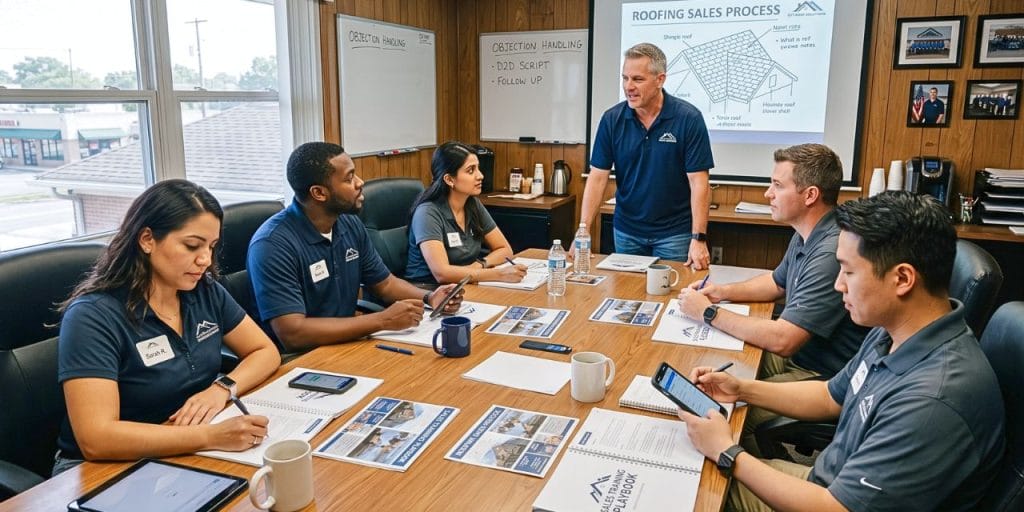
- Week 2: Role-play on discovery and objection handling. Supervised door knocking with real-time feedback. First self-generated leads.
- Week 3: Solo canvassing with daily check-ins. Proposal and pricing presentation practice. Introduction to financing and insurance claim workflows.
- Week 4: Independent selling with manager review of every proposal. Close the first deal. Debrief on what’s working and what needs adjustment.
Ongoing Coaching and Reinforcement
Here’s a counterintuitive finding: high-turnover field sales teams actually coach more hours than low-turnover teams. In the State of Field Sales data, 64% of high-turnover teams spend three or more hours a week on coaching, compared to 52% of low-turnover teams.
More coaching doesn’t fix a broken foundation. What matters isn’t volume — it’s whether coaching is targeted, timely, and grounded in real performance data.
The best roofing sales managers run weekly role-plays on specific scenarios (not generic “objection handling” — more like “the homeowner says they’re getting three bids and your price is $4,000 higher”). They review real proposals and pitch recordings. They ride along with reps who are struggling on a specific step in the process, not just reps who are new.
The key is catching problems in week two, not month four. A manager who can pull up a rep’s activity report and see they booked 12 visits but only completed six has a Friday coaching conversation — not a month-four surprise that ends with a resignation.
Using Technology to Scale Training
CRM adoption is one of the clearest dividers between teams that retain reps and teams that churn them. 78% of low-turnover teams use a CRM or field sales platform, compared to 54% of high-turnover teams. Low-turnover teams are also 2.4x more likely to run on just one to two systems, versus high-turnover teams where reps juggle five or more tools.
Every additional system a new rep has to learn is another week before they’re productive. The goal isn’t “trained on the system by week three.” It’s “working their territory in the system by day three.”
A field sales platform should give new reps immediate structure: mapped territories so they know where to go, prospect data so they’re not building lists from scratch, one-tap activity logging so every visit and follow-up gets captured, and field activity visibility so managers can see progress without waiting for end-of-month reports.
Storm Guard Roofing & Construction runs 39+ franchise locations across 17 states — all built around door-to-door storm restoration sales. Before SPOTIO, their managers couldn’t see what was happening in the field. Reps relied on manual notes that were hard to find and impossible to share, and re-knock opportunities fell through the cracks. SPOTIO gave every location a single system from day one: pin-based territory maps with color-coded prospect stages, manager dashboards showing team activity, and systematic re-knock tracking so no follow-up gets missed. The result was what Storm Guard President Shane Lynch called the ability to “see where those successes were and multiply on them” — the kind of visibility that turns one rep’s win into a repeatable playbook across the entire franchise.
For a deeper dive into how field sales teams are building this foundation, SPOTIO’s Field Sales Retention Playbook breaks down the five operational patterns that separate low-turnover teams from high-turnover teams — with the full data set and a five-step action plan.
Best Roofing Sales Training Courses
The methodology above gives you the framework. These courses fill in specific skills and techniques.
Top Rep Training
Top Rep Contractor Sales Training was built by industry veterans Chuck Thokey and Jim Johnson. The program focuses on live, in-person training through sales conferences, workshops, and hands-on exercises — including quizzes and flash cards for reinforcement.
Top Rep is best known for helping contractors close $20K+ jobs and improve closing rates. Their “Champion Mindset Framework” covers prospecting, negotiation, and advanced closing strategies specific to roofing and home services.
Best for: Experienced reps and managers looking to increase average ticket size. Pricing varies by program format.
Roof Sales Mastery
Roof Sales Mastery was created by Becca Switzer and is built specifically for storm restoration sales. The program is designed for new reps who need a step-by-step system — from knocking doors to getting contracts signed.
The curriculum covers three core areas: what to say at the door, how to run the inspection conversation, and how to close the deal. It’s online and mobile-accessible, so reps can work through modules between appointments.
Best for: New-to-roofing reps, especially in storm restoration markets. Contact for current pricing.
D2D Experts Roofing Sales Course
The D2D Experts Roofing Sales Training course offers 14 modules covering the full door-to-door sales cycle: creating inspections, filing claims, and closing deals across all roof types.
D2D Experts also provides a broader ecosystem including a CRM for field teams and route planning tools, which makes it a strong option for companies that want their training and field tools to connect. Their content library includes a 12-week course roadmap with KPIs and activity benchmarks.
Best for: D2D roofing teams that want a structured, module-based program. Contact for pricing.
The Roofing Academy
The Roofing Academy is a comprehensive business training platform founded by Randy Brothers of Elite Roofing and Solar. The program goes beyond sales to cover production, administration, hiring, marketing, and leadership.
Their flagship offering is a 7-step sales process with on-demand video training, a document vault with plug-and-play templates, and access to live coaching calls. They’re also a certified JobNimbus partner, which means their training integrates directly with CRM workflow setup.
Best for: Roofing entrepreneurs and company owners scaling a business — not just reps looking to sharpen skills. Tiered packages range from self-paced courses to full coaching programs with a 30-day money-back guarantee.
FPG Warrior Selling for Roofing
FPG’s Warrior Selling program is a 90-day system built specifically for B2C and in-home sales, including roofing. Created by Jason Forrest, the program focuses on mindset development alongside tactical sales skills — combining closing frameworks, persuasive language techniques, and weekly live coaching sessions.
What sets FPG apart is the ongoing reinforcement model: weekly Zoom “Dojo” sessions, role-playing scenarios, and personalized coaching that extends well beyond a one-time boot camp.
Best for: Teams that have tried one-and-done training and need a sustained coaching structure. Contact for pricing.
Sales Transformation Group
Sales Transformation Group was founded by Ryan Groth, who led sales for a large South Florida roofing contractor before building STG into a practice serving construction and the trades exclusively — roofing, HVAC, plumbing, electrical, and general contracting. The company has worked with more than 900 contractors since 2017, and its positioning is deliberately unglamorous: operational, not motivational. Offerings span Sales Accelerator programs, ongoing coaching, and fractional sales leadership for companies not ready to hire a full-time VP of sales. For a deeper look at what STG’s methodology covers, see our guide to building a high-performance contractor sales team.
Its most roofing-specific program is Unlocking Service Growth, a 26-module system for building a commercial and retail service division. The curriculum follows a four-stage roadmap — generate and qualify, inspect and estimate, propose and produce, close out and maintain — and includes a library of 130+ pre-built roof deficiencies reps can use to standardize inspections and quote on the same visit. STG cites benchmarks including roughly 80% gross margin on maintenance agreements and average maintenance contracts near $1,500.
Best for: Roofing companies building a service or commercial division, and owners who want repeatable process over motivational content. Pricing is quoted directly; the service course is in final production as of publication.
Choosing the Right Roofing Sales Training
Match Training to Your Team’s Stage
Not every team needs the same thing. A new or small team (under five reps) benefits most from a structured course like Roof Sales Mastery or D2D Experts that provides a ready-made process. The priority is getting reps a repeatable system fast.
A growing team (5–20 reps) needs onboarding infrastructure. The Roofing Academy’s systems-level approach or FPG’s ongoing coaching model helps managers build something that scales beyond tribal knowledge.
An established team looking to improve close rates or average ticket size should look at Top Rep’s advanced sales training or FPG’s Warrior Selling framework — programs that sharpen specific skills rather than teach fundamentals from scratch.
Complement Training with the Right Tools
Training teaches reps what to do. Tools make sure they actually do it — consistently, every day, across the whole team.
The field sales teams that ramp reps fastest and keep them longest give every new hire a platform on day one: mapped territories, prospect data, activity tracking, and manager visibility. That’s the foundation that makes everything else — coaching, skills training, compensation — actually work.
SPOTIO gives roofing teams that foundation. Reps get territory maps with prospect data already populated, one-tap activity logging with GPS location verification so nothing falls through the cracks, and multichannel follow-up sequences that reps enroll prospects into to keep deals moving. Managers get visibility into rep activity as it happens — which means coaching is based on what’s actually happening in the field, not what reps remember to report at the end of the week. See how it works →
Frequently Asked Questions
Most teams should target productive selling within 60 days. SPOTIO’s State of Field Sales data shows that 70% of low-turnover teams get reps productive in under two months, while only 47% of high-turnover teams hit that benchmark. A structured four-week onboarding program followed by a month of supervised selling with coaching feedback is a realistic timeline for most roofing companies.
At minimum: product knowledge (materials, roof assessment, damage documentation), discovery and qualification skills, objection handling for the three core objections (price, trust, timing), closing techniques including good-better-best presentations and financing, and insurance claims process training for storm restoration markets. Beyond content, the program needs a reinforcement structure — weekly role-plays, ride-alongs, and data-driven coaching.
Costs range widely. Self-paced online courses run from a few hundred to $1,500+. Comprehensive programs with live coaching, workshops, and ongoing support can run several thousand per year. When evaluating cost, factor in the alternative: a single failed rep can cost $50,000–$100,000 in wasted ramp salary, dead territory, and manager time.
Both have a place. In-person training (Top Rep, FPG workshops) is strongest for advanced skills, role-play practice, and team culture. Online training (Roof Sales Mastery, D2D Experts) works well for onboarding and standardizing a process across distributed teams. The best programs combine both — online modules for knowledge and in-person or live-virtual sessions for practice.
Track three metrics: time-to-first-deal for new reps, close rate before and after training, and rep retention at 6 and 12 months. A simple ROI formula: multiply the number of reps hired per year by the monthly fully loaded cost per rep, then multiply by the number of months you save by cutting ramp time. If you hire 10 reps a year at $7,500/month and cut ramp by two months, that’s $150,000 in annual savings — before counting additional deals closed.
What Separates Teams That Ramp Fast from Teams That Don’t
Roofing sales training isn’t about finding the perfect course. It’s about building a repeatable process, reinforcing it consistently, and giving reps the tools to execute from day one. The teams that get this right ramp reps faster, close more deals, and stop the cycle of constant re-hiring.
See how SPOTIO helps roofing teams build that foundation. Request a demo →
Trey Gibson is the founder and CEO of SPOTIO, where he helps sales leaders build more efficient, high-performing field sales teams. With a background in entrepreneurship and as the founder of a roofing company, Trey brings hands-on experience leading door-to-door and B2B sales organizations. He combines real-world sales leadership with a passion for technology and operational efficiency to help teams scale, perform, and win more deals.