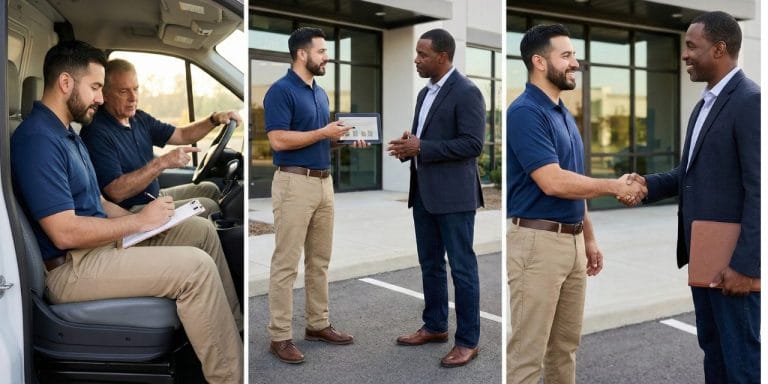

Most D2D guides are written for reps. This one is for the manager building the team behind them.
Face-to-face selling is still one of the most effective channels in sales — but only when the operation behind it is built right. Territory setup, rep onboarding, daily KPIs, coaching rhythms, tech stack — when any one of those breaks down, your reps are grinding hard and producing less than they should. According to SPOTIO’s 2026 State of Field Sales survey, field sales reps spend just 37% of their workweek in face-to-face selling. The other 63% goes to admin, meetings, planning, and everything else. Your job as a manager is to protect that 37% and make every hour of it count.
This playbook covers what it actually takes to build a high-performing D2D team: how to set up territory assignments that make sense, hire and onboard reps who stick, coach consistently, and give your team the tools to execute in the field without slowing down.
If you’re still deciding how to organize your team — canvasser/closer splits, manager ratios, when to add a management layer — start with our field sales team structure guide.
What Is Door to Door Sales?
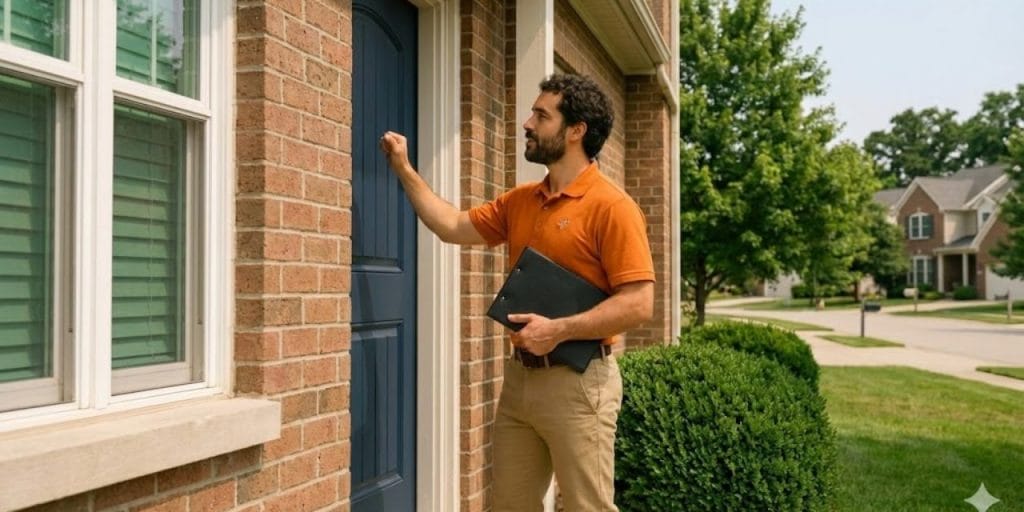
Door to door sales is the process of canvassing territories and meeting face-to-face with potential customers to explain product benefits, answer questions, and close deals on the spot.
It’s the oldest sales channel there is — and for high-consideration products that require trust, in-person demonstrations, or on-site assessments, it still outperforms most alternatives.
B2B vs. B2C D2D Sales
In B2B contexts, reps visit businesses to reach decision-makers, schedule follow-up appointments, or leave materials. The goal is often relationship-building and multi-touch engagement rather than same-visit closes. If you’re running a B2B field motion alongside D2D, see our B2B sales strategy playbook — the frameworks and activity standards are different enough to warrant a separate approach.
B2C D2D targets residential neighborhoods, knocking doors to speak directly with homeowners. Reps frequently use social proof — mentioning that a neighbor just purchased — to build credibility and urgency at the door.
Those differences matter when you’re building systems. B2B reps need calendar flexibility and appointment-setting workflows. B2C reps need high door counts, tight territory coverage, and fast objection handling. Build your operation to match your motion.
The Five Stages of Every D2D Sale
Every successful D2D transaction moves through the same five stages:
- Prospecting — Finding new customers to keep your pipeline full. Without a steady flow of qualified prospects, growth stalls.
- Qualifying — Identifying whether the prospect has pain (a problem worth solving), budget (money to spend), and decision power (authority to say yes). Ask open-ended questions. Listen more than you talk.
- Pitching — Explaining how your product solves their specific problem, not a generic list of features. Skip what they already know. Focus on what only you can offer.
- Closing — Asking for the business and handling the final objections. The best closers read the room — some prospects need a direct ask, others need reassurance. Match your close to the person, not the playbook.
- Follow-up — Post-sale check-ins that protect customer satisfaction, generate referrals, and open doors for upsells.
Why Door to Door Sales Still Works in 2026
D2D isn’t declining — it’s evolving. Digital outreach continues to flood inboxes and ad feeds. The result: standing out is getting easier, not harder. When a rep knocks a door and handles an objection in real time, they’re doing something no email sequence can replicate.
For products that require trust — a new roof, a fiber line, a security system — the in-person conversation still closes at rates digital channels can’t touch.
Industries Where D2D Dominates
Roofing: Storm-chasing roofing teams canvass neighborhoods after hail events to offer free inspections. Reps can assess damage on the spot, explain urgency, and close before competitors show up. D2D is often the primary acquisition channel for roofing companies.
Telecom and Fiber: Canvassing works for telecom because reps can make a compelling live case for switching providers — and social proof lands fast. Mentioning that a neighbor just signed builds credibility in seconds. For fiber-to-home operators specifically, D2D is often the only effective way to drive residential penetration in new service areas. For more on tactics specific to this vertical, see our telecom sales strategies guide.
Home Services and Home Improvement: Reps know they’re speaking with the decision-maker when they meet a homeowner at the door. Qualification happens fast. Products that benefit from a visual walkthrough — HVAC, windows, security — close more efficiently when reps can see the property. See our guide to home improvement sales for vertical-specific tactics.
Alarm and Security: Security systems are best explained in person. Reps can walk the property, identify vulnerabilities, and tailor the solution to the home’s layout — something a phone call or ad can’t do.
Medical Devices: Reps calling on clinics and medical offices benefit from the same trust dynamics as B2C D2D. In-person visits build the practitioner relationships that drive ongoing purchasing.
Managing a Door to Door Sales Team
A D2D sales manager isn’t just a supervisor. You’re the person who translates daily canvassing into revenue the CEO cares about — and you do that by fixing the systems your reps operate inside of, not just coaching their pitches. For a broader look at the management function, see our guide to field sales management.
Territory Setup Before Anything Else
Before you worry about scripts or training, fix your territory assignments. Bad territory setup is the #1 hidden reason reps underperform. When two reps are knocking the same blocks, or one rep has a dense suburb and another has 40 miles of rural route, your performance comparisons mean nothing.
Assign territories based on opportunity, not just geography. Consider account density, household income, homeownership rates, competitor saturation, and average deal size for your product. Use territory management software to visualize this on an interactive map, spot gaps, and balance workloads before you send anyone into the field. For a deeper look at how to structure your territories, see our guide to sales territory management.
If your team is managing territories in Google Maps, this breakdown covers exactly where it falls short and when it’s time to move on.
A well-balanced territory gives every rep a fair shot. It also makes your coaching data useful — because when territories are equitable, differences in rep performance are about skills and execution, not luck of the draw.
KPIs Every D2D Manager Should Track
Activity metrics tell you why outcome metrics trend up or down. Track both. For a deeper framework on setting and measuring these, see our guide to sales activity tracking.
| Activity KPI | What It Tells You |
|---|---|
| Doors knocked per day | Rep effort and time-in-field |
| Contact rate (knocks → conversations) | Territory quality and opening effectiveness |
| Conversation-to-demo rate | Qualification and pitch quality |
| Demo-to-close rate | Closing effectiveness |
| Average deal size | Product-market fit and upsell activity |
| Pipeline velocity (days first contact → close) | Sales cycle health |
Review these weekly, not monthly. When a rep’s conversion rate drops, pull the activity data first — is this a volume problem (not enough knocks), a contact problem (bad territory timing), or a skills problem (weak pitch)? The fix is different for each.
Once you have consistent pipeline velocity data, you have the inputs for a reliable sales forecast. See our guide to sales forecasting methods for field teams.
Coaching Frameworks That Stick
The managers who build the best D2D teams don’t coach once — they coach constantly, in structured ways that scale. For a roundup of tools that support a consistent coaching cadence, see our guide to sales coaching tools.
SPOTIO CEO Trey Gibson sat down with Sam Taggert — founder of D2D University and one of the most recognized names in door-to-door sales — to discuss what separates top performers from everyone else. Sam breaks down how he segments teams into three performance tiers, why investing in your best rep delivers more ROI than trying to rescue your lowest performer, and the mindset shift that defines the top 1% of D2D producers.
Three coaching habits that produce results:
- Weekly role-plays with recorded review. Run 15-minute sessions where reps practice objection handling. Record them (with permission) and debrief as a team. Hearing their own pitch is more instructive than any feedback you can give.
- Ride-alongs at least monthly. What you see at the door is never what you hear in debriefs. Ride-alongs reveal posture, tone, timing, and transitions that reps can’t self-report.
- Share wins publicly, in detail. When a rep closes a tough deal, have them walk the team through exactly what they said at the door. Specificity is what makes a win story useful.
These coaching habits require protected time — which means your managers need to be coaching, not carrying a personal pipeline. If you’re still running a player-coach model, see our breakdown of when that structure helps and when it hurts.
Hiring and Training D2D Reps
D2D turnover is the operational reality every manager has to plan around. SPOTIO’s 2026 State of Field Sales survey found that 68% of field sales teams report 30% or higher annual turnover. You can’t eliminate churn, but you can dramatically reduce the cost of it by hiring smarter and onboarding faster.
What to Look for in Interviews
Generic traits — persistence, communication skills, adaptability — are table stakes. Everyone says they look for those. What actually predicts D2D success is how a candidate responds to rejection in real time.
During interviews, run a scenario at the door. Hand the candidate a one-pager and say: “I just told you I’m not interested. What do you say next?” Their response tells you more than any resume line. You’re looking for someone who recovers without getting defensive, pivots to a question rather than a harder close, and stays genuinely warm.
Decide early whether you want experienced or new-to-D2D reps. Experienced canvassers produce faster but may bring habits that are hard to unlearn. New reps take longer to ramp but you can train them exactly how you want them to work.
Interview at least five candidates before extending an offer. Source from LinkedIn, Indeed, and your professional network — and don’t underestimate employee referrals from your top performers. They know what the job actually requires.
The 4-Week Onboarding Timeline
The fastest path from hire to quota is a structured, documented onboarding process. Handing a rep a stack of flyers and saying “go get ’em” is how you build a turnover machine.
Trey Gibson, CEO of SPOTIO: “At a previous company, we documented every step of our sales process — not just the pitch, but how we answered phones, when invoices went out, everything. On Day 1, new canvassers got a written process for what to say at the door and the most common rebuttals. They practiced the opener, then shadowed an experienced rep. By Day 2, they were running the full process with a veteran watching. By Day 3, they were knocking on their own. Because we tracked every door, we could spot ratio problems by Day 4 and course-correct before the weekend. That structure let us scale from $1 million to $18 million in three years.”
Use this framework as your baseline:
Week 1: Product training, pitch framework, territory overview, CRM setup, shadowing top performers Week 2: Co-selling with manager (you knock, they observe; then they knock, you observe and coach) Week 3: Independent selling with daily debriefs — focus on ratio analysis, not just results Week 4+: Full territory ownership with weekly one-on-ones; flag ratio problems early, not monthly
From SPOTIO’s State of Field Sales survey: 56% of field sales teams ramp new reps in under three months. If your ramp is consistently longer, look at your onboarding documentation first, then your territory assignments.
Ongoing Training That Drives Consistency
Inconsistent messaging is invisible from the manager’s desk and costly at the door. When every rep pitches differently, you can’t identify what’s actually working.
Standardize frameworks, not scripts. Give reps the structure — key talking points, common objection pivots, closing questions — but leave room for their own voice. Rigid word-for-word scripts create robotic delivery. Flexible frameworks create consistency.
Run weekly role-plays. Record pitches. Share what works across the team. When you see a rep’s contact rate climb, find out what they changed and spread it.
How to Sell Door to Door: Scripts and Techniques
This is the section most D2D guides skip. They tell you to “structure your pitch in four steps” — without ever showing you what those steps sound like at an actual door.
The Door Opener: First 10 Seconds
You have roughly 10 seconds before a homeowner decides whether to keep listening. The goal of your opener is not to pitch — it’s to earn the next 60 seconds.
This framework works across most D2D verticals:
“Hi, my name is [Name] — I work with [Company] and I’ve been out here talking to a few of your neighbors today about [brief context, e.g., a recent storm in the area / our new service in this neighborhood]. I just have a quick question for you — do you have 60 seconds?”
What makes this opener effective:
- Name and company up front — removes the “who is this?” uncertainty that triggers defensiveness
- Neighbor reference — social proof without fabricating a close
- One question, low commitment — “do you have 60 seconds?” is far easier to say yes to than an implicit request to hear a pitch
If they say no, take it gracefully and leave a door hanger. If they say yes, ask your first qualifying question immediately — don’t launch into a pitch. For more examples across verticals, see our sales pitch examples guide.
Qualification Questions That Work
Once they’ve given you 60 seconds, your job is to qualify, not present. Ask open-ended questions and let them talk:
- “How are you currently handling [relevant problem — roof age, internet speed, energy bills]?”
- “Has that been an issue for you, or has it been fine?”
- “Is that something you’ve thought about addressing, or is it on the back burner?”
Listen for signals of pain, timeline, and decision authority before you present a single feature. If they have a problem, budget, and authority — now you pitch.
Handling Objections with the LAER Model
Objections are not rejections. Most “nos” at the door are obstacles, not final answers. See our full objection handling guide for a deeper breakdown.
Use the LAER model, developed by Carew International — Listen, Acknowledge, Explore, Respond:
- Listen completely without interrupting
- Acknowledge their concern genuinely: “That makes sense — I hear that a lot.”
- Explore the root: “When you say the timing isn’t right, is it more about budget or just the decision feeling too quick?”
- Respond with empathy and a targeted reply
One technique that consistently works for D2D: give them permission to say no early.
“If at any point you feel what I’m offering isn’t valuable to you, just tell me. You won’t hurt my feelings, and I don’t want to waste anyone’s time.”
Prospects who stay after that line are actually interested.
Common D2D Sales Challenges
High Turnover
Turnover is the operational tax every D2D manager pays. 68% of field sales teams see 30%+ annual rep turnover per SPOTIO’s 2026 survey — and the cost isn’t just recruiting fees. It’s lost territory coverage, inconsistent customer experience, and the institutional knowledge that walks out the door with every rep who quits.
Fix it with the hiring and onboarding system above first. The reps who leave in the first 30 days usually reveal a hiring problem. The reps who leave at month three to six usually reveal an onboarding problem. Map your churn timeline before you change anything else.
Then: build clear career paths (show reps how to move into management), celebrate wins publicly, and use leaderboards and incentive programs that reward activity, not just closed deals — especially early in a rep’s ramp.
Inconsistent Messaging
When every rep pitches differently, you can’t identify what’s working and what’s not. Inconsistency also damages your brand in the field — if two reps from the same company sound like they’re selling different products, prospects notice.
Fix it by standardizing pitch frameworks (not rigid scripts), running weekly role-plays, and recording field pitches with customer permission. Review them as a team. When a rep nails a tough objection, that recovery becomes the team’s new standard.
Prospecting Fatigue
Top D2D reps typically aim to knock 50–70 doors per day — enough volume to generate meaningful pipeline without burning out. But that pace is physically and mentally demanding, and reps hear rejection at a rate few other roles require. Fatigue compounds fast when the pipeline isn’t visibly moving.
Fix it by rotating territories regularly to keep things fresh, using leaderboards that reward daily activity (not just closed deals), and creating visible momentum. When reps can see that they’re making progress — conversations held, appointments set, pipeline built — the daily grind becomes sustainable.
Technology for Door to Door Sales Teams
The right field sales tech stack does two things: it removes friction from rep execution, and it gives managers visibility into what’s actually happening in the field. The wrong stack adds steps without adding value.
What Managers Need
Territory Management: Territory management software lets you define territories by geography, ZIP code, demographics, and custom criteria. Set user permissions so reps see only their assigned accounts, then pull analytics to spot underperformance before it compounds. Adjust boundaries as market conditions change without re-assigning reps manually.
Rep Activity Visibility: Rep tracking gives you visibility through location-verified activities — reps log a check-in at each visit, so you can see the time and location of every logged activity and whether they completed their planned route. You’re not monitoring reps for the sake of it; you’re getting the field data you need to coach accurately.
Sales Tracking Dashboards: Sales tracking gives you real-time visibility into activity metrics (doors knocked, conversations held, demos completed) and outcome KPIs (deals closed, revenue, conversion rates) across your entire team and every territory.
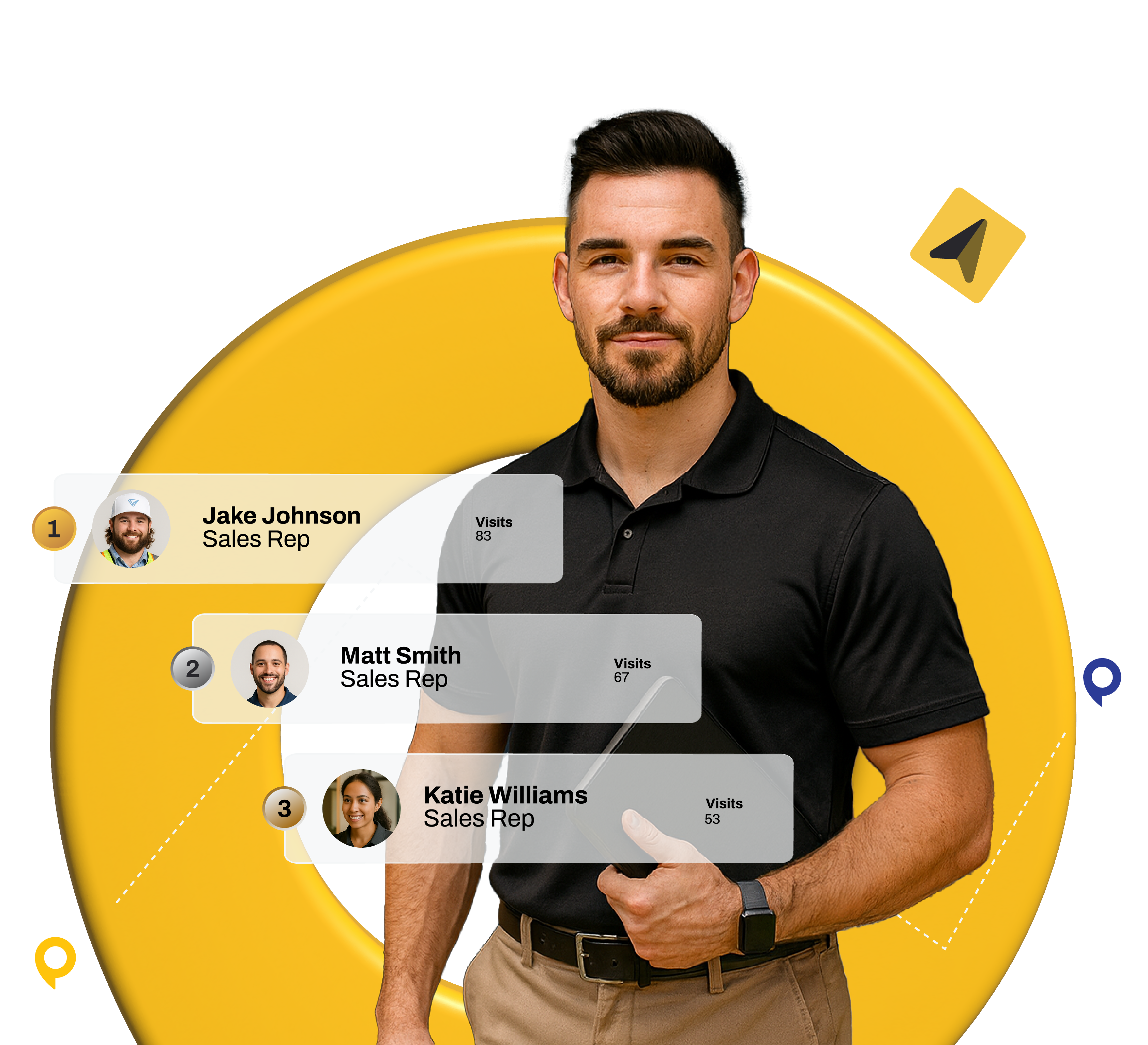
Sales Leaderboards: Leaderboards surface real-time rep rankings that motivate healthy competition and keep top performers pushing. They’re also a coaching tool — a sudden drop in a rep’s ranking is often the first visible signal of a problem worth investigating.
Performance Analytics: Performance analytics give you a consolidated view of rep and team performance across territories — activity completion rates, conversion ratios, pipeline health, and quota attainment — without pulling data from multiple places. Instead of building a picture from disconnected reports, you see what’s happening across your entire team in one view, filtered by rep, territory, or time period.
Sales Coaching Tools: SPOTIO’s sales coaching tools connect manager visibility to rep development. Because coaching data is grounded in logged field activity — not self-reported numbers — you can walk into a one-on-one with a specific rep knowing exactly where their funnel is breaking down. That turns coaching from a general performance conversation into a targeted fix.
What Reps Need
A map of every account in their territory. Before a rep can execute, they need to see their world — which doors have been knocked, what happened at each one, and where the open opportunities are. A customer mapping solution plots every prospect and customer on an interactive map. Reps tap a pin before they knock and see full account history, prior rep notes, and current status — so they walk up informed, not starting from scratch.
A fast way to capture what happened at the door. The biggest productivity drain in D2D isn’t driving — it’s the documentation that piles up when reps try to remember 50 visits at the end of the day. One-tap activity logging lets reps record a visit, add a note, and set a follow-up while still standing at the door. The activity is location-verified and syncs to the CRM automatically — no end-of-day data entry sessions.
Prospect data before they even knock. Cold territory is expensive. SPOTIO Lead Machine lets reps filter B2C residential prospects by 15 data points — property type, homeownership, demographics, and more — so they’re targeting the right doors before they leave the truck. For B2B D2D, reps can tap businesses on the map to pull contact information from Google Places while in the field.
AI-assisted workflows between stops. Driving time is dead time unless reps can use it. DASH AI gives reps two capabilities that matter in the field: DASH Go captures voice notes and activity updates between stops, with a confirmation tap before anything is written to SPOTIO; and DASH IQ pulls a 10-second account brief — prior activity, open tasks, key details — before a knock, so reps aren’t reading through notes in the driveway.
An efficient route through their day. The order reps visit accounts matters more than most realize. A route planner calculates the most efficient sequence for planned stops, cutting wasted drive time between visits. SPOTIO plans the route and hands off to Google Maps or Waze for navigation — and completed routes sync to the CRM so nothing needs to be re-entered later.
Guided follow-up so nothing falls through. Most D2D deals don’t close on the first visit. AutoPlays give reps a structured follow-up sequence for every prospect — text, email, call, or return visit — based on a playbook the manager has configured. Reps enroll a prospect manually, and AutoPlays surface the next step at the right time. No spreadsheet of “who do I need to call this week.”
Pipeline visibility for multi-touch deals. For B2B D2D reps and higher-consideration B2C cycles where a deal takes multiple visits to close, pipeline management gives reps a clear view of where every open opportunity stands — stage, next action, and close timeline — without relying on memory or a separate spreadsheet.
Offline access when connectivity drops. Rural territories, basements, and low-signal areas are a reality for D2D teams. SPOTIO’s Download My Day feature lets reps pre-load their schedule and account data before heading into the field — up to 24 hours of offline access. Notes, activity logs, and appointments sync back when connectivity is restored.
Digital business cards. After a visit, reps need a frictionless way to stay connected. Digital business cards replace paper cards that get lost and make it easy for prospects to reach back out after the knock.
How the Tech Stack Connects
The biggest value isn’t in any single feature — it’s in the connection between manager visibility and rep execution. When a rep one-tap logs a location-verified activity in the mobile app, that information feeds into your territory analytics and CRM simultaneously. No double entry. No end-of-day data dump. Managers get a clear picture of field activity as activities are logged — without chasing reps for end-of-day updates.
For teams exploring AI in the field, DASH layers into that same workflow — voice input, record Q&A, and drafted communications, all with rep confirmation before anything is saved.
When Chipr implemented systematic activity monitoring through SPOTIO, their leadership could identify which approaches generated the highest conversions — then scale those techniques across the entire team, hitting their 6% close rate targets consistently.
Top Industries Using D2D Sales
Roofing: Storm-chasing roofing teams canvass neighborhoods after hail events, offering free inspections and closing while damage is fresh. On-site assessment combined with urgency and social proof makes D2D the most effective acquisition channel in the industry.
Telecom and Fiber: For fiber-to-home operators and telecom dealers alike, canvassing drives residential penetration in ways digital advertising can’t. A neighbor who just switched is the strongest sales tool a rep has. See our telecom sales strategies guide for vertical-specific tactics.
Home Improvement and Home Services: D2D works for home improvement because reps are speaking with the homeowner — the decision-maker — in person. Products that benefit from a visual walkthrough close more efficiently when the rep can see the property. See our guide to home improvement sales software for tools that support in-home presentations and follow-up.
Alarm and Security: In-person explanation and property walkthroughs give alarm reps a closing advantage that remote channels can’t replicate. Reps identify vulnerabilities, tailor the system to the home, and close on the spot.
Medical Devices: Reps calling on clinics build practitioner relationships through consistent in-person visits. Same trust dynamics, B2B motion. A medical device rep typically plans 8–10 clinic stops per day during business hours, building familiarity over multiple visits before a purchasing decision is made.
Solar Energy: Residential solar D2D relies on in-home consultations for roof viability assessment and real-time savings calculations. See our door-to-door solar guide for sales-specific strategies.
Frequently Asked Questions
D2D builds trust faster than digital channels — which is critical when selling high-consideration products like roofing, security systems, or telecom services. Reps handle objections in real time, assess the property or situation on the spot, and close decisions that would take weeks over email. The face-to-face conversation remains irreplaceable for products that require explanation, demonstration, or customization — and because the rep is speaking directly with the decision-maker, qualification happens fast.
D2D is physically demanding — top reps aim for 50–70 doors per day — and rejection rates are high. Most D2D teams see 30%+ annual rep turnover per SPOTIO’s 2026 State of Field Sales survey, making rep retention a constant management challenge. Unpredictable schedules, weather, and homeowner availability make D2D less predictable than inside sales. Territory mapping software prevents the costly problem of reps knocking doors that have already been worked by a teammate.
Conversion rates vary widely by industry, product price point, and territory quality. The more useful metric to track is your funnel ratio — doors knocked to conversations held to demos to closes — because that reveals exactly where your team is losing deals. In high-consideration categories like roofing, well-run teams close 30–40% of qualified inspection leads. For door-to-conversation rates, the target is typically a 30–40% contact rate on a given pass through a neighborhood.
D2D earnings vary significantly by industry, experience level, and compensation model. Most D2D positions include commission, making performance the primary driver. Top performers in high-ticket categories like roofing, fiber, and security can earn well into six figures. Check current compensation benchmarks at PayScale or Glassdoor for your specific vertical and region.
Most high-performing D2D teams use a tiered commission structure with a modest base salary — enough stability to keep reps focused during slow weeks, with enough upside to reward performance. Commission-only works for experienced, self-motivated reps who want maximum earning potential. Gross margin commission aligns rep incentives with company profitability. Tiered structures (e.g., 5% up to $10K in sales, 8% above) motivate reps to push past minimum quota.
Hire more deliberately (scenario-based interviews, not trait checklists), onboard with documented processes rather than informal shadowing, and create visible career paths. SPOTIO’s State of Field Sales survey shows that low-turnover teams are 2.4x more likely to run consolidated tech stacks (1–2 systems) compared to high-turnover teams — suggesting that tool complexity itself contributes to churn. Build your onboarding around the actual tools reps will use from Day 1.
Yes — operationally, the motions are quite different. B2B D2D is appointment-driven, multi-touch, and focused on business hours and decision-maker access. A B2B rep calling on medical offices, for example, plans 8–10 stops per day during clinic hours and may take three visits before a decision is made. B2C D2D is higher volume, faster-cycle, and closes more frequently on the first or second visit — with an evening and weekend availability window that B2B doesn’t have. The technology, training, and KPIs for each should reflect those differences.
Build the System. Let the Reps Execute.
The managers who build the best D2D teams don’t rely on talent alone. They build systems — documented onboarding, equitable territories, clear KPIs, coaching rhythms — that give good reps the structure to become great ones.
SPOTIO is built for field sales teams that sell face-to-face. Chipr used SPOTIO’s activity monitoring and coaching data to hit their 6% close rate targets consistently. Wire 3 saw a 309% increase in field visits and a 21% lift in calls after moving their team onto SPOTIO.
Ready to see what that looks like for your territory? Request a demo.

Trey Gibson is the founder and CEO of SPOTIO, where he helps sales leaders build more efficient, high-performing field sales teams. With a background in entrepreneurship and as the founder of a roofing company, Trey brings hands-on experience leading door-to-door and B2B sales organizations. He combines real-world sales leadership with a passion for technology and operational efficiency to help teams scale, perform, and win more deals.
Research and drafting assisted by AI tools; all content is reviewed, fact-checked, and approved by Trey and the SPOTIO editorial team.