
Most manufacturers don’t lose distribution deals because their product is bad. They lose because they walk into a distributor’s office without understanding what that distributor actually needs — and pitch like they’re selling to an end customer instead of a channel partner.
Getting a distributor to carry your product is a different sale entirely. You’re not convincing someone to solve a problem. You’re convincing a business operator to bet their warehouse space, their rep time, and their customer relationships on you. That takes real preparation — understanding their business, their margins, and what it will take to earn space in their sales bag.
This guide walks through exactly how to do it — from identifying the right distribution partners to enabling them to sell on your behalf. Whether you’re breaking into a new region or trying to scale faster than your direct sales team can handle, these steps will get you there.
Why Sell Through Distributors
The global wholesale and distribution market is estimated at over $57 trillion in 2025 — and it’s growing. The core appeal of selling through distributors is leverage. Instead of building a regional sales team from scratch, you plug into a network that already knows the buyers, already has the shelf relationships, and already makes weekly calls into the accounts you’re trying to reach.
Wider market reach is the most obvious benefit. A single distribution partner can give you access to dozens or hundreds of end customers in a geography you couldn’t cover cost-effectively on your own. That’s why distributors are so common in industries like industrial supply, building materials, food service, and medical devices. In MRO distribution specifically, the combination of massive SKU counts and price-sensitive buyers makes field rep coverage especially critical — and especially hard to scale without channel partners.
There are other benefits that get overlooked:
- Faster sales cycles — distributors maintain existing account trust, often shortening the time from introduction to first order
- Reduced logistics burden — many distributors handle warehousing, delivery, and returns, freeing your team to focus on product and growth
- Local market intelligence — a good distributor knows what competitors are doing in their region before you do
The tradeoff is margin and control. You’ll sell at a lower per-unit price, and you won’t own the customer relationship directly. For most manufacturers trying to scale, that’s a worthwhile trade — but it’s worth going in with eyes open.
If your manufacturing sales strategy includes building a direct field team alongside your distribution channel, our manufacturing sales strategy playbook covers how to structure territory coverage, enablement, and technology for reps selling into plants and facilities. For onboarding those reps, see our guide to manufacturing sales training — including a 90-day ramp framework and coaching cadence built for long-cycle industrial sales.
What Distributors Want From You
Here’s where most manufacturer pitches fall apart: they focus entirely on their product and almost nothing on the distributor’s business. A distributor’s job is to move product profitably and keep their customers happy. Your pitch needs to answer three questions before anything else.
Can I make money on this? Distributors work on margin. Before your first meeting, know your pricing structure cold — manufacturing cost, your distributor price, the expected retail or end-user price, and the resulting margin at each tier. A rough example:
| Tier | Price | Margin |
|---|---|---|
| Your manufacturing cost | $10 | — |
| Distributor purchase price | $14 | Your gross: 40% |
| End-user / retail price | $22 | Distributor gross: ~36% |
Note: These are illustrative figures. Your actual margins will vary by product category and distributor tier.
If the margin math doesn’t work for the distributor, no relationship story or product feature will save the deal.
Will my customers actually want this? Distributors carry hundreds of SKUs. They’re not going to take a flyer on a product without demand proof. Come in with whatever evidence you have — customer testimonials, pilot results, regional sales data, or even a clear ICP that maps to their existing customer base.
Will you support me after the deal? This is the question manufacturers most often underprepare for. Distributors want to know you’ll provide training for their reps, co-marketing materials, a responsive point of contact, and a plan for handling returns or warranty issues. The deal doesn’t end at the contract — it starts there.
How to Find the Right Partners
Not every distributor is the right distributor. A poor fit — wrong geography, wrong customer base, wrong scale — wastes months and poisons your reference list.
Match to Your Target Market
Start by mapping where your end customers are concentrated. If you sell industrial cleaning equipment to manufacturing plants in the Midwest, you need a distributor with those plant relationships — not a broad-line distributor who happens to cover the region. Territory fit matters more than size.
Use trade associations, industry directories, and competitor analysis to identify who already distributes complementary (not competing) products to your target buyers. If your product would sit next to something a distributor already carries, that’s a strong fit signal.
Vet Before You Pitch
Before you invest time in a formal pitch, run a quick vetting pass:
- How many active accounts do they service in your target geography?
- What brands do they currently carry — and do any compete directly with you?
- What’s their rep-to-account ratio? A stretched team won’t prioritize a new product launch.
- Do they have a track record of successfully launching new product lines vs. just adding SKUs?
- Are they financially stable? A distributor with cash flow problems will slow-pay you and under-invest in your product.
This isn’t due diligence overkill — it’s protecting your launch. A bad distributor choice can lock you out of a market for a year or more if the agreement includes exclusivity provisions.
📋 Want a repeatable system for managing distributor accounts in the field? See how SPOTIO helps field sales teams track activity, plan territories, and keep distributor relationships moving. [Watch a 2-minute overview →]
How to Sell to Distributors: 9 Steps
Step 1: Build Your Ideal Distributor Profile
Before prospecting, define what “right” looks like. Document the geography, vertical, customer base size, existing product portfolio, and rep count that would make a distributor a strong fit. This is your IDP — Ideal Distributor Profile — and it works the same way an ICP does for your direct sales motion.
Your IDP should document at minimum: target geography, customer verticals served, existing product categories carried, annual revenue range, rep count, and whether they have a dedicated outside sales team. The cleaner your IDP, the faster you can qualify — and disqualify — distributors before investing time in a pitch.
Step 2: Research the Market
Understand who your target distributors’ customers are and what competitors they’re already buying from. Walking into a pitch with regional market knowledge signals you’re a serious manufacturer, not a cold call. Three sources to start:
- Trade association directories — most industries publish member distributor lists by region (NAW, HARDI, IMARK, etc.)
- Competitor distributor mapping — check competitors’ “where to buy” pages to identify who’s already carrying similar lines in your target markets
- Regional demand signals — look at distributor job postings, trade show exhibitor lists, and LinkedIn activity to gauge which distributors are growing vs. contracting
Step 3: Map Your Pricing and Margin Structure
Nail your margin math before any conversation. Build a one-page pricing sheet that shows the distributor exactly what they’ll make per unit, at what volume tiers, with what minimum order requirements. Ambiguity on pricing kills deals before they start.
At a minimum, your pricing sheet should show: base distributor price, volume tier breaks (e.g., 10% discount at 500 units/quarter), MAP (minimum advertised price) if applicable, and your suggested end-user price. If you walk in without volume tier pricing, the first question a sharp distributor will ask is one you’re not ready to answer.
Step 4: Perform a Competitive Analysis
Know which manufacturers the distributor already works with in your category. Understand how your product’s margins, quality, and support compare. Competitive positioning isn’t about badmouthing competitors — it’s about clearly articulating why adding your line improves their portfolio without creating internal conflict.
Before your pitch, know the answers to these four questions: What margins are competitors offering on comparable lines? What’s their lead time and fill rate reputation in this territory? Where are their product or service gaps that your line addresses? And which of their reps are quietly dissatisfied — because a distributor rep who’s frustrated with a competing manufacturer is your fastest path to shelf space.
Step 5: Identify Your Sales Channels and Outreach Approach
Distributors get pitched constantly. How you make first contact matters. Cold email rarely works. The highest-conversion approaches are:
- Warm intro through a mutual contact or trade association connection
- Meeting at an industry trade show where the distributor is already evaluating new lines
- A referral from one of their existing supplier partners
- A direct call from your VP of Sales or founder — not a junior SDR
Step 6: How to Pitch a Distributor — A 5-Step Outreach Framework
Once you have the meeting, structure your pitch around the distributor’s business — not yours.
- Open with their market — show you understand their territory, their customer base, and a gap you can help them fill
- Present the margin math — put your pricing sheet in front of them early; don’t make them ask
- Bring demand proof — customer testimonials, pilot data, or a named reference account in their region
- Outline your support model — training, co-op marketing funds, dedicated contact, return policy
- Propose a pilot — instead of asking for full commitment, offer a defined 90-day trial with a specific SKU set and a clear success metric
In practice, a pilot proposal lowers the distributor’s perceived risk significantly — it’s far easier to say yes to 90 days than to a full partnership.
💡 Why most manufacturer pitches fail:
- Leading with product features instead of margin math
- Showing up without demand proof or reference accounts
- Treating the distributor pitch like an end-customer pitch
- Ignoring enablement — and going quiet after the contract is signed
Step 7: Negotiate Distribution Contracts
The contract defines the relationship. Key terms to align on:
- Exclusivity and channel conflict — will you give geographic or account exclusivity, and for how long?If you plan to run multiple distributors in overlapping territories, define vertical carve-outs clearly in the contract (e.g., Distributor A owns industrial accounts; Distributor B owns commercial construction). Nothing damages a distribution relationship faster than a rep discovering you signed their competitor down the street without warning. Build price protection clauses in as well — if you cut price with one distributor, the others need to know how and when that affects them. Ambiguity here creates resentment that no amount of enablement can fix.
- Minimum purchase commitments — what volume guarantees, if any, are expected?
- Pricing protection — how will price changes be communicated and implemented?
- Performance benchmarks — what triggers a review of the relationship?
- Term and termination — how long is the agreement, and what are the exit conditions?
Get legal counsel involved before signing anything with exclusivity provisions. A poorly structured exclusivity clause can block you from entering a market for years.
Step 8: Enable Your Distribution Partners
Winning the contract is the beginning, not the end. Channel partner enablement is what separates manufacturers whose products move off the shelf from manufacturers whose products collect dust in a warehouse.
Provide distributors with:
- Product training for their sales reps (even a 30-minute recorded session helps)
- A co-branded sell sheet and pricing guide they can use with end customers
- A named contact at your company for rep questions
- Regular updates on new products, promotions, and competitive positioning
The distributors who prioritize your line are the ones who feel supported. The ones who don’t hear from you after the contract signing will quietly deprioritize you.
Win the Branch, Not Just the Boardroom
A corporate distribution agreement is only as good as the branch managers who choose to act on it. In practice, channel sales is won at the local level — and if the branch manager in your target territory doesn’t know you, doesn’t trust you, or doesn’t see why your line is worth pushing, you won’t move product regardless of what the contract says.
Make it a rule: within 30 days of signing any distribution agreement, visit the key branch locations in your territory in person. Bring lunch. Run a 20-minute product training for the counter staff and outside reps. Learn the branch manager’s name, their top accounts, and what lines they’re currently most excited about selling. That visit — more than any co-op program or pricing sheet — is what gets your product into their sales bag.
The reps who sell your line consistently are almost always the ones who met you face-to-face and decided you were worth backing. Relational equity at the branch level is the single most underestimated variable in distribution sales.
Step 9: Track Performance and Optimize
Set joint KPIs at the start of the relationship — units sold per quarter, new accounts opened, sell-through rate by SKU. Review them quarterly with your distributor contact, not just annually. If a line is underperforming, diagnose before you react:
- Demand problem — end-users aren’t asking for it; revisit your pull strategy and regional marketing
- Pricing problem — the margin isn’t motivating their reps compared to competing lines; revisit your tier structure or spiff program
- Enablement problem — their reps don’t know how to position it; go back to the branch and retrain
Most underperforming lines have an enablement problem, not a product problem. The manufacturers who grow fastest through distribution treat every distributor like a named account — with a plan, a contact owner, and a quarterly review.
Marketing to Distributors After the Deal
Getting distributors to carry your product is step one. Getting them to actively sell it is a different challenge — and one that most manufacturers underfund.
Co-op Programs and Partner Enablement
Co-op marketing programs are a proven tool for keeping distributors actively engaged. These programs provide distributors with a marketing budget — typically a percentage of purchases — that they can spend on activities promoting your product in their market. In exchange, you get more visibility without running every campaign yourself.
What effective co-op programs include:
- Pre-approved ad templates and digital assets distributors can customize locally
- Reimbursement for trade show appearances where your product is featured
- Incentive programs (spiffs) for distributor reps who hit volume milestones
- Joint webinars or product demos for end customers
The manufacturers who run structured co-op programs see higher sell-through rates and stronger rep engagement because they’re giving distributors a tangible reason to prioritize their line over the dozens of others on the shelf.
Visibility Into What’s Actually Selling
One of the hardest parts of selling through distributors is the information gap. You often don’t know which SKUs are moving, which accounts are buying, or which rep is actually pushing your product. Closing that gap requires building reporting expectations into the relationship from day one — and using tools that give your team field-level visibility.
If your distributors are evaluating their own CRM and field tools, our guide to wholesale CRM for field sales covers what distribution sales teams should look for.
Create End-User Demand to Beat Distributor Inertia
Distributor reps have comfort zones. Lines they’ve sold for 10 or 15 years, relationships they trust, products they can pitch in their sleep. Getting them to open their bag for a new manufacturer requires either exceptional relational equity — or a reason they can’t ignore.
The most reliable reason is pull demand: end-users asking for your product by name before the distributor rep has even been trained on it. When a contractor calls the branch and asks for your equipment, or a plant manager emails asking where they can buy your line, the distributor rep is suddenly motivated in a way that no spiff program can replicate.
Build pull into your go-to-market from day one:
- Run regional promotions directly with end-users in your distributor’s territory — trade shows, direct mail, LinkedIn campaigns targeting the buyer persona
- Seed product samples or demo units with 3–5 key end-user accounts in the territory before the distributor relationship even launches
- Share end-user inquiry data with your distributor contact regularly — proof that demand exists in their backyard is the most compelling enablement tool you have
Distributors prioritize lines that sell themselves. Give them evidence that yours does, and inertia stops being your problem.
How SPOTIO Supports Distribution Sales Teams
Field sales teams managing distributor accounts need to know what’s happening on the ground — which accounts are being visited, which are going cold, and where new opportunities exist in a territory. That’s exactly the problem Hadco Metal Trading solved with SPOTIO.
💡 Success Story: Hadco Metal Trading
Hadco Metal Trading’s field team was struggling with territory visibility and rep accountability across a wide account base. After implementing SPOTIO, they gained an interactive map of all their accounts, the ability to assign territories strategically, and real-time insight into rep activity through location-verified activities. The result: a dramatically more efficient sales operation and a team that could focus on high-value accounts instead of guessing where to spend their time.
“SPOTIO has revolutionized our sales team’s workflow. The ability to strategically plan and execute our daily tasks has significantly improved our efficiency and productivity.”
— Ron Dvir, VP of Business Development, Hadco Metal Trading
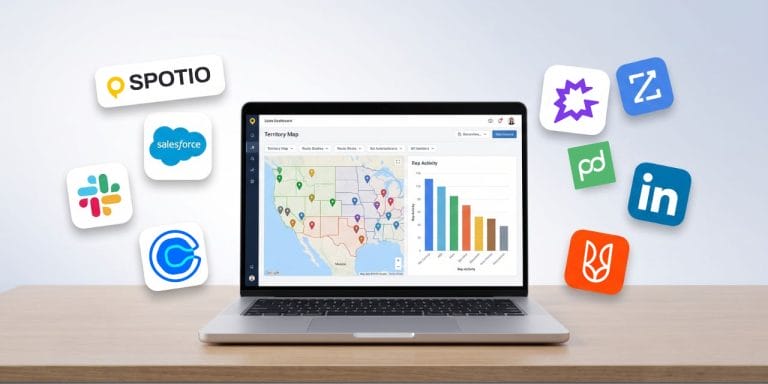
Territory mapping is where most distribution sales teams feel the pain first. When you’re managing a network of distributors across multiple regions, knowing which accounts belong to which rep — and whether reps are logging activities at those accounts — is critical. SPOTIO’s interactive territory maps let you visualize your entire account footprint through location-verified activities, identify white space, and assign coverage strategically.
Beyond mapping, SPOTIO helps distribution sales teams with:
- One-tap activity logging — reps log every visit, call, and follow-up in a single tap so nothing falls through the cracks
- AutoPlays — enroll distributor accounts in guided follow-up sequences that walk reps through next actions so no account goes cold
- Pipeline visibility — see deal stages and activity history across your entire distributor network based on logged rep activity
- Real-time, bi-directional CRM sync — seamlessly connect with Salesforce, HubSpot, and other platforms so field data flows back to your system of record
SPOTIO’s AI co-pilot, DASH, adds another layer of field readiness. Between stops, a rep asks DASH to pull up their last three interactions with a distributor account. DASH surfaces the visit notes, open tasks, and the last order date — in seconds. The rep walks in prepared, not scrambling.
If your team is managing distributor relationships from a spreadsheet or trying to hold territory accountability together with calendar reminders, there’s a better way. [Get a personalized demo of SPOTIO’s field sales platform →] and see how teams like Hadco use it to run leaner, more accountable distribution sales operations.
Frequently Asked Questions
Distributors primarily evaluate three things: margin potential, demand proof, and manufacturer support. They want to know they can make money on your product, that there’s a real market for it in their territory, and that you’ll support their reps with training, marketing materials, and a responsive point of contact. The manufacturers who get prioritized are the ones who make the distributor’s job easier, not harder.
The highest-converting first contacts are warm introductions — through a trade association, mutual supplier partner, or industry event. If you’re going cold, a direct call from a senior leader performs far better than cold email. Lead your outreach with a brief market insight specific to their territory, not a product pitch. Get the meeting first; save the pitch for when you’re in the room.
A wholesaler primarily buys products in bulk and resells them without adding significant services. A distributor typically adds more value — warehousing, rep training, marketing support, and active selling to end customers. In practice the terms are often used interchangeably, but distributors generally have a closer, more collaborative relationship with the manufacturers they represent.
Distributors make money on the margin between what they pay manufacturers and what they charge end customers. A distributor buying at $14 and selling at $22 earns a gross margin of roughly 36%. They also sometimes earn volume rebates, co-op marketing funds, and performance bonuses from manufacturers. Rep incentive programs (spiffs) can add meaningful income for individual distributor reps who prioritize specific product lines.
The most common reasons: insufficient rep training, margin that isn’t compelling compared to competing lines, or no active follow-up keeping your product top of mind. Audit your enablement first. Then look at your pricing. If both are solid, the problem may be distributor fit — and you may need a different partner in that territory.
The highest-leverage tactics are: run a spiff program to motivate distributor reps directly, provide updated co-branded sell sheets quarterly, schedule regular joint business reviews to track KPIs, and use field sales technology to give your team visibility into account coverage gaps. Distributors respond to manufacturers who treat the relationship as an ongoing partnership — not a contract that gets filed away.
Build Your Distribution Sales System
Selling to distributors isn’t a transaction — it’s a channel strategy that compounds over time. The manufacturers who win in distribution build systems: structured pitches, clear pricing, real enablement programs, and the field visibility to know what’s actually happening in each territory.
SPOTIO helps field sales teams manage distributor accounts the way great manufacturers do — with clear territory ownership, location-verified activity, and the data to make smarter decisions in the field. Teams like Hadco use it to run leaner, more accountable distribution sales operations. Get a personalized demo of SPOTIO’s field sales platform →

Scott Shapiro is President of SPOTIO and a seasoned sales and revenue leader with more than two decades of experience scaling high-performance sales organizations. Before joining SPOTIO as Chief Revenue Officer, he held CRO roles at PowerDMS and Igloo Software, and spent nearly 11 years at Paycor progressing from Area Sales VP to VP of Sales. A 9-time President's Club qualifier — recognized as the top sales executive or leader in his organization 6 of those years — Scott brings deep expertise in sales management, revenue operations, and go-to-market strategy. He holds an MBA from the University of Notre Dame and a B.S. from the University of Cincinnati.