
You’re standing on a porch, and the homeowner is already shaking their head before you finish your first sentence. They’ve been pitched by three other alarm reps this month. They “already have a system.” They “need to think about it.” Sound familiar?
Here’s what makes home security one of the toughest — and most rewarding — verticals in door-to-door sales: you’re asking someone to pay every month for protection against something that might never happen. That’s a fundamentally different sell than roofing, where they can see the damage, or telecom, where they’re already paying a competitor. The global home security market hit $75 billion in 2025 and is growing at nearly 10% annually. According to SafeHome.org’s 2026 report, 61% of U.S. households now have at least one security camera — which means most doors your reps knock already have some form of security. The question isn’t whether they have a system. It’s whether they have the right one.
This guide covers the specific techniques that top-performing alarm and security teams use to build trust at the door, handle the objections that kill deals, and build a repeatable canvass-to-close process. These aren’t generic sales tips — they’re field-tested strategies from teams installing 30,000+ systems a year.
Know Your Buyer Before You Knock
Build a Security-Specific ICP
Not every homeowner is an equal opportunity. The reps who close consistently aren’t knocking randomly — they’re targeting the homes most likely to buy.
High-probability prospects in security sales tend to share a few characteristics. Families with young children prioritize safety differently than empty nesters. Homeowners in neighborhoods that have experienced recent break-ins or package theft are primed for the conversation. New movers are replacing or upgrading systems they left behind. And homeowners without visible security signage — no yard signs, no doorbell cameras — are the most obvious untapped opportunity on any block.
Build your ICP around these signals:
- Homeowners (not renters) in single-family residences
- Families with children or elderly family members at home
- Neighborhoods with recent crime activity or construction (new builds lack systems)
- Homes without visible security signage, cameras, or smart doorbells
- Recent movers (public records and USPS change-of-address data)
Use Local Data to Target Territories
The most effective alarm reps don’t just canvass neighborhoods — they choose which neighborhoods to canvass based on data. Before your team hits a new area, research recent crime incidents using your local police department’s public crime map or a tool like CrimeMapping.com.
Being able to say, “There have been eight reported break-ins within a mile of your home in the last 90 days” is far more compelling than vague national crime statistics. It makes the conversation immediately relevant to this homeowner, on this street.
With SPOTIO’s territory management, managers can cut territories by zip code, county, or custom-drawn boundaries on a digital map and assign them to specific reps. Pair that with Lead Machine — which filters residential prospects using 15 criteria including homeownership status, home market value, dwelling type, and household income — and your team can prioritize the doors most likely to convert before they ever leave the office.
Pro Tip — Lead Machine Filters for Security Teams: The most useful Lead Machine criteria for alarm sales are Home Owner – Renter (only knock owner-occupied homes — renters rarely buy systems), Home Market Value (target mid-to-upper range homes where security investment makes sense), and Home Recent Buyer (new movers need a system for their new home and haven’t been pitched yet). Layer in Resident Age to target established families most likely to prioritize home security.
Craft a Security Sales Pitch That Builds Trust
The Conversational Opener
The biggest mistake alarm reps make is pitching before they’ve earned a conversation. Homeowners have been conditioned to shut down the moment they sense a sales script. Your opener needs to feel like a neighbor talking, not a telemarketer reading.
Here’s a framework that works — adapted from a real alarm sales opener:
“Hi, I’m Sarah with Guardian Home Security. I was just over at your neighbor’s house on Maple — the Johnsons — checking on the system we installed last month. They mentioned they’ve been really happy with the app alerts. I don’t know how you feel about home security, but with some of the break-ins that have been reported in this area recently, I wanted to stop by. What’s your current setup like?”
Why this works:
- Names you and your company immediately — builds credibility
- References a real neighbor — triggers social proof and trust (“if the Johnsons trust them…”)
- Mentions a specific benefit (app alerts) — plants a feature seed without pitching
- Cites local relevance (break-ins in this area) — creates urgency without fear tactics
- Ends with an open question — invites a conversation, not a yes/no shutdown
One important note: only reference a neighbor if you’ve actually spoken with them or installed their system. A fabricated name-drop that gets fact-checked (“I just talked to Linda and she’s never heard of you”) will destroy your credibility on the entire block.
The key insight from behavioral economics: Nobel Prize-winning Prospect Theory (Kahneman & Tversky, 1979) explains that people weigh potential losses more heavily than equivalent gains. You’re selling protection against a potential loss — which means the homeowner must believe the threat is real, the product works, and the cost is justified. Lead with education, not fear. Fear makes people defensive. Education makes people curious.
Run a 3-Minute Tablet Demo
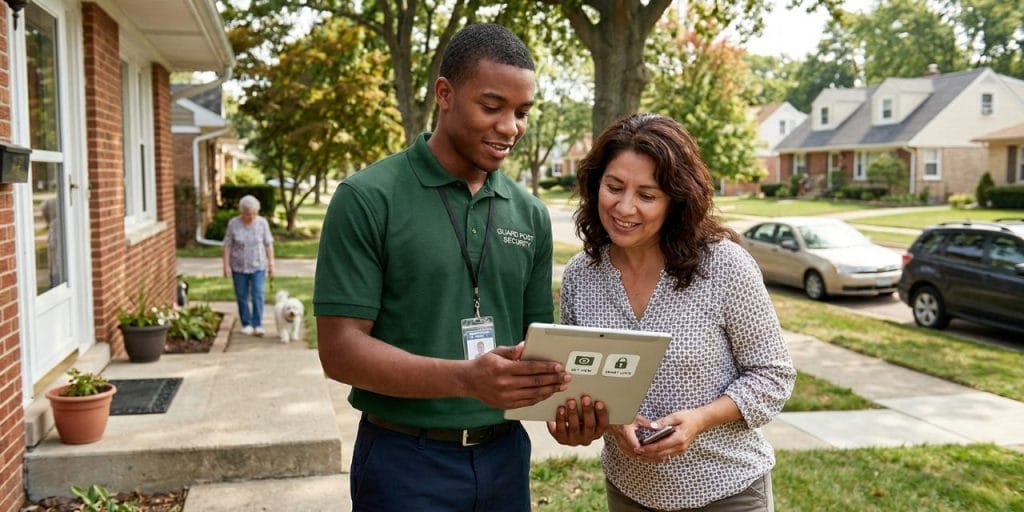
Once you’re in a conversation, the fastest way to move from interest to commitment is a live demo on your tablet. Keep it under three minutes. Attention drops fast at the door, so every second matters.
Show exactly four things:
- Motion detection alerts — how they’ll get a phone notification when someone approaches
- Doorbell camera footage — live view from their phone, anywhere
- Smart lock integration — lock/unlock remotely, set temporary codes for guests or contractors
- Professional monitoring response — what happens when the alarm triggers, and how fast
The demo isn’t about features — it’s about helping the homeowner picture themselves using it. “Imagine you’re at work and your kids get home from school. You get a notification, you see them walk in on your phone, and the system disarms automatically.” That’s the moment where “I need to think about it” starts turning into “How much is this?”
Use Social Proof on Every Block
After your first installation on a street, every subsequent knock becomes easier. Social proof is the most powerful tool in alarm sales, and most reps underuse it.
Whenever you close a deal, immediately re-canvass the surrounding homes. Your script shifts:
“Hey, I just installed a system for your neighbor at 412. He can check his cameras from his phone now. Since we’re already out here, I wanted to see if you’d be interested in a free security assessment.”
This works because people trust their neighbors’ buying decisions more than any brochure or website. The key: mention the neighbor by address (not name, unless you have permission), mention a specific feature they’re using, and offer something free to start the conversation.
How HomePro Uses SPOTIO for Security Sales: HomePro, a smart home technology and security company with 50–100 field reps in Texas, struggled with lead management visibility and missed follow-ups before SPOTIO. After implementing the platform, they streamlined canvasser-to-closer handoffs and gave leadership real-time visibility into field activity — across 30,000+ home installations per year.
Handle Home Security Objections
Most alarm deals don’t die because of price. They die because the rep didn’t have a ready response when the homeowner hesitated. Here are the four objections you’ll hear most — and how to handle each.
“I Already Have a System”
This isn’t a “no” — it’s an opportunity. Many homeowners are locked into outdated systems with high monthly fees, poor smart home integration, and slow monitoring response times.
Ask: “That’s great — how long have you had it? Are you happy with the monitoring response times? Does it connect to your phone?” Most homeowners with systems older than three years will reveal frustration with at least one of these. That’s your opening for an upgrade conversation.
Here’s a stat worth sharing with your team: DIY installation has now overtaken professional for the first time — 49% of alarm system owners installed their own setup, versus 42% who hired a pro. That means nearly half the “I already have a system” doors have a self-installed setup. And if you spot a Ring doorbell or Nest camera on the front porch, don’t skip that door — DIY systems often cover the front entry and nothing else. The back slider, the garage, the side gate? Wide open. That’s your upgrade pitch.
“It’s Too Expensive”
Reframe the cost. A $30–50/month monitoring fee breaks down to about $1–1.65/day — less than a cup of coffee to protect their home, their family, and their belongings. Many insurance companies offer 5–20% homeowner’s premium discounts for monitored security systems, which can offset a significant portion of the monthly cost.
Don’t argue price. Anchor value: “Most of our customers tell us the insurance discount alone covers about half the monthly cost. The rest is the peace of mind.”
“I Need to Think About It”
This usually means you haven’t built enough urgency or removed enough risk. Two tactics work here:
Offer a free security assessment. Walk the perimeter with them, identify vulnerabilities (unlocked side gates, no motion lighting, visible entry points from the street). This gives them something tangible to “think about” — and positions you as an expert, not a salesman. It also triggers reciprocity: you just did something valuable for free, and they feel compelled to reciprocate.
Leave behind and follow up. If they genuinely need time, leave a one-page info sheet with your direct number and a specific callback window: “I’ll check back Thursday afternoon. If you have questions before then, here’s my cell.” Then actually follow up Thursday. Most reps don’t — and the homeowner forgets.
“I Don’t Feel Unsafe Here”
This is where local data shines. “I totally understand — this seems like a safe neighborhood. But I checked the crime map before coming out here, and there have been [X] property crimes reported within a mile in the last 90 days. Most of them were package thefts and garage break-ins, not anything violent — but those are exactly what a system like this catches.”
You’re not creating fear. You’re correcting the perception gap between feeling safe and being informed. That’s an important distinction in how you frame it.
Build a Repeatable Sales Process
Set Activity Benchmarks
Top-performing security teams don’t leave daily output to chance. Set clear daily minimums for your team and track them:
Sample Benchmarks — Adjust for Your Market
| Activity | Target | Why It Matters |
|---|---|---|
| Doors knocked | 40–60/day | Volume drives pipeline. Period. |
| Conversations (contact rate) | 25–35% of knocks | If contact rate drops below 20%, adjust your timing. |
| Demos given | 5–8/day | If you’re having conversations but not demoing, your opener is working but your transition isn’t. |
| Appointments set | 2–4/day | Closers need a full calendar. Track this daily, not weekly. |
Use SPOTIO’s one-tap activity logging with location-verified check-ins to log knocks, conversation outcomes, and appointments in seconds — no typing in the car required. The data feeds directly into your coaching conversations: “You knocked 55 doors yesterday but only demoed twice. Let’s work on your transition from opener to demo.”
Streamline the Canvasser-to-Closer Handoff
If your team runs a canvasser/closer model, the handoff is where deals go to die. A canvasser has a great conversation, books an appointment, and scribbles a few notes. By the time the closer shows up two days later, the context is gone. The homeowner has to re-explain their concerns, the closer starts from scratch, and the deal cools off.
SPOTIO solves this by storing every detail at the pin level — the canvasser’s notes, the homeowner’s concerns, their current system (if any), the appointment time, and any photos of the property. When the closer pulls up the pin, they walk into the appointment fully briefed. No context lost, no re-introductions, no dead air. With DASH Go, canvassers can talk to SPOTIO between stops to dictate follow-up notes and queue next-step reminders, then confirm with a quick tap. No pulling over to type — notes are captured and attached to the lead’s pin before you reach the next door.
Follow Up Before They Forget
Homeowners who are interested today will forget by Friday. The most effective follow-up cadence for security sales:
- Same day: Quick text — “Great meeting you today, [name]. Here’s my direct number if any questions come up about what we discussed.”
- Next day: Brief call — “Just following up from yesterday. Did you have a chance to talk it over with [spouse/partner]?”
- Day 3: Email or text with a specific value-add — a link to a short video demo, a local crime stat, or the insurance discount details.
- Day 7: If no response, one final check-in. After that, mark the lead for re-canvass next quarter.
Set up these touchpoints as a SPOTIO AutoPlay sequence. AutoPlays are enrollment-based — you manually enroll each lead, and SPOTIO guides reps through each step with reminders. This keeps the follow-up personal while making sure nothing falls through the cracks.
Frequently Asked Questions
The best alarm pitch is a conversation, not a script. Open by introducing yourself and your company, reference a nearby customer or recent installation for social proof, and ask an open-ended question about the homeowner’s current security setup. Focus on education over selling — explain what a modern system does (phone alerts, remote camera access, smart locks) and let the homeowner’s curiosity drive the conversation toward a demo.
Ask about their satisfaction. Most homeowners with systems older than three years are paying too much, don’t have smart home integration, and can’t access their cameras from their phone. Ask about monitoring response times, monthly cost, and app features. Position your offering as a technology upgrade, not a replacement — many customers are stuck in legacy contracts and welcome a modern alternative.
The top four objections are “I already have a system,” “it’s too expensive,” “I need to think about it,” and “I don’t feel unsafe here.” Each requires a different response — but they all share one root cause: the homeowner doesn’t yet see enough value to act. Address each with specific evidence (local crime data, insurance discounts, neighbor references) rather than pressure.
Compensation varies by company, but most D2D security reps earn a base salary plus per-installation commission. Top performers in high-volume markets can earn well into six figures. Commission structures typically pay per installed system, with bonuses for monitoring contract length and add-on equipment. Companies that offer a draw against commission help new reps survive ramp-up.
Most security teams find that late afternoon and early evening (4:00–7:00 PM) produce the highest contact rates, since homeowners are arriving home from work. Saturday mornings (10:00 AM–1:00 PM) are also productive. Avoid Monday mornings and Friday evenings. In summer, extended daylight lets you push knocking later — but always respect local solicitation ordinances and time restrictions.
The most effective lead sources for alarm sales are door-to-door canvassing (still the highest-converting channel), referrals from recent installations, and data-driven prospecting using local crime maps and homeowner data. SPOTIO’s Lead Machine helps identify homeowner-occupied residences in target areas using 15 criteria. Combine this with re-canvassing neighborhoods where you’ve already installed systems to leverage social proof.
Yes — the home security market is projected to exceed $170 billion by 2034, growing at nearly 10% annually. Demand for smart home security (app-based monitoring, video doorbells, smart locks) is accelerating as more homeowners upgrade from legacy systems. For D2D reps, security sales offers high earning potential, year-round selling seasons (unlike roofing or solar), and strong repeat business from referrals and system upgrades. Read our door-to-door sales guide for more on building a career in field sales.
Close More Alarm Deals With SPOTIO
Selling home security door to door rewards the reps and managers who combine trust-building at the door with a disciplined, data-driven process behind it. The techniques in this guide — hyper-local targeting, conversational pitching, objection handling, and systematic follow-up — are what separate teams that install thousands of systems from those that struggle to fill a closer’s calendar.
SPOTIO is built for exactly this workflow. HomePro, a security and smart home company with 50–100 field reps, uses SPOTIO to manage lead flow, track field activity, and give closers full context on every handoff. Request a free demo to see how SPOTIO works for alarm and security teams.