
Disclosure: SPOTIO is our product and appears first on this list. We’ve applied the same evaluation criteria — G2 ratings, feature depth, and field sales use case fit — to every tool, including our own.
Most AI sales tool guides are written for SDRs sitting at desks with dual monitors and stable Wi-Fi. This one isn’t.
Field reps work differently. They pitch on doorsteps in the rain, drive between appointments in dead zones, and log notes from parking lots between stops. The AI tools that transform desk-based teams often fail in the field — not because the technology is bad, but because it was never built for the rep on the move.
According to SPOTIO’s State of Field Sales survey, one in three field sales teams isn’t using AI at all. Among those that are, adoption is concentrated at the surface level: email personalization, call recording, and basic CRM data entry. The higher-value capabilities — lead scoring, predictive forecasting, behavior analysis — are being used by fewer than 20% of teams. That gap is a competitive opening for managers willing to move deliberately.
This guide covers the 10 best AI sales tools for field teams in 2026. For each one, we cover what it actually does in field conditions, what reps experience day-to-day, and where it fits in a field sales stack. We’re not here to dump feature lists — we’re here to give you enough context to make a smart buying decision. Jump to the tools list →
How Field Sales Teams Are Using AI Today
Before choosing tools, it helps to understand where the industry actually is — not where vendors claim it is.
SPOTIO’s State of Field Sales survey asked field sales professionals to select all the ways AI is impacting their day-to-day work. Here’s what they said:
| AI Use Case | % of Teams |
|---|---|
| Not using AI in sales at all | 33% |
| Automated email/message personalization | 30% |
| Conversation intelligence and call analysis | 28% |
| Content generation for proposals/presentations | 26% |
| Automated CRM data entry | 24% |
| Predictive analytics for deal forecasting | 20% |
| Customer behavior analysis | 20% |
| Lead scoring and prioritization | 18% |
| Planning to implement AI within 6 months | 10% |
For context: Salesforce’s 2026 State of Sales report found that 87% of sales organizations broadly use some form of AI. The gap is specific to field teams — reps working from trucks, doorsteps, and parking lots don’t have the same access to AI-powered workflows that desk-based SDRs take for granted.
A few things stand out.
One in three teams hasn’t adopted a single AI tool. That’s a meaningful performance gap — and it compounds over time as AI-enabled competitors get faster, smarter, and more efficient.
Most adoption is clustered at the easy end. Email personalization and call recording are the most common entry points — lightweight tools that don’t require deep CRM integration or major process change. The strategic tools — scoring, forecasting, behavior analysis — are where fewer teams have gone.
A meaningful segment is ready to move. About 10% of teams plan to implement AI within six months. The obstacle usually isn’t awareness — it’s knowing which tools to buy and how to roll them out without disrupting what’s already working. If your team is experimenting with ChatGPT or Claude but getting generic results, our AI sales prompt library has 30+ structured prompts built specifically for field sales workflows.
To learn more, read our in-depth article on AI adoption in field sales.
Not sure where your team falls on the AI maturity curve? Download the State of B2B Field Sales or State of B2C Field Sales report to see how teams at your stage are building their AI stack — and what’s separating top performers from everyone else.
What Makes an AI Tool Actually Work in the Field
Not every AI tool survives contact with field conditions. Here’s the framework we used to evaluate each tool in this guide.
Rep-side criteria
Latency: A voice note that takes five seconds to process, or a map that lags before showing nearby leads, will get abandoned. Speed matters more in the field than in any other sales environment.
Offline reliability: Field reps work in basements, rural areas, and buildings with poor signal. A good field AI tool captures data locally when connectivity drops and syncs cleanly when it returns — without overwriting back-office updates or creating duplicate records.
Mobile UX: Thumb-friendly workflows, minimal typing, and readability in direct sunlight are table stakes. If the AI feature requires a laptop or a multi-step menu, it won’t get used.
Battery load: AI-heavy apps drain batteries fast. If reps are running 8-hour days and the app kills their phone by 2pm, you have an adoption problem before you even start.
Manager and RevOps criteria
Configurability: Can you build custom scoring models, playbooks, and routing rules? Or is the tool a black box?
Reporting and attribution: Can you tie AI-driven activity back to pipeline and revenue? If not, you can’t prove ROI or improve the model.
CRM integration depth: “Connects with your CRM” means different things to different tools. What you want is two-way sync, field-level mapping, and data that stays current — not a nightly export.
How we selected and reviewed these tools
We evaluated tools against five criteria: field sales relevance (does it solve a problem specific to outside reps?), AI depth (is AI core to the product or a surface feature?), G2 rating with a minimum of 25 verified reviews, CRM integration quality, and pricing transparency. Tools are grouped by function — field execution, enrichment/research, conversation intelligence, and CRM/sequencing — to reflect how field teams actually build stacks. SPOTIO is our own product and is evaluated against the same criteria as every other tool on this list.
The 10 Best AI Sales Tools for Field Teams
| Tool | Primary job | Best for | Field fit |
|---|---|---|---|
| SPOTIO | Field sales execution platform with AI co-pilot and predictive next-best-action | Teams of 5+ needing territory, routing, and an AI co-pilot for field workflows | High — built for map-based territory work, offline sync, and mobile-first rep workflows |
| Leadbeam | Voice/image CRM capture | Teams whose primary pain is CRM data entry and field activity logging | High — purpose-built for field capture; lighter on territory management |
| Badger Maps | Route optimization | Small teams (1–4 reps) needing routing on top of an existing CRM | Medium — strong routing; limited offline, no territory hierarchy |
| Clay | Data enrichment and list building | RevOps teams building targeted prospect lists for territories | Limited — lives upstream; reps see output, not the tool |
| Apollo.io | B2B prospecting and contact data | B2B teams doing pre-call research before in-person visits | Medium — most value upstream of the field visit |
| 6sense | Predictive account intent | Enterprise B2B teams with RevOps capacity and defined account lists | Limited — requires significant implementation; not a rep tool |
| Gong | Conversation intelligence | Hybrid teams running discovery and negotiations over phone or video | Medium — less relevant for short D2D pitches |
| Otter.ai | Lightweight recording and transcription | B2C residential teams needing affordable pitch review | High for D2D — fast, simple, fits high-volume short interactions |
| Salesforce Einstein / HubSpot AI | CRM-embedded forecasting and scoring | Teams already on Salesforce or HubSpot wanting more from existing stack | Medium — back-office layer; pairs with a field-first tool |
| Outreach / Salesloft | AI-assisted sequencing and prioritization | Orgs with SDR teams booking meetings for field reps | Limited for D2D — built for desk-based outbound motions |
Category 1: Field-First AI Platforms
These tools live closest to where reps do their actual work — in the car, on the doorstep, and in the CRM.
1. SPOTIO — Field Execution Platform with AI Co-Pilot
G2 Rating: 4.5/5 (380+ reviews)
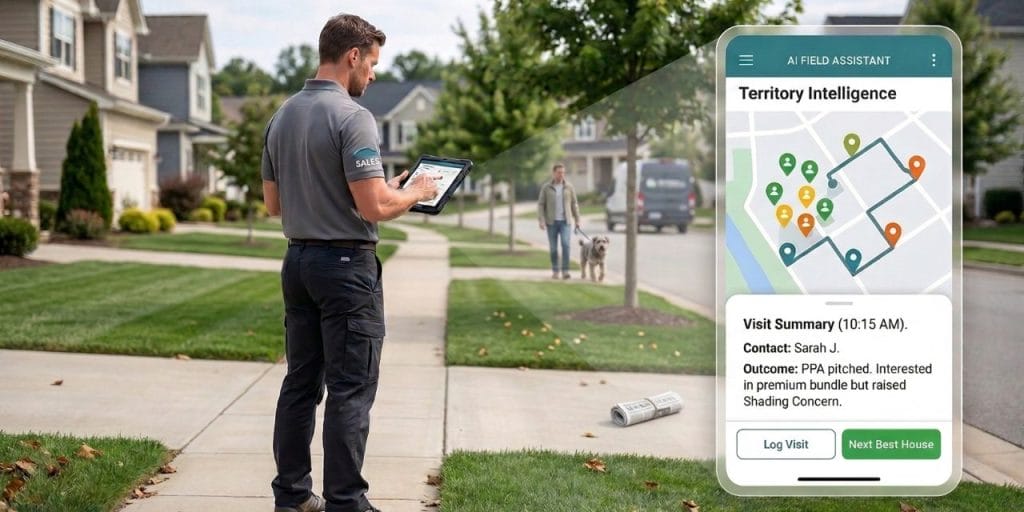
SPOTIO is a field sales execution platform — territory management, route planning, lead management, activity tracking, and pipeline visibility in a single mobile-first system. DASH is the built-in AI co-pilot, designed specifically for reps who work from maps, drive between stops, and need to log visits without sitting down at a desk.
Key Capabilities:
- DASH IQ: Delivers 10-second record briefs before each visit and surfaces visit history and suggested next steps — so no rep walks in blind. With Advanced AI enabled, DASH also answers company and product questions from your uploaded knowledge base.
- DASH Actions: Lets reps create and update records, schedule follow-ups, and complete multi-step workflows through chat or voice — with a confirmation preview before anything writes to SPOTIO. Snap a photo of a business card and DASH extracts the name, number, and address into a structured record — review the preview and confirm with one tap. Need a follow-up email? DASH drafts one using visit history and SPOTIO data — the rep reviews, edits, and sends.
- DASH Go: Reps talk to DASH between stops to hear account summaries and dictate visit notes, then confirm with a tap. Keeps eyes on the road, not on a screen.
- DASH Connect: Links DASH to the LLM of your choice — Claude, ChatGPT, or others — and to your CRM through SPOTIO’s existing integrations.
- NBA (Next Best Action): Assigns every record a predictive Value Score and a recommended next best action — Visit, Call, Text, or Email — based on your organization’s own SPOTIO data. Combines machine learning trained on activity patterns, pipeline movement, and historical outcomes with LLM-level reasoning. It’s purpose-built intelligence trained on your team’s own data and results — not a generic AI layer. Reps see the score and recommendation; they decide what to do.
What reps actually experience: A rep arrives at a prospect and asks DASH for a 10-second brief — visit history, last conversation summary, suggested next steps. After the pitch, they tell DASH what happened through voice, chat, or a photo. DASH parses the update, shows a confirmation screen, and writes it to SPOTIO once the rep approves. If a cancellation opens up 45 minutes, NBA surfaces which nearby leads have the highest Value Scores and what action to take — no guessing, no paper lists, no end-of-day data entry marathon.
Manager edge: SPOTIO gives managers a ground-level view of what’s actually happening in the field — rep activity, territory coverage, pipeline health, and team performance all in one place. Location-verified activities, leaderboards, and coaching dashboards replace end-of-week guesswork with data that reflects what reps did that day. Works with the tools you already use. See integration details →
💡 Wire 3, a Central Florida fiber-to-home field sales team, saw a 309% increase in visits, a 21% lift in calls, and their revisit rate climb from 69% to 76% after implementing SPOTIO. See the full case study.
Pricing: Scales by team size and feature tier. See plans or book a working session with a field sales specialist.
Best for: Door-to-door teams, outside B2B reps with defined territories, and field sales orgs running a hybrid B2B/B2C motion with 5 or more reps. If your team needs AI that fits into a proven execution workflow rather than replacing it, SPOTIO is built for that. See how territory management works in SPOTIO →
✅ What we like: Territory management depth that no point solution matches; offline functionality through Download My Day for up to 24 hours; DASH co-pilot built into the platform rather than bolted on — every action stays human-approved.
⚠️ Watch out for: Built for teams of 5 or more — if you’re running a solo operation or a 2–3 rep team, the platform depth will outpace your needs and a simpler tool will serve you better.
“We’ve been using SPOTIO for nearly 8 years to power our nationwide brand ambassador campaigns — and they’ve been nothing short of essential. With every update, SPOTIO gets smarter, faster, and more impactful. I’ve tested other platforms, done the research, and nothing compares. SPOTIO stands out. Every. Single. Time. They actually listen to customer feedback and put it into action and that’s a big deal.” — PowerDirect, 5-Star Google Review, June 2025
2. Leadbeam — AI Field Sales Platform
G2 Rating: 4.8/5 (70+ reviews)
Leadbeam is a field sales app built around a single core problem: field reps don’t log their CRM data, and managers can’t see what’s happening in the field. The product centers on voice and image capture to reduce post-visit admin time.
Key Capabilities:
- Pulse (Voice/Image Capture): Reps drop a voice note or photo after a visit and Leadbeam automatically extracts key details and populates CRM fields. No typing required.
- Atlas (AI Lead Discovery): Surfaces high-potential leads in the rep’s territory based on firmographic signals and account scoring. Signal definitions and model methodology are not publicly documented.
- Beamly (Meeting Prep): Auto-enriches leads with firmographics and account history before each visit, summarized into a quick brief.
- Compass (Smart Routing): Plans multi-stop routes based on account priority, deal stage, and geography, hands off to Google Maps, Waze or Apple maps for real-time traffic.
- Studio (Manager Dashboard): Real-time visibility into rep activity, conversion rates, and territory performance for coaching and forecasting.
What reps actually experience: The workflow centers on voice and image capture — reps narrate what happened, and the AI handles the CRM update. Meeting prep cards are useful for reps who walk into cold visits. For teams whose biggest pain is simply getting field activity into Salesforce or HubSpot, the voice-to-CRM workflow removes friction.
Manager edge: Studio gives managers territory health scores, rep activity views, and AI-surfaced alerts for coaching.. Leadbeam integrates with Salesforce, HubSpot, Pipedrive, Zoho, and Dynamics 365.
Pricing: Starting at $49/user/month (billed annually).
Best for: SMB field sales teams whose primary pain is CRM adoption and field activity capture — particularly B2B teams that don’t need complex territory hierarchy or multi-channel follow-up sequences.
✅ What we like: Voice-to-CRM workflow is fast and polished
⚠️ Watch out for: Newer entrant with a smaller customer base; G2 rating based on fewer than 80 reviews; territory management lacks documented hierarchy, import, or governance controls for multi-level field orgs; B2C and D2D capabilities not documented; named case studies with verified outcome metrics not published.
FieldSalesTools.com independently reviewed both platforms and selected SPOTIO as the stronger choice for field sales teams.
“Being able to add all my notes in one place and have them uploaded to Salesforce is amazing! It makes the admin work and end-of-day wrap-up so much easier. Instead of double-entering information, I can stay focused on meaningful follow-up and the action items that matter.” — Verified G2 review, April 2026.
Teams evaluating whether Leadbeam is the right fit — or looking at the broader landscape — can see our comparison of the best Leadbeam alternatives.
3. Badger Maps — Route Optimization for Small Teams
G2 Rating: 4.7/5 (320+ reviews)
Badger Maps is a route optimization specialist. Under the hood it runs a Vehicle Routing Problem (VRP) solver — the same class of algorithm used in logistics — rather than simply plotting stops in order. Given a set of leads, time windows, and priorities, it calculates the most efficient visit sequence and hands off to Google Maps or Waze for navigation.
Key Capabilities:
- Route optimization: Calculates the most efficient multi-stop sequence based on lead priority, geography, and appointment times.
- Lasso tool: Reps draw a circle around their current location to find nearby qualifying leads and fill cancelled time slots — up to 120 stops factored in at once.
- CRM integration: Syncs with Salesforce, HubSpot, and others (note: CRM integration requires a higher-tier plan).
- Mileage reporting: Tracks visit density and route distances for territory planning.
What reps actually experience: The Lasso feature is useful — when an appointment cancels mid-morning, a rep circles their location, filters nearby qualifying leads, and fills the slot within minutes. Battery drain is a practical consideration; Badger’s GPS processing is hardware-intensive, and reps on full-day routes typically need a car charger. There is no offline functionality, which means a signal dead zone can disrupt the route mid-day.
Pricing: Business plans start from $58/user/month (billed annually).
Best for: Individual reps or very small teams (1–4 reps) who need route optimization as a standalone capability and are satisfied with their existing CRM. Teams that need territory management, pipeline visibility, and rep accountability in a single platform — especially at 5+ reps — will outgrow Badger quickly.
✅ What we like: Lasso tool for filling cancelled slots is a useful field workflow; VRP-based routing is more sophisticated than basic stop-ordering.
⚠️ Watch out for: No offline mode; battery drain on full-day routes; CRM integration requires a higher-tier plan commitment.
“The route planning is phenomenal, saving me so much time by optimizing my routes so I don’t waste time driving all over. Within seconds I can create a route, which is super helpful.” — Michael P., verified G2 review, April 2026
Category 2: Intelligence & Pre-Visit Research
Only 18% of field teams are currently using AI for lead scoring and prioritization — the capability with the clearest ROI that most teams haven’t activated yet. These tools help close that gap by giving reps better information before they ever make contact.
For a deeper look at data enrichment and intelligence tools, see our sales intelligence tools guide.
4. Clay — Data Orchestration for RevOps
G2 Rating: 4.7/5 (220+ reviews)
Clay is a data orchestrator — a platform that connects dozens of data sources and automates the enrichment and segmentation work that would otherwise require multiple subscriptions and hours of manual research.
A field sales RevOps team might use Clay to pull a local permit database, identify homeowners who just pulled a roofing or HVAC permit, match them to contact records, verify the data through a waterfall of providers, and write a custom opening line based on the permit type. That entire process — which used to take an analyst a full day — runs automatically.
A roofing team using SPOTIO, for example, might import a Clay-enriched list of homeowners who pulled storm damage permits directly into SPOTIO, with territory pins and “reasons to knock” pre-populated before the week starts.
Pricing: Usage-based; free tier available. Paid plans scale by credits and data provider access.
Best for: RevOps teams supporting field sales orgs that run high-volume residential or SMB prospecting campaigns. Clay requires RevOps-level setup — reps don’t interact with it directly. They see the output: a lead list already enriched and prioritized.
✅ What we like: Waterfall enrichment logic is particularly powerful for field sales teams working with incomplete residential or SMB data.
⚠️ Watch out for: Meaningful setup investment required; not suitable without a dedicated RevOps function; learning curve is real.
“It helps solve the challenge of collecting and enriching prospects data from multiple sources in a structured way. Instead of manually researching contacts, companies, and additional attributes across different tools, clay brings that information together in one place and automate the enrichment process.” Riya A., Verified G2 Review (March 2026)
5. Apollo.io — B2B Prospecting & Contact Data
G2 Rating: 4.7/5 (9,600+ reviews)
Apollo pairs a large B2B contact database with sequencing and AI-assisted messaging, so field reps can walk into a territory with pre-built lists of the right titles at the right companies. It’s especially useful for mapping accounts inside a ZIP or metro, enriching them with direct dials and firmographics, and pushing those targets into your field workflows.
Pricing: Free tier available; paid plans from $49/user/month (annually). Note: Apollo uses a credit-based model — costs can increase significantly for teams making high volumes of phone lookups. Verify at apollo.io/pricing.
Best for: B2B field teams that rely on pre-call research and outbound sequences to support in-person meetings. Significantly less critical for pure D2D B2C motions where contact data comes from territory maps rather than outbound prospecting.
✅ What we like: Large verified B2B contact database; AI email personalization for hybrid motions where SDRs warm accounts before field visits.
⚠️ Watch out for: Credit-based pricing means real costs often exceed the advertised rate for active prospecting teams; most value is upstream of the field visit itself.
“What stands out most to me is the all-in-one approach: I can find leads, enrich contact data, run email sequences, and track the pipeline without having to jump between different tools. The per-user pricing model also feels transparent, and it seems to scale well for small teams. Overall, it’s easily the best value in B2B prospecting right now.” Praveen K., Verified G2 Review, May 2026.
For a step-by-step walkthrough of how field teams apply AI specifically to prospecting — from territory-based discovery through predictive prioritization — see our guide to AI for sales prospecting.
6. 6sense — Predictive Intent for Enterprise Teams
G2 Rating: 4.3/5 (1430+ reviews)
6sense identifies the “dark funnel” — the research activity that happens before a prospect ever fills out a form. It tracks which businesses in your territory are actively searching for your category of solution, how long they’ve been in market, and where they are in their buying journey. For a field team covering 500 target accounts, 6sense can answer: “Which 30 should we prioritize this week because they’re evaluating right now?”
The power comes with meaningful implementation complexity. Mapping intent signals to territory assignments and rep workflows requires a RevOps team comfortable with data modeling. If that foundation isn’t built correctly, the signals become noise, and reps lose trust in the prioritization.
Pricing: Custom — contact 6sense for a quote.
Best for: Enterprise or mid-market B2B field teams with defined account lists, a capable RevOps function, and clean CRM hygiene. If your RevOps team doesn’t have the bandwidth, start with Clay or Apollo and build toward 6sense.
✅ What we like: Unmatched for surfacing which accounts are “in market” before competitors even know to call.
⚠️ Watch out for: Significant implementation investment; overkill for teams under 25–30 reps; custom pricing makes TCO hard to evaluate without a full demo cycle.
“6sense Revenue Marketing lights up the dark funnel, helping us connect with buyers at the right time. It uses predictive analytics to determine buying stages and provides profile fits, technographic, and firmographic details to target accounts effectively.” Verified G2 Review, April 2026
Category 3: Conversation Intelligence
Conversation intelligence is one of the fastest-growing AI categories in our survey — 28% of field teams are already using it. For managers, it’s one of the clearest demonstrations of AI ROI: you stop coaching on anecdotes and start coaching on what actually happened.
7. Gong — Full-Funnel Conversation Intelligence
G2 Rating: 4.7/5 (6,650+ reviews)
Gong records and analyzes sales calls, meetings, and emails, then surfaces what’s actually happening in your deals — who joined, what was discussed, which objections came up, whether next steps are defined. Instead of relying on rep notes, managers get a single view of interactions and deal health signals across the pipeline.
What reps experience: No detailed note-taking during calls — Gong captures the conversation, summarizes key points, and can push action items back into the CRM. Reps jumping between in-person visits and remote meetings can review what was said and what they committed to without digging through notes.
Manager edge: Deal board and dashboards highlight at-risk opportunities, common objections, and gaps in multi-threading — so coaching conversations are grounded in real interactions rather than anecdotes.
Pricing: Custom pricing — most teams report starting costs in the $100–$150+/user/month range based on third-party estimates. Contact Gong for a current quote.
Best for: Hybrid teams where field reps also run key conversations over phone or video. Less critical for pure door-to-door B2C motions where most interactions are short pitches that don’t warrant full recording.
✅ What we like: Pattern recognition across calls is genuinely powerful for enablement and onboarding; deal health scoring improves forecast accuracy for distributed field teams.
⚠️ Watch out for: Pricing is hard to justify for teams where most conversations happen at the door rather than on Zoom; not designed for in-person recording.
“What I like best about Gong is how it gives clear visibility into customer conversations and turns them into actionable insights. It helps teams improve coaching, identify deal risks early, and understand what top performers are doing differently.” Verified G2 Review, May 2026.
8. Otter.ai — Lightweight Recording for D2D Teams
G2 Rating: 4.4/5 (490+ reviews)
Otter.ai is faster and more affordable than Gong, but it trades sales-specific intelligence for simplicity. It transcribes conversations accurately and quickly — it doesn’t understand MEDDIC or objection patterns, but for high-volume D2D teams, it doesn’t need to.
The workflow many D2D teams use: reps record the first 30–60 seconds of each pitch, managers review a batch at week’s end to evaluate whether the opening hook is working, and coaching focuses on that narrow but high-leverage piece of the interaction.
Pricing: Starting around $10–$17/user/month. Verify current pricing at otter.ai/pricing.
Best for: B2C residential teams running high-volume, short-duration interactions where full Gong capabilities are overkill. Budget-conscious teams beginning conversation intelligence without enterprise pricing.
✅ What we like: Fast, affordable, works outdoors; perfect for doorstep pitch review where you don’t need deal stage analytics.
⚠️ Watch out for: No sales-specific intelligence — it’s a transcription tool, not a coaching platform. Won’t identify objection patterns or score rep performance against a playbook.
“I use Otter.ai as my virtual assistant in meetings. It records conversations and provides summaries, action items, and answers to questions. This prevents forgetting details and helps me focus more on participation, making post-meeting tasks more manageable.” Verified G2 review, April 2026
Category 4: CRM AI & Sequencing
These tools tackle the back end of field sales AI: CRM automation, forecasting, and lead prioritization — areas most field teams haven’t fully activated yet.
9. Salesforce Einstein / HubSpot AI — CRM-Embedded Intelligence
G2 Ratings: Salesforce Sales Cloud 4.4/5 | HubSpot Sales Hub 4.4/5
If your team is already on Salesforce or HubSpot, both platforms have embedded AI features worth using — particularly for pipeline forecasting, deal scoring, and activity recommendations. Salesforce Einstein surfaces predictive lead scores and opportunity health indicators; HubSpot’s AI assistant helps with email personalization, pipeline reporting, and contact enrichment at the CRM level.
The key limitation for field teams: neither platform is built for territory-level, geospatial field workflows. They work best as a back-office intelligence layer supporting a field-first system like SPOTIO, rather than as the primary tool reps use in the field.
Pricing: Included in higher-tier Salesforce and HubSpot plans; contact each vendor for current pricing.
Best for: Teams already deeply embedded in Salesforce or HubSpot who want to extract more value from their existing stack without adding a new platform.
✅ What we like: No additional vendor or contract — the AI improves a tool reps are already using.
⚠️ Watch out for: Einstein and HubSpot AI often require plan upgrades; neither replaces field-specific UX for reps who spend their day away from a desk.
10. Outreach / Salesloft — AI-Assisted Sequencing
G2 Ratings: Outreach 4.3/5 | Salesloft 4.5/5
Outreach and Salesloft — both leading sales engagement platforms — have layered AI onto their sequencing engines — signal-based prioritization, AI-generated email variants, and meeting intelligence. In practice, they’re best at orchestrating high-volume outbound and surfacing the accounts showing engagement so someone can act.
For field reps, these tools usually live one step upstream: SDRs or inside reps run the sequences, book meetings, and hand off the most engaged accounts for in-person visits. A field rep in this model feels the impact as a steadier stream of warm appointments — not as a tool they open during the day.
Pricing: Custom enterprise pricing — contact each vendor for a quote.
Best for: Teams with a real SDR or inside sales engine that books meetings for field reps. Overkill for small, pure door-to-door teams not running high-volume outbound sequences.
✅ What we like: AI prioritization (“work these accounts now — they just re-engaged”) genuinely improves pipeline conversion for hybrid field motions.
⚠️ Watch out for: Designed for desk-based outbound; field reps won’t interact with these tools directly; custom enterprise pricing.
Honorable Mentions
A few tools didn’t make the main list but earn a spot in the right field sales stack:
- Rilla — In-Person Conversation Intelligence: Records and analyzes face-to-face conversations in homes and on job sites — giving managers virtual ride-alongs without needing to be in the truck. The highest-fidelity coaching tool for D2D and home services teams. SPOTIO integrates natively with Rilla via webhook: use SPOTIO for territory, routing, and CRM; use Rilla for in-person conversation coaching. See the SPOTIO + Rilla integration →. G2: 4.8/5.
- LinkedIn Sales Navigator — B2B Decision-Maker Research: Helps reps find and research B2B decision-makers before visits using advanced filters, relationship insights, and AI-powered recommendations.
- ZoomInfo — Deep B2B Data and Intent: Detailed company and contact data plus buyer intent signals for sharpening territory planning and account selection.
- Seismic — AI-Powered Content Enablement: Ensures reps have the right collateral for each meeting, with AI recommending content based on industry, persona, and deal stage.
- Lavender — Email Coaching: Scores and optimizes outbound and follow-up emails so reps booking their own appointments send stronger, more relevant messages in less time.
How to Build Your Field Sales AI Stack
Not every team needs every tool here. Start with your current AI maturity and build from there.
Starter stack — early AI adoption
Best for the one in three teams not yet using AI, or using only one or two point tools.
- SPOTIO — field execution, territory, routing, one-tap activity capture
- Otter.ai — conversation recording for pitch coaching
- Apollo.io — contact data for B2B territories
Goal: eliminate manual data entry, improve territory coverage, begin systematic pitch review.
Scaling stack — growing AI maturity
Best for teams that have nailed the basics and are ready to add intelligence.
- SPOTIO — core platform
- Gong — full conversation intelligence and coaching
- Clay — data enrichment and pre-knock research
- CRM-embedded AI — Salesforce Einstein or HubSpot AI for forecasting
Goal: better pre-visit targeting, systematic coaching infrastructure, improved pipeline accuracy.
Advanced stack — AI-mature, RevOps-capable
Best for enterprise or fast-scaling teams with dedicated RevOps capacity.
- SPOTIO — core platform
- 6sense — predictive intent and territory prioritization
- Gong — conversation intelligence
- Clay — data orchestration
- Outreach or Salesloft — AI-assisted sequencing for hybrid motions
Goal: surface highest-priority accounts before competitors, unify RevOps and field data, drive systematic improvement through coaching and forecasting intelligence.
The Field AI Implementation Checklist
Before signing any contract, run each tool through this checklist.
Latency
- What happens when the rep is on 4G LTE, not office Wi-Fi?
- Does voice processing complete within a few seconds in a normal field environment?
Offline reliability
- What happens when the rep loses signal mid-visit?
- Does the tool timestamp locally and resolve conflicts on sync, or does it lose data?
Mobile UX
- Can a rep log a visit, view a lead, and update a status in under 30 seconds on a phone?
- Is the interface readable in sunlight? Can it be operated with one thumb?
Data hygiene
- What are the deduplication rules?
- Does the tool enforce required fields or allow incomplete records through?
Battery load
- What’s the estimated drain per hour of active use?
- What’s the minimum phone spec for full AI functionality?
CRM integration
- Is the sync two-way?
- Can it push activity data to your BI or reporting tool?
Change management
- What does the vendor do when rep adoption stalls at week 3? Ask them — it’s where most rollouts break down.
- What does a 90-day rollout look like, and what are the typical adoption milestones?
Frequently Asked Questions
An AI sales tool for field sales is software that uses artificial intelligence to automate or improve specific parts of the outside sales workflow — capturing visit data by voice, optimizing routes between appointments, surfacing the right accounts to prioritize, or coaching reps based on their actual conversations. The distinction from inside sales AI tools is the field requirement: mobile-first design, offline reliability, and workflows that work with one hand while standing at a door.
For teams under 15 reps, prioritize a platform that consolidates capabilities rather than requiring a separate stack. SPOTIO covers territory management, route optimization, mobile CRM, and AI-assisted activity capture in one platform, which reduces training overhead and integration complexity. Most small teams don’t need Clay, 6sense, or Gong until they’ve nailed the fundamentals. Leadbeam is worth evaluating for teams whose primary pain is CRM data capture rather than territory management.
Both are built specifically for field sales and both prioritize mobile-first workflows. SPOTIO’s strength is platform depth — territory hierarchy, field-first workflows, and multi-vertical support (roofing, telecom, distribution, home services, security) built over more than a decade. Leadbeam’s strength is voice and image capture. For smaller teams whose primary problem is getting field activity into Salesforce at all, Leadbeam deserves a close look. For teams of 5 or more reps that need comprehensive territory management, location-verified activity capture, and tools for coaching, SPOTIO is typically the stronger fit. For a broader comparison that includes Badger Maps, RepMove, and other options, see our guide to the best Leadbeam alternatives.
D2D reps need tools that work fast, work offline, and work with one thumb on a doorstep. The highest-impact AI tools for D2D teams are SPOTIO (territory mapping, routing, and AI co-pilot for activity capture), Otter.ai or Rilla (pitch recording and coaching), and Clay (RevOps-managed lead lists with pre-populated “reasons to knock”). Avoid enterprise-heavy tools like 6sense or Outreach for pure D2D motions — they add complexity without field-relevant value.
No. AI automates the administrative work that pulls reps away from selling — data entry, routing, reporting, note-taking — and gives managers better visibility without micromanagement. The human elements of field sales (relationship building, reading body language, adapting a pitch in real time) are exactly what AI can’t replicate. Top-performing teams use AI to amplify what their reps already do well, not replace them.
Entry-level tools like Otter.ai start around $10–$17/user/month. Leadbeam starts at $49/user/month. Badger Maps business plan starts at $58/user/month (annually). Apollo.io has a free tier; paid plans from $49/user/month — note the credit-based model means active prospecting teams often spend more. SPOTIO pricing varies by team size and feature tier — contact for a quote. Gong, 6sense, Outreach, and Salesloft are custom-priced enterprise platforms.
Many teams report measurable productivity gains within the first 30–60 days, primarily from reduced admin time and faster activity logging. Revenue impact often takes 90–180 days as improved territory coverage, better pre-visit prep, and sharper coaching compound into higher conversion rates. The biggest driver of ROI timeline is adoption — teams that invest in structured onboarding in the first 30 days see faster returns. Wire 3 achieved 85% rep adoption within 30 days using a structured pilot rollout, and saw a 309% increase in visits.
It depends on the tool. SPOTIO’s Download My Day feature lets reps pre-download specific areas for up to 24 hours of offline access, with clean sync when connectivity returns. Leadbeam also supports offline capture. Badger Maps does not have offline capability. Before purchasing any field tool, test it explicitly in the conditions your reps actually encounter — dead zones, basements, rural areas.
Conclusion
One in three field sales teams is still operating without AI. Among those that are, most are working with one or two surface-level tools rather than a coherent system built for the realities of field work.
The teams that move deliberately in 2026 — choosing tools built for field conditions, implementing them well, and staying consistent on adoption — will have a durable advantage over competitors still grinding through manual processes and patchy data.
Start with one category. Get adoption right. Then build.
Ready to see what a field-first AI stack looks like for your team? Book a demo with a SPOTIO field sales specialist — we’ll map out a stack based on your team size, vertical, and current tools.
Sources: SPOTIO 2026 State of Field Sales | Salesforce 2026 State of Sales | G2 ratings verified Q2 2026.

Brian Reinhart is the Chief Technology Officer at SPOTIO. He is an enthusiastic software leader, architect and entrepreneur with extensive knowledge of web technologies, mobile development, and enterprise B2B solutions. His professional interests include building top tier engineering teams, AI/Machine Learning, Security, gaming, big data, and more. Brian has lead the engineering teams for several successful startup exits and has started several companies such as Vellum Interactive, Inc and Cocoa-Mag.
Research and drafting assisted by AI tools; all content is reviewed, fact-checked, and approved by Brian and the SPOTIO editorial team.