
Field sales reps spend roughly 70% of their week on work that isn’t selling — data entry, route planning, meeting prep, CRM updates, follow-up emails. That number, from Salesforce’s sixth-edition State of Sales report, has barely budged in years, and it hits harder when your team is on the road instead of behind a desk.
But here’s what’s changing: AI tools built specifically for field sales are finally closing that gap. Not the generic chatbot-and-email-sequence AI designed for inside sales teams — tools that work from a truck cab, a parking lot, or a prospect’s doorstep.
This article breaks down how field sales teams are actually using AI in 2026, the real benefits they’re seeing, and how to get started without overhauling your entire tech stack.
What Is AI in Field Sales?
When most people think of AI sales tools, they picture ChatGPT drafting outbound emails or Gong analyzing call recordings. Those are powerful — but they’re built for reps who work from a desk with dual monitors and stable Wi-Fi.
AI in field sales is different. It’s the layer of intelligence embedded in the tools reps already carry into the field — their phones, their route planners, their CRM apps. It handles the work that piles up between stops: logging visits, prepping for the next meeting, scheduling follow-ups, and keeping the CRM accurate without end-of-day admin marathons.
How Field Sales AI Differs from Inside Sales AI
Inside sales AI optimizes digital touchpoints — email sequences, call cadences, chat routing. Field sales AI optimizes physical workflows — territory coverage, drive time, visit prep, and in-the-field data capture. The biggest technical difference is the environment: field AI has to work on spotty cell signals, run on a phone screen in direct sunlight, and let reps interact with minimal typing. If it requires a laptop or a five-step menu, it won’t get used.
| Inside Sales AI | Field Sales AI | |
|---|---|---|
| Optimizes | Email sequences, call cadences, chat routing | Territory coverage, visit prep, in-field data capture |
| Runs on | Desktop with stable Wi-Fi | Phone with spotty signal and direct sunlight |
| Input method | Keyboard and mouse | Voice, taps, and photo snaps |
| Offline needs | Minimal — always connected | Critical — basements, rural areas, dead zones |
| Primary time saved | Research and email drafting | CRM updates, route planning, meeting prep |
| Rep context | At a desk between calls | In a car between stops |
How Field Sales Teams Are Using AI
Most field teams are either not using AI at all or just getting started. SPOTIO’s 2026 State of Field Sales report found that one in three teams hasn’t adopted a single AI tool. Among those that have, adoption is clustered around lightweight applications:
| AI Application | % of Teams Using |
|---|---|
| Email personalization | 30% |
| Conversation intelligence | 28% |
| Content and proposal generation | 26% |
| Automated CRM data entry | 24% |
| Lead scoring | <20% |
| Predictive forecasting | <20% |
| Customer behavior analysis | <20% |
The highest-impact capabilities — lead scoring, forecasting, and behavior analysis — are the least adopted. That gap is where the competitive advantage lives. Here’s what the teams closing that gap are actually doing.
Lead Prioritization and Territory Intelligence
Every territory has hundreds of potential stops. AI helps reps figure out which ones matter most right now — not based on gut feeling or “we haven’t been there in a while,” but on actual signals: recent activity, deal stage, engagement patterns, and data from past visits.
Instead of spending Sunday night planning the week in a spreadsheet, reps can let AI surface the accounts most likely to convert or churn and build their week around those.
Meeting Prep with AI
Walking into a prospect meeting cold is one of the fastest ways to lose credibility. But prepping properly — pulling up last visit notes, checking recent status changes, reviewing what your company offers for their situation — takes time most reps don’t have between stops.
This is where DASH IQ changes the game. Here’s what that looks like inside SPOTIO:
- Rep heading to their next appointment speaks to DASH to get a summary of the account
- DASH pulls the last visit notes, recent activity history, and any status changes
- Rep asks a product question — “What’s our warranty policy on the premium tier?” — and DASH answers from the company knowledge base
- Rep walks in knowing exactly what happened last time, what to pitch, and how to answer objections
No digging through the CRM. No texting the manager for answers. Reps get a quick brief on any record in seconds and walk in prepared.
Voice-to-CRM After a Visit
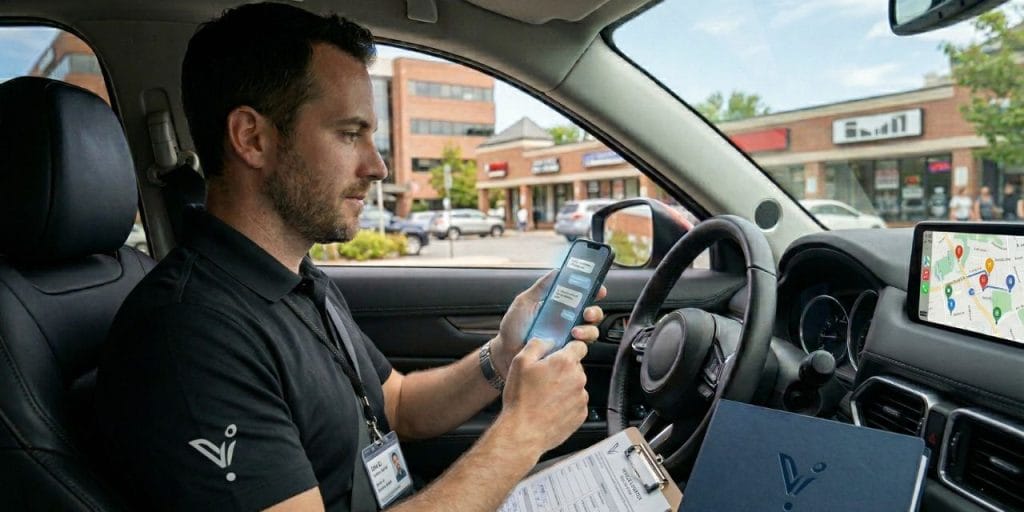
The admin backlog starts the moment a rep walks back to their car. Traditional CRM updates mean parking, opening the app, navigating to the right record, typing out notes, scheduling a follow-up, and moving on. Multiply that by a full day of stops and you understand why CRM data is always incomplete.
Here’s how DASH Go and DASH Actions collapse that workflow:
- Rep finishes a door knock and gets back in the car
- Instead of typing, they talk to DASH: “Met with the homeowner, they’re interested in the premium package, schedule a follow-up for Thursday”
- DASH drafts the visit notes, updates the record, and queues the follow-up task — then shows the rep a confirmation preview of everything before writing any changes to SPOTIO
- Rep confirms with a quick tap when it’s safe, then moves on to the next stop
Every action is human-approved — DASH shows a confirmation preview before writing any changes. Leaders get clean data without chasing reps for updates, and reps spend less time on their phone and more time selling.
Automating Follow-Up and Outreach
The best reps follow up fast. The problem is that after a full day of field visits, drafting personalized follow-up emails for every conversation is the last thing anyone wants to do.
AI handles this by using the context from the visit — what was discussed, what the prospect cared about, where the deal stands — to draft a follow-up email or text that the rep just reviews, tweaks, and sends. SPOTIO’s DASH Actions drafts personalized, on-brand emails and texts using SPOTIO data. Reps review, tweak if needed, and send — so follow-up happens while the conversation is still fresh, not three days later. DASH drafts the message, but the rep owns the send button. Nothing goes to a prospect without a human set of eyes on it.
Want to see these workflows in action? Check out our breakdown of the 9 best AI sales tools built for field teams.
Benefits of AI for Field Sales Teams
More Selling Time, Less Admin
This is the headline benefit and it’s not theoretical. Salesforce’s 2024 data shows reps spend 70% of their week on non-selling tasks. AI that automates CRM updates, visit logging, and follow-up scheduling directly attacks that number. SPOTIO’s 2026 State of Field Sales survey found that among teams already using AI, the most common applications are email personalization (30%), conversation intelligence (28%), and content generation (26%) — all admin-reduction tools.
The teams that aren’t using AI at all? According to the same survey, that’s still one in three field sales organizations. That gap is a competitive advantage for the teams that close it.
Better Forecasting and Pipeline Visibility
When reps log visits by voice instead of skipping CRM updates, leaders get a real-time picture of what’s happening in the field. AI-powered analytics can then flag at-risk deals, surface stalled opportunities, and give managers the data they need to coach effectively — instead of asking “how’d that meeting go?” in a weekly one-on-one and getting a vague answer.
Personalization That Scales
A rep visiting 15 accounts a day can’t hand-craft a unique pitch for each one. But AI that pulls account history, recent interactions, and relevant product info can arm that rep with personalized context before every stop. DASH IQ pulls the last visit notes and account context so the rep can reference specifics from the previous conversation. The AI did the research, and the rep brought the relationship.
Will AI Replace Field Sales Reps?
No. And this question keeps coming up, so let’s be direct about why.
Field sales is relationship work. It requires reading body language at the door, navigating a skeptical homeowner’s objections in real time, and building trust that turns a cold knock into a closed deal. AI is very good at pattern recognition, data processing, and surfacing signals at scale. It cannot build rapport, read the room, or earn trust.
What AI Can’t Do in the Field
- Read a homeowner’s body language and know when to shift the pitch
- Build trust at the door with a skeptical prospect
- Navigate real-time objections that don’t follow a script
- Know when to stop selling and start listening
These are the skills that close deals. AI handles everything around them so reps can focus on what only humans can do.
What AI does is handle the admin work that keeps good reps from doing more of what they’re best at. When reps spend less time on data entry and more time in front of prospects, they close more deals. Salesforce data backs this up: teams using AI are 1.3x more likely to see revenue growth than teams without it.
The reps who should be worried aren’t the ones being replaced by AI — they’re the ones being outperformed by competitors whose reps have AI handling the busywork.
How to Get Started
You don’t need to overhaul your tech stack to start seeing results from AI. Here’s a practical path.
Start with Your Biggest Time Sink
For most field teams, that’s CRM data entry and visit logging. If your reps are spending 30+ minutes a day typing notes into their phones, that’s the place to start. A voice-to-CRM tool can reclaim that time immediately. Start with the reps who are drowning in admin, not the ones who are resistant to change. Early wins create internal advocates who sell the tool better than any training session. [NEW]
Evaluate Tools for the Field, Not the Office
Most AI sales tools are built for inside sales. Before you buy, pressure-test for field conditions:
- Mobile-first UX: Can a rep use it one-handed in a parking lot?
- Offline reliability: Does it work in basements, rural areas, and buildings with no signal?
- Speed: If a voice note takes more than 3 seconds to process or a route takes more than 5 seconds to recalculate, reps will stop using it.
- CRM integration: Does it connect to your existing system without creating duplicate records?
Keep Humans in the Loop
AI that writes directly to your CRM without rep approval is a data quality nightmare waiting to happen. Look for tools that show a confirmation preview before committing any changes. SPOTIO’s DASH follows this principle across every action — the AI drafts, the rep approves.
How you introduce AI matters as much as which tool you pick. If reps think it’s a tracking device, they’ll leave it in the truck. If they see it as a personal assistant that gets them home by 5 PM, they’ll use it every day.
Transform Your Field Sales With SPOTIO
AI is changing how the best field sales teams operate — but only when the tools are built for the realities of life on the road. SPOTIO’s DASH is the AI co-pilot designed for field sales: it preps reps before every visit with DASH IQ, handles CRM updates and follow-ups through DASH Actions and DASH Go, and keeps humans in control with confirmation previews on every action.
See how SPOTIO can put more selling time back in your reps’ day — request a personalized demo.
Frequently Asked Questions
The highest-impact workflows combine AI for prep and admin with human judgment for selling. For example, AI handles pre-visit research and post-visit CRM updates while the rep focuses entirely on the conversation in between. Teams using this approach report spending significantly less time on administrative tasks and more time in front of prospects.
AI improves follow-up in two ways: speed and consistency. After a visit, AI can draft a personalized follow-up email or text using context from the conversation, then queue it for the rep to review and send. This means follow-ups go out the same day instead of getting lost in the end-of-day backlog. AI also queues follow-up tasks for the rep to confirm, so nothing falls through the cracks.
The best tools are purpose-built for reps who work on the road, not adapted from inside sales platforms. Key capabilities to look for include voice-based CRM updates, mobile-first design, offline functionality, and AI-powered visit prep. For a detailed comparison, see our guide to the best AI sales tools for field teams.
No. AI handles administrative tasks, data processing, and pattern recognition — the work that keeps reps from selling. It cannot build trust, read body language, or navigate complex in-person negotiations. The most effective field sales teams use AI to augment their reps, not replace them. Salesforce data shows AI-using teams are 1.3x more likely to grow revenue.