You know the product. You can walk a roof blindfolded, spot wind lift from the driveway, and quote three shingle lines from memory. None of that matters when a homeowner crosses their arms and says, “We need to think about it.”
The gap between roofing knowledge and sales confidence is where deals go to die. One roofing company told us their reps were unknowingly canvassing the same streets for weeks; they only discovered the overlap after mapping their territories digitally. That kind of operational waste compounds when reps also lack a playbook for the objections they hear at every door.
This guide gives you specific scripts for the five objections that stall roofing deals, plus the closing techniques and follow-up cadences that move homeowners from “maybe” to a signed contract. For the broader fundamentals of how to sell roofing from prospecting through close, start there.
Why Homeowners Say No
Before you can respond to an objection, you need to understand what’s actually driving it. Homeowners rarely object for the reason they state out loud.
The Trust Deficit After Storm Season
The roofing industry carries a reputation problem. Storm chasers collect deposits and disappear, leaving every legitimate contractor to answer for it. After major weather events, homeowners hear from half a dozen roofing companies in a single week, and most of those pitches sound identical. Your first job at the door isn’t selling a roof. It’s building trust with roofing prospects and proving you’ll still be in town six months from now.
Price Shock vs. Perceived Value
A roof replacement is one of the most expensive home improvements a homeowner will make, and it’s largely invisible from the ground. Insurance deductibles alone can trigger sticker shock, typically ranging from 1% to 5% of a home’s insured value. Unlike a kitchen remodel that they’ll see every morning, a new roof delivers its value quietly. That makes it easy to postpone.
Disruption and Decision Fatigue
The noise, the crew in the yard for one to three days (longer for complex roofs), the worry about landscaping: it’s a lot. Add in HOA approval requirements, material decisions they don’t feel qualified to make, and a spouse who isn’t home during the appointment, and you’ve got a homeowner who finds it easier to say “not yet” than to say “yes.” Recognizing this fatigue changes how you approach the close.
How to Overcome 5 Common Roofing Sales Objections
Each objection below includes a scripted response framework: the homeowner’s words, the question you ask before responding, and the reframe that keeps the conversation moving. Practice these until they feel natural, not rehearsed.
“We Need to Get More Quotes”
This is rarely about price comparison. It’s about the homeowner wanting to feel like they’ve done their due diligence.
Ask first: “That makes complete sense. What specifically are you hoping to compare when you get those other quotes?”
Most homeowners can’t answer that clearly. They’ll say “price” or “to see what’s out there.” That’s your opening.
Reframe: “I’d encourage you to get other quotes; you should feel confident in this decision. What I’d suggest is comparing three things side by side: the exact materials spec’d, the warranty terms in writing, and whether the crew is in-house or subcontracted. I’ll put all three in writing for you right now so you have a benchmark.”
That makes you the transparent option. You’re not fighting the objection; you’re shaping the evaluation criteria in your favor.
“We Can’t Afford It Right Now”
The cost objection has two versions: homeowners who genuinely can’t pay and homeowners who haven’t seen a payment structure that works.
Ask first: “When you say the cost is a concern, is it the total project cost or more about how the payments are structured?”
That question separates the two versions fast.
Reframe (insurance job): “I understand; the deductible feels like a big number right now. One thing worth knowing is that your premium is likely to adjust based on overall claims activity in your ZIP code, whether you file or not. So if the rate’s going up anyway, you might as well get the roof your policy already covers.”
Reframe (retail job): “A full replacement at $14,000 is a real investment. What a lot of homeowners don’t realize is that a new roof typically returns 60–70% of its cost at resale and can shave real dollars off monthly energy bills. And right now, I can walk you through a financing option that breaks this into payments that look more like a car note than a renovation.”
Pro Tip: Have financing terms pre-calculated before every appointment. Presenting a monthly payment alongside the total cost reframes a $14,000 decision into a $190/month decision. Roofing companies that offer financing at the kitchen table close 20–35% more jobs than those that don’t.
“We Want to Wait and See”
This objection usually means the homeowner doesn’t feel enough urgency to act now. They need to see the cost of delay.
Ask first: “Completely understand. Is there a specific thing you’re waiting on, or does the timing just feel off right now?”
If they’re waiting on a specific event (another season, a second opinion, a spouse’s input), you have something to work with. If it’s vague, they need a reason to act.
If the answer is “I need to talk to my spouse,” don’t push for a close. Instead, ask: “Would it help if I left a written summary your spouse can review tonight? I can also make myself available for a quick call with both of you if that would move things along.” This respects the decision process while keeping the deal active.
Reframe (for vague hesitation): “That’s fair. The one thing I’d want you to know is that the minor issues I found today, the cracked flashing and the three missing shingles on the north slope, tend to turn into interior water damage within one storm cycle. A $400 repair today can become a $4,000 ceiling repair plus a full replacement six months from now. I don’t want that for you.”
Specificity is everything here. “Your roof is getting worse” doesn’t land. “Three missing shingles on the north slope” does.
“We’ll Let Insurance Handle It”
This one comes up constantly after storms, and it’s often based on a misunderstanding of how the claims process works.
Ask first: “When you say you’ll let insurance handle it, do you mean you’ve already filed a claim, or are you planning to call them?”
The answer tells you where they are in the process, and most haven’t called yet.
Reframe (if no claim filed): “I’d actually recommend we do this together. Most insurance companies send their own adjuster who may not catch every item. If I’m there during the inspection, I can point out damage the adjuster might miss: things like starter strip failure or soft spots that aren’t visible from a ladder. That typically results in a more complete scope, which means less out-of-pocket cost for you.”
State laws vary on how involved a contractor can be during an adjuster inspection; make sure your company’s process has been reviewed by your legal counsel so reps know exactly where the line is.
Reframe (if claim filed): “Great. Do you have a copy of the adjuster’s scope? I can review it line by line against what I found on the roof. If they missed anything, we can file a supplement before work starts rather than discovering it mid-project.”
One line you should never cross: If a homeowner asks you to “cover” or “absorb” their deductible, the answer is always no. In nearly every state, waiving or paying a homeowner’s deductible is insurance fraud. The right response: “I can’t do that legally, and any contractor who offers to should be a red flag. What I can do is make sure your scope is complete so your out-of-pocket stays as low as it should be.”
In both cases, you’re positioning yourself as the homeowner’s advocate against a bureaucratic process, not as someone who’s trying to take their money.
“How Do I Know You’re Legit?”
This question is a buying signal. They’re interested enough to worry about getting it right.
Don’t get defensive. Match their skepticism with transparency.
Reframe: “That’s the right question to ask, especially after a storm when a lot of companies show up and not all of them will be here next year. Here’s what I’d look at: We carry [specific license number], we’re bonded and insured through [carrier], and we have [number] reviews on Google at a [X.X] rating. I’d also encourage you to check our BBB profile. And the Hendersons on [nearby street]: we replaced their roof in 10. You’re welcome to knock on their door.”
Leave behind a digital business card and your company brochure so they can verify everything after you leave.
Neighborhood proof is the strongest trust tool in residential roofing. If you’ve done work within a few blocks, name the street. If the homeowner can see a house you’ve roofed from their front porch, walk them outside and point to it.
Roofing Sales Techniques That Improve Close Rates
Beyond objection handling, these three techniques consistently move the needle on close rates.
Good-Better-Best Pricing
Never present a single number. Every estimate should include three options:
- Good: Repair or patch; addresses immediate issues at the lowest price point
- Better: Standard replacement with mid-tier materials and standard warranty
- Best: Premium system with upgraded materials, extended warranty, and enhanced ventilation
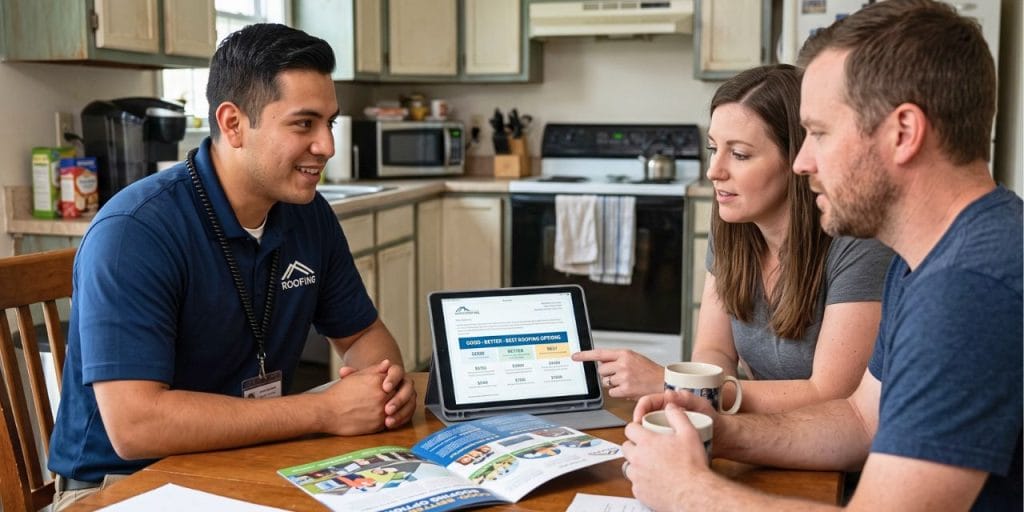
Homeowners who see a range are less likely to reject outright. The middle option becomes the anchor, and the top tier reframes the standard option as reasonable. You’ll also catch upsell opportunities you’d otherwise miss; some homeowners genuinely want the best and won’t ask for it unless you present it.
Visual Evidence at the Kitchen Table
Bring the roof damage inside. Before your appointment, use drone footage or close-up photos to capture the specific issues: not stock damage photos, but shots of their cracked flashing, their lifted shingles, their rusted pipe boots.
Display these on a tablet alongside photos of completed projects from the same neighborhood. When homeowners can see the damage and picture the outcome side by side, the abstract “you need a new roof” becomes concrete.
The Neighborhood Proof Approach
When you’ve completed jobs in the same area, use them. This works especially well during storm-response canvassing:
“We’ve been working in this neighborhood since the storm two weeks ago. The Garcias on Elm just had their roof replaced; same hail damage pattern I’m seeing on your north slope. If you want, I’ll ask if they’re OK with you swinging by to see the finished work.”
The most effective reps actively mention nearby customers as references during their door-to-door presentations. This combines social proof with urgency (the storm was recent, your neighbors are already acting) without pressure tactics.
How to Follow Up Without Losing the Deal
More roofing deals die in the follow-up gap than at the door. A strong first appointment means nothing if you go quiet for a week.
Build a Repeatable Follow-Up Cadence
A consistent cadence removes guesswork and keeps you top-of-mind without becoming a nuisance. Here’s a cadence that works for residential roofing:
- Same day: Thank-you text within 2 hours of the appointment; reference something specific from the conversation
- Day 3: Phone call to answer any questions and ask if they’ve received other quotes
- Day 5: Email with before/after photos from a recent project in their area
- Day 7: If the prospect hasn’t responded, a brief text with a photo of a recent nearby project works well. In neighborhoods where you’re already working, a drive-by to leave a door hanger with your card (not another pitch) is another option.
- Day 14: Final check-in call; offer to re-inspect if more than two weeks have passed since the original assessment
The reps who stick to a cadence like this close at a significantly higher rate than those who follow up “when they remember.” The key is consistency: every prospect, every time, no skipping steps because the pipeline is busy.
Know When to Push and When to Pause
Not every “not yet” is a dead lead. A homeowner who asked detailed questions, walked the roof with you, or mentioned their spouse needing to weigh in is still in play. A homeowner who wouldn’t open the door twice is not.
Track the last interaction outcome for every prospect. “Reviewed quote, waiting on spouse” gets a different cadence than “not interested, asked not to return.” Treating both the same wastes time and burns goodwill.
SPOTIO’s AutoPlays help roofing teams build these cadences once and enroll prospects into the right sequence after each appointment. Reps review and approve each touchpoint before it sends, so timing stays consistent without the follow-up feeling robotic. For a deeper look at building training around these cadences and other core skills, see the roofing sales training guide.
How to Spend More Time Selling Roofs
The biggest constraint for most roofing sales reps isn’t skill; it’s time. Every hour spent on admin, bad leads, or driving in circles is an hour not spent at a kitchen table. These productivity strategies apply across home improvement sales, but the examples below are specific to roofing.
Qualify Leads Before You Knock
Knocking blind is the most expensive prospecting method in roofing. Before canvassing a neighborhood, filter by the data points that predict need: home age, roof age, property value, and recent storm activity.
SPOTIO’s Lead Machine gives roofing teams up to 15 data points per residential property, enough to identify which homes are worth the walk to the door and which ones aren’t. Pair that with the HailTrace integration after a storm and you can build canvassing zones around the actual damage swath, assign reps to specific blocks, and get boots on the ground while competitors are still checking the weather radar.
Plan Your Day Around Geography
Zigzagging across a territory between appointments burns fuel and selling time. Group your appointments and canvassing blocks by geography, and use SPOTIO’s route planning to sequence your stops before handing navigation off to Google Maps or Waze.
Cut Admin Between Appointments
Every visit note, CRM update, and follow-up reminder that a rep has to type out manually is time away from the next conversation. Use mobile activity logging to capture a visit outcome in seconds. Between stops, voice-to-CRM lets reps dictate notes and updates by voice, then review and confirm with a tap before anything writes to the system.
The pattern is simple: log the visit, queue the follow-up, and move to the next door without pulling over to do data entry.
If you’re evaluating which platform fits your team’s sales motion, the best roofing CRM software comparison walks through how SPOTIO stacks up against AccuLynx, JobNimbus, Leap, and other options.
Frequently Asked Questions
The five objections roofing reps encounter most frequently are price resistance, the desire to get multiple quotes, wanting to delay the decision, confusion about the insurance claims process, and skepticism about the contractor’s legitimacy. Each one has a different root cause, and the most effective approach is to ask a clarifying question before responding; it prevents you from answering an objection the homeowner didn’t actually raise.
Same-day closes in roofing come down to preparation, not pressure. Arrive with financing options pre-calculated, drone or ladder photos of the specific damage, a good-better-best estimate ready to present, and references from nearby completed jobs. When the homeowner has all the information and no unanswered questions, the close becomes a natural next step, not a high-pressure ask.
Close rates vary widely by lead source and sales motion. The blended industry benchmark is around 27%, but the range is wide: exclusive, inspection-completed leads can close well above that, while shared leads or cold canvassing typically close well below. If your team is consistently under-performing relative to their lead quality, the issue is usually in follow-up consistency or how quotes are presented, not in the initial pitch.
Off-season selling shifts from urgency (“the storm just hit”) to education and prevention. Focus on homeowners with aging roofs, 15+ years for asphalt shingles, and lead with an inspection offer rather than a sales pitch. Position the off-season as an advantage: shorter wait times, more scheduling flexibility, and the chance to address issues before the next storm season.
HOA restrictions add a step but don’t have to kill the deal. Research the neighborhood’s approved materials and color palettes before the appointment so you can present compliant options from the start. Offer to help the homeowner draft the HOA approval request; that small act of service builds trust and removes a friction point that causes many homeowners to stall.
Close More Roofing Jobs With SPOTIO
Handling objections is a skill. Having the time and tools to get in front of enough homeowners to use that skill is a systems problem. SPOTIO gives roofing teams the prospecting data, follow-up structure, and field productivity tools to spend less time on admin and more time at the door.
Request a demo to see how it works for roofing teams.
Trey Gibson is the founder and CEO of SPOTIO, where he helps sales leaders build more efficient, high-performing field sales teams. With a background in entrepreneurship and as the founder of a roofing company, Trey brings hands-on experience leading door-to-door and B2B sales organizations. He combines real-world sales leadership with a passion for technology and operational efficiency to help teams scale, perform, and win more deals.