
Field sales reps spend only 44% of their working hours actually selling — the rest goes to admin, CRM updates, travel between stops, and the planning overhead that comes with running a territory. It’s not a reflection of effort. Field sales is structurally harder to organize than inside sales: your office changes every hour, your schedule depends on other people showing up, and every cancelled appointment costs you travel time on both ends.
Sales rep organization and time management look different in the field than they do in an office — and most advice on the topic is written for inside sales. This guide covers how to build a system that fits the actual constraints of field work: how to get organized before the day starts, how to protect selling time once you’re in the field, and how to cut the admin friction that accumulates in the background.
Why Field Reps Lose More Time Than Inside Reps
Inside sales reps deal with distraction and admin. Field sales reps deal with all of that plus geography. A bad day in the field doesn’t just mean fewer calls — it means driving 45 minutes in the wrong direction, arriving at a prospect who’s not there, and burning an hour you can’t get back.
The admin tax in the field
B2B field reps spend 25% of their week on administrative work — that’s roughly 10 hours every week not spent in front of a buyer. For B2C teams the number is lower (18%), but still nearly a full workday per week per rep. Multiply that across a team of 10 and you’re looking at over 5,200 hours of lost selling capacity every year.
The admin tax isn’t just a time problem. It’s a morale problem. Reps who spend half their day on non-selling tasks don’t stay long. The work feels administrative, not purposeful — and that feeling compounds. Better time management for sales reps starts with understanding where the hours are actually going.
→ Read the 2026 State of Field Sales Report
Travel time is a multiplier
A missed appointment or an unoptimized route doesn’t just cost the hour — it costs the travel time before and after it too. That’s the part of field sales that inside sales never has to absorb. When the day is structured around geography as much as appointments, small inefficiencies compound in ways that are hard to see until you add them up at the end of the week.
The opportunity isn’t working harder. It’s building a system that handles the structural friction before the day begins.
Time Management Starts Before the Day Does
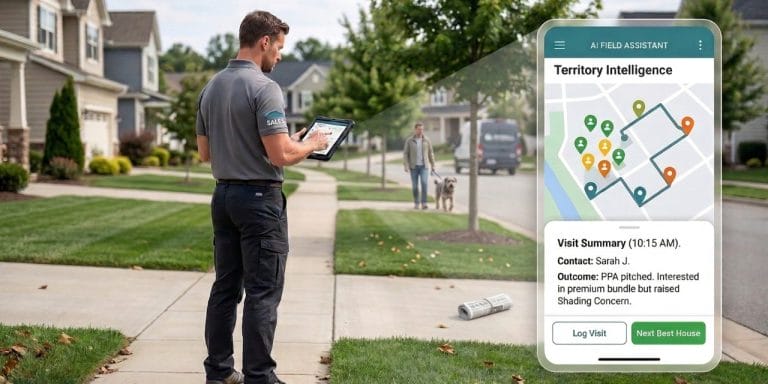
A territory-first approach to organization means starting the day with a map, not just a task list. Getting organized as a field rep starts with your sales territory management system — knowing where your best prospects are, which ones are worth visiting today, and how to sequence your stops so travel works for you rather than against you.
Plan your route before you plan your day
Route planning isn’t just a time-saving hack — it’s the foundation of a productive field day. When you know which stops you’re making and in what order, every other decision (when to make calls, when to log notes, when to eat lunch) falls into place around a fixed skeleton.
Use a route optimization tool to sequence your stops geographically before you leave in the morning. Set your first stop, add your planned visits, and let the tool calculate the most efficient path between them. Build in buffer stops — nearby prospects you can visit if an appointment falls through — so you’re never scrambling to fill dead time.
- Plan routes the night before, not the morning of
- Group stops by zip code or neighborhood, not by appointment time alone
- Always have 2–3 buffer prospects in the same area as your scheduled meetings
- Log notes between stops — one tap at a time — so admin doesn’t pile up at day’s end
Qualify first, visit second
Time spent visiting an unqualified prospect isn’t selling time — it’s admin time disguised as field activity. Before you invest drive time in a lead, make sure they actually fit your ICP.
If you’re in B2C sales, a tool like SPOTIO’s Lead Machine lets you filter prospects in your territory by up to 15 data points — including home purchase date, credit capacity, and age — so you’re visiting the people most likely to buy, not just the ones who are geographically convenient. For B2B teams, use a sales intelligence platform to filter by business type, revenue, and other commercial criteria before you schedule a visit.
The goal isn’t fewer visits. It’s fewer wasted visits.
Protect Your Selling Hours
Getting organized sets the stage. Protecting your selling hours is what keeps the day from unraveling once it starts.
Time blocking for field reps
Time blocking — dedicating specific windows to specific activities — is the most reliable way to prevent your best selling hours from getting swallowed by admin, email, or “quick” tasks that aren’t quick. Research from the American Psychological Association shows that switching between tasks can cut productive time by as much as 40% — every context switch carries a cognitive cost.
A well-structured field day looks something like this:
| Time | Activity |
|---|---|
| 8:00–9:00 AM | Review route, confirm appointments, prep notes on first 3 stops |
| 9:00 AM–12:00 PM | Field visits — selling time only, no email |
| 12:00–12:30 PM | Lunch + batch inbox check (one window, not continuous) |
| 12:30–5:00 PM | Field visits continue |
| 5:00–5:30 PM | Log remaining activities, update pipeline, plan tomorrow’s route |
The specifics will vary by vertical and territory. The principle doesn’t: selling happens in protected blocks, and admin happens outside them. If you don’t set those boundaries deliberately, the admin will expand to fill whatever space you leave it.
Build your schedule around your buyer’s day
The best time to reach a prospect depends entirely on who they are. For B2B reps, that means knowing your buyer’s business rhythms: a roofing contractor is on-site by 7 AM and unavailable until mid-afternoon; a restaurant owner is slammed from noon until 9 PM; a telecom dealer is most accessible mid-morning before the lunch rush.
For B2C and D2D teams, timing is equally critical — and the benchmarks are more precise. Here’s what field experience shows by vertical:
| Vertical | Best Time to Visit | Notes |
|---|---|---|
| Roofing / Storm Restoration | 3–6 PM weekdays, Saturday AM | Look for missing shingles, hail damage, aging materials |
| Home Services (pest, lawn, HVAC, security) | 9–11 AM weekdays | Overgrown landscaping, aging exterior systems |
| Telecom / Fiber | 5–7 PM weekdays | New construction, serviceable addresses |
| Home Improvement (windows, doors, blinds) | Saturday mornings | Foggy windows, outdated doors, old frames |
| Solar | 3–6 PM weekdays, Saturday AM | South-facing roof, open plane, minimal shade |
Know your buyer’s schedule as well as you know your own. Structure your visit windows around when prospects are most likely to be available — and save your admin, route planning, and inbox management for the gaps their schedules create, not yours. For more on timing strategy for D2D teams, see our complete guide to canvassing.
Cut Admin Time Without Losing Data Quality
The most common reason reps skip logging activities isn’t laziness — it’s friction. When it takes four taps to log a visit, it doesn’t get logged. When logging happens at end-of-day from memory, it’s inaccurate. The solution isn’t to ask reps to try harder. It’s to remove the friction.
One-tap activity logging
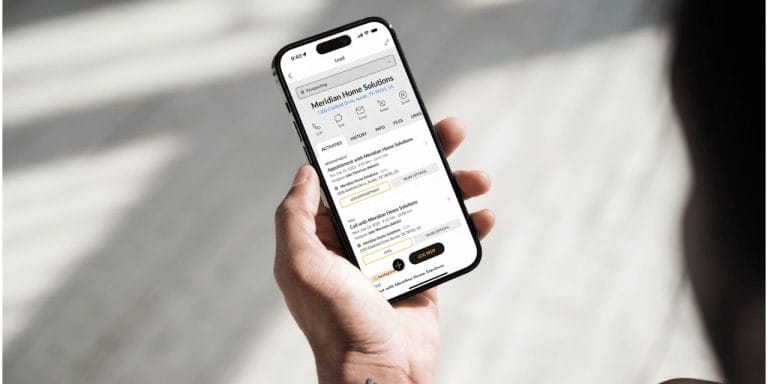
SPOTIO’s activity tracking is built for reps in motion. Log a visit, completed call, or follow-up task with a single tap — no navigating through menus, no typing paragraphs into a notes field while sitting in a parking lot. The activity is timestamped and location-verified at the moment of logging, so managers get accurate field data without chasing reps for updates.
The payoff for managers: when your reps log consistently, you stop flying blind. You can see which territories are getting coverage, which prospects are stalling, and where the pipeline actually stands — without a weekly check-in call to piece it together.
How DASH AI handles the between-stops work
The 10 minutes between appointments is where most field reps either get ahead or fall behind. It’s also when it’s least safe to be typing on a phone.
SPOTIO’s DASH AI co-pilot is built for exactly this moment. Using DASH Go, reps can talk to DASH while driving — summarizing a visit, flagging a follow-up, or pulling a quick brief on the next prospect — and review a confirmation preview before anything is written to SPOTIO. Every update requires human-in-the-loop confirmation before it’s saved, so nothing gets logged incorrectly.
Practical uses between stops:
- “Log a completed visit at [prospect name] — left a quote, follow up in 3 days” → DASH drafts the update and shows a preview before saving
- “What do I know about my next stop?” → DASH pulls a 10-second account brief from SPOTIO data
- “Add a note: they’re renewing their contract in Q3, check back in June” → DASH drafts the note; rep confirms before it’s saved
This isn’t autopilot. It’s a co-pilot that turns drive time between stops into productive time.
The Mental Side of Organization
Sales rep organization and time management aren’t just operational — they’re psychological. The best field reps have systems for the inevitable moments when the day doesn’t go as planned.
The 80/20 rule applied to your pipeline
Look at your current pipeline. There are names in there who will never buy — but they keep getting follow-up visits because no one has made a final call. The 80/20 rule (Pareto Principle) says 20% of your prospects will generate 80% of your results. Applied to field sales, it means this: every visit to an unqualified prospect is a visit you didn’t make to a high-probability one. Qualification isn’t something that happens once at the top of the funnel. It’s an ongoing filter you apply every time you add a stop to your route.
Get to “no” faster
Spending three visits on a prospect who was never going to buy isn’t persistence — it’s time debt. The faster you can get a definitive “no” from a low-probability prospect, the faster you can redeploy that time to someone worth the effort.
Ask the disqualifying question earlier. If the answer signals a bad fit, move on to your next stop — the time recovered compounds across a full week of territory visits.
Learn to say no (to your own schedule, too)
One of the most underrated sales rep organization tips: protect your selling blocks from internal demands. Managers scheduling mid-day check-ins, colleagues asking for “quick” favors, and non-essential meetings all erode the protected field time you’ve built.
The most productive reps treat their field schedule the way a surgeon treats an operating room — you don’t walk in mid-procedure with a quick question. If someone needs something during your field hours, they can get it at 5:30 PM. This applies equally to managers building out their team’s schedule: protect your reps’ selling windows or you’ll wonder why the numbers aren’t moving.
Build the System Once, Run It Every Day
The reps who stay consistently organized aren’t doing something heroic — they’re running a repeatable system. The same is true for time management for sales reps: the effort goes into building the system once, then trusting it.
The night-before routine
Five minutes the evening before is worth an hour the next morning. Before you close out for the day:
- Log any remaining activities from the day
- Confirm tomorrow’s appointments and pull up the prospects’ recent notes
- Plan your route and identify 2–3 buffer stops
- Set your first morning action so you don’t have to decide it at 7 AM
Reps who build the next day’s plan at end-of-day hit the ground running. Reps who plan in the morning spend their best selling hours figuring out where to go instead of going there.
Create repeatable sales plays
Every visit carries cognitive load — qualifying the prospect, adjusting the pitch, deciding next steps on the fly. Repeatable plays — a core set of qualification questions, a standard follow-up sequence, a defined process for handing off to a closer — reduce that load on the parts of the job that don’t need to be reinvented each time, so reps can bring more energy to the parts that do.
This is also where managers can build leverage across a team. When every rep runs the same play in similar situations, you can actually diagnose what’s working and what isn’t. If the play works for 8 of your 10 reps and fails for 2, you have a coaching problem with 2 people. If every rep is improvising, you have a process problem with everyone.
Frequently Asked Questions
According to SPOTIO’s 2026 State of Field Sales survey, field sales reps currently spend an average of 44% of their working hours selling — 33% for B2B reps and 49% for B2C and hybrid reps. The target should be higher. Reducing admin by just 5 percentage points can unlock a 10–15% gain in selling capacity, depending on your team’s model. The benchmark to aim for isn’t “more than average” — it’s maximizing the hours between your first and last appointment.
The highest-impact changes are structural, not motivational. First, make logging frictionless — one-tap activity capture at the point of the visit beats end-of-day manual entry every time. Second, use route optimization to eliminate planning time in the morning. Third, batch all remaining admin (inbox, pipeline updates, reports) into a defined window at end-of-day rather than letting it bleed into selling hours. SPOTIO’s one-tap logging and DASH AI between-stop workflow address the first two directly.
Build qualification into the front end of the route-planning process, not the back end. If reps are filtering prospects by ICP criteria before they build their daily route — using data points like business type, revenue, or residential criteria — they’re only visiting people worth visiting. Establish a standard set of qualifying questions to ask early in a first visit, and give reps permission to move on quickly when the answer signals a bad fit.
A well-structured day starts the night before with route planning and a confirmed appointment list. Selling windows run without interruption — no email, no admin, no non-essential calls. Buffer stops (nearby prospects who can fill a cancelled appointment slot) are planned in advance. Between stops, reps use short windows to log notes and brief themselves on the next prospect. Admin is batched at end-of-day, not scattered throughout. The key word is system — a day that runs the same way every day, regardless of what the territory throws at you.
The most useful tools for field reps are ones built for mobility — not desktop CRMs ported to a phone. Look for route optimization that works natively on mobile, one-tap activity logging that doesn’t require navigating menus, and voice-enabled workflows for between-stop updates. SPOTIO is built specifically for field teams, with route planning, prospect filtering, one-tap logging, and DASH AI’s co-pilot — accessible via chat, voice, or snaps — all in one platform. See our full breakdown of the best sales productivity tools for field teams. For broader productivity, time-blocking your calendar and using the night-before routine requires nothing more than discipline and 10 minutes.
Managers have two levers for improving sales rep organization and time management across a team: system design and protection. System design means building the tools, processes, and routes that make it easy for reps to stay organized — clear territories, qualified prospect lists, repeatable plays. Protection means defending your reps’ selling hours from internal demands: non-essential meetings, mid-day check-ins, and administrative requests that could wait until 5:30 PM. The data is clear — teams that protect selling time hit quota more consistently. That’s not a rep discipline issue — it’s a management decision.
The Bottom Line
Field sales is a game of inches — the difference between a productive day and a wasted one is often a handful of systems that take minutes to build and hours to recover if you skip them. Get organized before you leave the driveway, protect your selling hours once you’re in the field, and cut the admin that’s quietly working against your quota. For a deeper look at reclaiming selling hours, see our guide on how to improve sales productivity.
SPOTIO is built for exactly this workflow — route optimization, prospect filtering, one-tap activity logging, and DASH AI’s between-stop co-pilot. See how field teams use SPOTIO to build a structured, productive field day. Get a custom demo →