

Your field reps aren’t sitting at desks updating Salesforce between calls. They’re driving between appointments, knocking doors, scribbling notes on their phones, and mentally tracking which leads are hot in three different zip codes. By the time they get home — or remember to log in — half of that activity data is gone.
That’s the core problem with most “revenue operations software” conversations: they’re written for inside sales teams. Pipe Gong calls, enrich CRM records, forecast deals in Clari. Useful tools in the right context. Field sales has unique RevOps needs, and the software stack that solves them looks different too.
This guide is built for RevOps teams supporting field sales organizations — the operators who are tired of piecing together their RevOps function from spreadsheets, sticky notes, and end-of-day data entry marathons. We’ll cover what revenue operations software actually means for field teams, the features that matter, and the 10 tools worth evaluating.
What RevOps Software Means for Field Teams
Revenue operations software gives sales, marketing, and customer success a shared data layer — so everyone is working from the same pipeline picture instead of three different versions of the truth.
For an inside sales team, that usually means conversation intelligence, email tracking, and CRM hygiene tools. For a field sales team, the RevOps problem is different at every layer:
- Data capture happens in a parking lot, not at a desk
- Territory coverage is a spatial problem, not just a pipeline stage
- Pipeline visibility depends on whether reps logged activity after a long day of driving
The cumulative cost of those friction points is what SPOTIO’s 2026 State of Field Sales research calls the admin tax. B2B field reps lose 25% of their workweek — roughly 10 hours — to administrative tasks and data entry instead of selling. On a 10-person team, that adds up to more than 5,200 hours of lost selling capacity every year. B2C field reps fare slightly better, but still lose 18% of their week, or about 7 hours.
RevOps software doesn’t eliminate that tax automatically. The right tools reduce it. The wrong ones add to it.
How Field Sales RevOps Differs from Inside Sales
Inside sales RevOps is primarily about what reps say — conversation intelligence, email cadences, deal scoring based on engagement signals. Field sales RevOps is primarily about where reps go and what they do there — territory coverage, visit frequency, activity logging at the point of contact.
A tool like Gong is built for recorded calls. A tool like SPOTIO is built for what happens before, during, and after a door knock or a field meeting. The data you need is different. The workflows are different. And critically, the mobile experience is non-negotiable — if the software doesn’t work from a phone in a driveway, your reps won’t use it.
Key Features for Field Sales RevOps Tools
Not all RevOps tools are built equal — and for field teams, a few capabilities separate the useful from the shelf-ware.
Territory and Activity Data Capture
The biggest RevOps gap in field sales isn’t forecasting — it’s data that never gets entered. Your reps visit 8 accounts on Tuesday and remember to log 3. Everything else disappears.
Look for tools where activity capture happens at the point of work: a one-tap log after a visit, a voice input with tap confirmation between stops, a pin drop from the parking lot. The less friction between the visit and the record, the better your pipeline data will be. Tools that require reps to reconstruct their day at 9pm will always produce incomplete data.
Mobile-First and Offline Capability
Most RevOps software is designed for a browser on a laptop. In the field, that’s a liability. Reps need tools that work from a phone, load fast on LTE, and don’t require WiFi to function.
Look for offline mode — the ability to capture activity and sync when connectivity returns. A rep in a rural territory or a building basement shouldn’t lose their work because the signal dropped.
Real-Time CRM Sync
Nearly two-thirds of B2B field reps spend 5 or more hours per week on CRM data entry, according to SPOTIO’s 2026 research. The fix isn’t more discipline — it’s real-time, bidirectional sync between your field tool and your CRM. Activity logged in the field appears in Salesforce or HubSpot immediately through native integration — no manual export step. Additional CRMs connect through Zapier, where sync frequency depends on your Zap configuration.
Teams with low turnover are 2.4x more likely to run on 1–2 integrated systems than high-turnover teams, who tend to stack 5 or more disconnected tools. Integration isn’t a nice-to-have — it’s a retention signal.
Pipeline Visibility Without Manual Reporting
If your pipeline review on Monday morning is only as good as what reps remembered to log on Friday afternoon, you don’t have a pipeline — you have a guess. Field sales managers need dashboards that reflect real activity in real time, not end-of-week summaries.
Revenue Operations Software for Field Sales Teams
Here are 10 tools worth evaluating, organized by the function they serve in a field sales RevOps stack.
Disclosure: SPOTIO is our product and appears at the top of this list. We’ve applied the same evaluation criteria — G2 rating and review volume, feature depth relevant to field sales operations, CRM integration, and pricing transparency — to every tool, including our own.
How We Selected These Tools
We evaluated these 10 tools based on four criteria: relevance to RevOps teams supporting field sales organizations (territory management, activity capture, forecasting, data enrichment, quoting); third-party G2 ratings with a minimum of 50 reviews; integration compatibility with Salesforce and HubSpot; and coverage across the core RevOps stack categories — field execution, CRM, revenue intelligence, forecasting, data enrichment, sales engagement, and CPQ. Where a tool is primarily designed for inside or hybrid sales, we’ve noted how it fits (or doesn’t) for field-heavy organizations.
Comparison Table
| Tool | Category | G2 Rating | Best For | Pricing | Field Sales Fit |
|---|---|---|---|---|---|
| SPOTIO | Field Sales Execution | 4.5/5 (387) | Territory management, activity capture, and pipeline visibility for field teams | Custom; 5-user min | ★★★★★ Built for field |
| Salesforce Sales Cloud | CRM | 4.4/5 (25,753) | Enterprise system of record with deep customization | From $25/user/mo | ★★★★☆ Strong with SPOTIO integration |
| HubSpot Sales Hub | CRM | 4.4/5 (13,599) | Mid-market CRM without Salesforce complexity | Free tier; paid from $15/user/mo | ★★★★☆ Strong with SPOTIO integration |
| Gong | Revenue Intelligence | 4.7/5 (6,455) | Conversation intelligence and AI-driven forecasting | Custom; ~$1,400–$1,600/user/yr + platform fee | ★★★☆☆ Call-heavy field roles only |
| Clari | Revenue Forecasting | 4.6/5 (5,559) | Pipeline roll-ups and forecast accuracy | Custom | ★★★☆☆ B2B long-cycle field teams |
| Apollo.io | Data Enrichment | 4.7/5 (9,603) | B2B contact database and outreach automation | Free tier; paid from $49/user/mo | ★★★☆☆ Pre-territory list building |
| Clay | Data Enrichment | 4.7/5 (200+) | Custom waterfall enrichment workflows across 100+ data sources | Free tier; paid from $149/mo | ★★★☆☆ Pre-territory enrichment |
| Outreach | Sales Engagement | 4.3/5 (3,534) | Multi-channel sequencing and pipeline management | Custom; ~$100–$160/user/mo | ★★☆☆☆ Hybrid field/inside only |
| Salesloft | Sales Engagement | 4.5/5 (4,269) | Unified engagement, conversation intelligence, and forecasting | Custom | ★★☆☆☆ Hybrid field/inside only |
| DealHub.io | CPQ | 4.7/5 (700+) | Complex quoting, approvals, and contract management | Custom | ★★★☆☆ B2B variable pricing |
G2 ratings and review counts verified as of May 2026 and are subject to change.
Field Sales Execution
1. SPOTIO
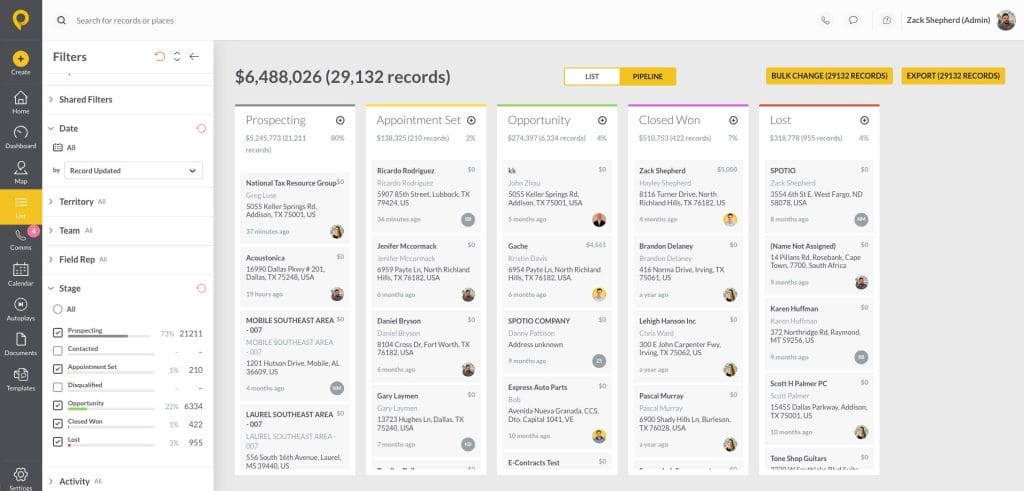
Best For: RevOps teams that need a field execution platform to capture activity data, manage territories, and feed clean pipeline data to the CRM
G2 Rating: 4.5/5 (387 reviews)
Pricing: Contact SPOTIO for custom pricing based on team size and features. Minimum 5 users.
SPOTIO is purpose-built for field sales execution — the data capture and territory management layer that most RevOps stacks are missing when reps work outside the office. It handles territory creation and assignment, prospect discovery, one-tap activity logging, and pipeline tracking from a mobile-first interface. For RevOps operators, the value is clean, real-time field data flowing into Salesforce or HubSpot without relying on reps to manually update the CRM at the end of the day.
Key Capabilities:
- Territory Management: Build, visualize, and assign territories on a map with hierarchy by region, district, and rep (hierarchy visible on web; mobile shows list view)
- Prospect Discovery: Filter and surface prospects using 15 data points through Lead Machine (B2C) or import account lists (B2B)
- One-Tap Activity Logging: Reps log visit outcomes, notes, and follow-up tasks with a single tap at the point of contact — no end-of-day data entry marathons
- Pipeline Dashboards: Real-time visibility into rep activity, lead status, and territory coverage
- CRM Integration: Native bidirectional sync with Salesforce and HubSpot; additional CRMs via Zapier
- DASH AI co-pilot: Answers account questions, drafts follow-up emails and texts for rep review, and updates records via conversation — every action requires rep approval through a confirmation preview before writing to SPOTIO
✅ What we like: Purpose-built for field workflows — the mobile experience is designed for parking lots, not offices. One-tap activity logging means reps actually capture field data, and native CRM sync pushes it to Salesforce or HubSpot in real time. Territory management with visual map hierarchy is best-in-class for field orgs.
⚠️ Watch out for: The 5-user minimum is a barrier for very small teams piloting a field sales motion. Some G2 reviewers flag occasional app performance issues on poor connectivity — though offline mode (Download My Day) mitigates most in-field scenarios.
User Review:
“I find the setup process with SPOTIO to be simple and straightforward, which eased the transition for our team. The software’s tracking and activity verification features are crucial, ensuring accountability within our team. I’m particularly impressed with the mapping features, which enhance our sales experience significantly. SPOTIO helps me streamline address-specific sales tasks and track team activities, ensuring appointments and sales are efficiently managed with mapping and verification tools. This accountability enhances the productivity and effectiveness of my door-to-door sales team.” — Verified G2 Review
CRM & Core Platforms
2. Salesforce Sales Cloud
Best For: Enterprise RevOps teams that need a deeply customizable CRM as their system of record
G2 Rating: 4.4/5 (25,769 reviews)
Pricing: Starter Suite from $25/user/month. Professional at $80/user/month; Enterprise at $165/user/month. Implementation costs vary significantly.
Salesforce is still the CRM hub that everything else in the stack syncs to — and for good reason. For RevOps teams, the value is in its depth of customization: custom objects, complex territory hierarchies, approval workflows, and reporting across every connected data source. SPOTIO integrates natively with Salesforce, providing real-time bidirectional sync so field activity flows directly into Salesforce records.
Key Capabilities:
- Pipeline & Opportunity Management: Deal tracking, stage management, and forecasting at enterprise scale
- Agentforce AI: AI-powered insights, next-step recommendations, and workflow automation built into the CRM
- Custom Reporting & Dashboards: Deep analytics across connected apps, including field activity data from SPOTIO
- Territory Management Module: Available at Enterprise tier; pairs with SPOTIO for the field execution layer
- AppExchange Ecosystem: 5,000+ integrations including SPOTIO’s native connector
✅ What we like: Handles complex org structures, multi-team visibility, and custom workflows that no lighter CRM can match. SPOTIO’s native integration means RevOps teams get field data in Salesforce without a middleware layer.
⚠️ Watch out for: Requires dedicated admin resources. Implementation costs frequently exceed licensing in year one. G2 reviewers consistently note a lower ease-of-use score compared to HubSpot — expect a longer ramp for teams without Salesforce experience.
User Review: Agentforce Sales helps solve one of the biggest problems in sales organizations: disconnected customer data and inefficient sales processes. Before using the platform, sales information was often scattered across spreadsheets, emails, and multiple tools, making it difficult to track leads, opportunities, and customer interactions effectively. — Verified G2 Review
3. HubSpot Sales Hub
Best For: Mid-market RevOps teams that want a full-featured CRM without Salesforce’s implementation complexity
G2 Rating: 4.4/5 (13,599 reviews)
Pricing: Free CRM tier available. Sales Hub Starter from $15/user/month; Professional at $90/user/month; Enterprise at $150/user/month.
HubSpot Sales Hub is the CRM that RevOps teams choose when they need pipeline management, reporting, and automation without a Salesforce admin on staff. Its Operations Hub adds data sync and workflow automation that close the gap for RevOps-specific use cases, and SPOTIO integrates natively for real-time field activity sync.
Key Capabilities:
- Visual Pipeline Management: Customizable deal stages with rep-level and team-level views
- Operations Hub: Data sync across connected tools, programmable automation, and data quality tools — no coding required
- Reporting & Dashboards: Real-time revenue reporting across sales, marketing, and service
- Sequences: Enrollment-based follow-up sequences for B2B reps managing longer sales cycles
- SPOTIO Integration: Native connector syncs field activity, lead status, and contact data bidirectionally
✅ What we like: Highest ease-of-use scores among major CRMs on G2. The free tier means RevOps teams can get started without budget approval. Operations Hub fills genuine RevOps gaps (data sync, automated workflows) that the base CRM doesn’t cover.
⚠️ Watch out for: Advanced features (custom objects, complex automation, enterprise reporting) require Professional or Enterprise tiers, which scale up in cost quickly. Teams already on Salesforce face significant switching costs.
User Review: Hubspot makes lead tracking and sales-marketing alignment much easier. The automation workflows, email tracking, and reporting tools help streamline follow-ups and improve campaign visibility in one place. The interface is intuitive, integrations are strong, and it works especially well for growing teams that need both CRM and marketing insights together. The main downside is that advanced features can become expensive as your business scales, and initial setup takes time to fully customize for your workflow. — Verified G2 Review
Revenue Intelligence & Forecasting
4. Gong
Best For: RevOps teams that need conversation intelligence, deal analytics, and AI-driven forecasting across recorded sales interactions
G2 Rating: 4.7/5 (6,609 reviews)
Pricing: Custom quotes only. Expect ~$1,400–$1,600/user/year for the Foundation tier, plus a mandatory platform fee ($5K–$50K+/year). Total first-year cost for a 10-person team typically runs $25,000–$30,000+.
Gong is the category leader in revenue intelligence — recording and analyzing sales calls, surfacing deal risk signals, and providing AI-driven forecasting. For RevOps teams supporting field sales orgs, Gong adds visibility into the phone and video conversations that field execution platforms can’t capture. SPOTIO uses Gong internally for its own sales team — it’s a genuine asset when your reps are regularly on the phone.
Key Capabilities:
- Conversation Analysis: Records and transcribes calls; surfaces winning talk tracks and at-risk deal signals
- Deal Intelligence: Identifies stalled pipeline using 300+ engagement signals before deals go cold
- Sales Forecasting: AI-generated forecasts that reduce manual pipeline review cycles
- Coaching Dashboards: Manager-facing analytics on rep behavior patterns to drive targeted coaching
- CRM Integration: Call data and deal updates sync to Salesforce and HubSpot automatically
✅ What we like: Deepest conversation analytics on the market. Forecasting is strong for B2B teams with longer sales cycles. Removes the “rep self-reporting” problem for call-based sales motions.
⚠️ Watch out for: Expensive — effective per-user cost runs 2–3x the advertised seat rate once platform fees and implementation are factored in. Pricing is opaque (no self-serve). The ROI case weakens for field teams that are primarily in-person or door-to-door with minimal call volume. G2 reviewers increasingly flag forced bundling and contract rigidity.
User Review:
“Gong helps us tackle challenges like understanding customer churn risks, identifying market trends, and gaining better visibility into deal activity. It bridges communication gaps by capturing and analyzing conversations, which has been critical for sales, customer success, and RevOps. For example, using trackers to monitor economic concerns has helped us proactively address potential risks. By providing actionable insights and enhancing collaboration, Gong has improved our decision-making and made our workflows more efficient across the board.” — Verified G2 Review
5. Clari
Best For: RevOps teams that need accurate pipeline roll-ups, forecast submissions, and deal risk visibility across multiple reps and territories
G2 Rating: 4.6/5 (5,600 reviews)
Pricing: Custom quotes only. Contact Clari for pricing.
Clari gives RevOps teams a clear, reliable view of pipeline and forecast health — whether the revenue model is transactional, recurring, or a mix. For field sales orgs, Clari’s pipeline roll-up visibility goes beyond what most CRMs offer natively, and it pairs naturally with SPOTIO as the upstream field activity capture layer.
Key Capabilities:
- Predictive Pipeline: AI-driven deal risk flags and opportunity scoring based on activity and engagement signals
- Automated Forecast Roll-Ups: Territory and rep-level forecasts that reduce the manual pipeline review cycle
- Pipeline Inspection: Comprehensive deal view organized by rep, territory, and time period
- CRM Integration: Deep Salesforce integration that pulls deal and activity data automatically
- Deal Momentum Tracking: Surfaces deals losing velocity before they go cold
✅ What we like: Forecast accuracy and pipeline visibility are best-in-class. The Salesforce integration is one of the most praised features across 5,500+ G2 reviews. Great for the Monday morning pipeline review.
⚠️ Watch out for: Interface is frequently described as unintuitive in G2 reviews — there’s a real learning curve. Dashboard customization is limited on lower tiers. Requires dedicated RevOps support to configure well. Less relevant for B2C/D2D field teams with short, same-day sales cycles.
User Review:
“Clari gives our Revenue and Sales teams a single source of truth for forecast accuracy. The visibility into week-over-week pipeline movement, deal health, and rep activity helps us spot risk early and keep leaders aligned. The UI is intuitive, and the roll-ups make it easy for executives to understand what’s changed and why. But Clari is only as good as your Salesforce hygiene and your internal operating rhythm. If reps aren’t consistently updating opportunities, forecast categories, and notes, some insights become less actionable. Implementation is not “set it and forget it”. Your RevOps admin needs to actively manage fields, definitions, and integrations to keep the system accurate but the teams are very supportive. — Verified G2 Review
Data Enrichment & Prospecting
6. Apollo.io
Best For: RevOps teams that need a B2B contact database and outreach automation to build territory account lists
G2 Rating: 4.7/5 (9,641 reviews)
Pricing: Free plan available (limited credits). Basic from $49/user/month; Professional at $79/user/month; Organization at $119/user/month.
Apollo.io combines a 275M+ contact database with outreach sequencing and CRM enrichment, making it a go-to for RevOps teams that need to build account lists and keep CRM records current. For field sales orgs, Apollo is strongest in the pre-territory phase — building the account list before SPOTIO takes over for in-field execution.
Key Capabilities:
- Contact Database: 275M+ contacts and 60M+ companies for B2B account list building
- Lead Scoring: Filters leads by fit and intent signals to prioritize outreach
- CRM Integration: Syncs enriched contact and account data to Salesforce or HubSpot automatically
- Outreach Sequences: Built-in email and LinkedIn sequencing for top-of-funnel prospecting
- Data Enrichment: Automatically updates existing CRM records with current contact data
✅ What we like: Strongest all-in-one prospecting platform by review volume (9,600+). The free tier lets RevOps teams test before committing. Strong CRM sync means enriched data flows to Salesforce/HubSpot without manual import.
⚠️ Watch out for: Data accuracy is the most consistent G2 complaint — outdated phone numbers and higher-than-expected email bounce rates, particularly outside the US. Pricing has also drawn criticism for inconsistency across customers. Best for initial list building, not as a real-time enrichment engine.
User Review:
“Apollo.io is very strong for outbound and prospecting. The contact database is large and regularly updated, filters are flexible, and it is easy to build targeted lists quickly. The email sequencing and CRM integrations save a lot of time for sales and revops teams. Overall, it combines data, engagement, and workflows in one place, which improves productivity. Data accuracy can sometimes vary depending on region or role, so occasional manual verification is needed.“ — Verified G2 Review
7. Clay
Best For: RevOps teams with technical operators who need to build custom data enrichment workflows across multiple data sources
G2 Rating: 4.7/5 (217 reviews)
Pricing: Free plan (100 credits/month). Starter at $149/month; Explorer at $349/month; Pro at $800/month. Credit-based model — costs scale with enrichment volume.
Clay is the data enrichment platform RevOps operators have fallen in love with — if they have the technical chops to use it. Unlike single-provider databases like Apollo or ZoomInfo, Clay lets you build custom waterfall enrichment workflows that cascade across 100+ data providers — if one source doesn’t have the email or phone number, the next one fires automatically. For field sales RevOps teams, Clay’s value is in building deeply enriched, accurate account lists before reps head into territory.
Key Capabilities:
- Waterfall Enrichment: Cascade across 100+ data providers in a single workflow — the highest enrichment match rates in the category
- Claygent AI Agent: Sends an AI agent to research companies, scan websites, and extract unstructured signals (news, hiring, tech stack) automatically
- CRM Sync: Enriched data syncs to Salesforce and HubSpot (Pro plan required for native CRM sync)
- Sculptor: Describe a workflow in plain language, and Clay builds it — no-code automation for RevOps teams
- Intent Signals: Account-level intent detection for funding rounds, hiring patterns, and web activity
✅ What we like: Waterfall enrichment across 100+ providers is genuinely unmatched — 20–40% higher match rates than single-provider tools. The RevOps community loves it for good reason. Flexible enough to build whatever enrichment workflow your org needs.
⚠️ Watch out for: Steep learning curve — Clay is closer to a low-code platform than a traditional sales tool. The credit-based pricing is unpredictable; failed enrichments still burn credits, and costs can spiral on large lists. Native CRM sync requires the Pro plan ($800/month). Clay is an enrichment engine, not a complete sales platform — you’ll still need separate tools for sequencing, calling, and field execution.
User Review:
“As a RevOps Strategist with an expert-level proficiency in Excel, I am absolutely floored by how much more efficient my workflow has become since integrating Clay Labs into our tech stack. The AI assistant is not just a game-changer; it’s a revolution in productivity. I can simply instruct it to create a complex similarity score to compare two columns, and within seconds, the formula is drafted and finely tuned, saving me countless hours of manual configuration. “ — Verified G2 Review
Sales Engagement & Automation
8. Outreach
Best For: RevOps teams running hybrid field/inside sales models that need structured multi-channel engagement sequences
G2 Rating: 4.3/5 (3,568 reviews)
Pricing: Custom quotes only. Based on user reports, expect $100–$160/user/month. No publicly listed pricing.
Outreach is a sales engagement platform built for RevOps teams that need to orchestrate multi-channel outreach at scale — email, phone, LinkedIn, and more. For field sales orgs where reps split time between in-person visits and phone/email follow-up, Outreach connects the field motion to structured engagement sequences and provides pipeline visibility alongside Salesforce.
Key Capabilities:
- Engagement Sequences: Multi-channel cadences for structured follow-up between field visits
- Pipeline Management: Deal health indicators and opportunity tracking with Salesforce integration
- Sales Forecasting: Data-driven forecast accuracy with AI-assisted pipeline review
- Conversation Intelligence: Call recording and analysis through Outreach’s Kaia AI
- CRM Integration: Deep Salesforce sync; HubSpot integration available but noted as less robust in reviews
✅ What we like: Strong sequencing for B2B field reps managing longer sales cycles where in-person visits are one touchpoint in a multi-step process. Pipeline management layered on Salesforce gives RevOps a cleaner deal view. AI capabilities have expanded significantly in 2025–2026.
⚠️ Watch out for: No field-specific capability — no territory management, visit logging, or location-verified activity. Pricing lacks transparency, and annual contracts are difficult to exit. G2 reviewers frequently flag a clunky UI and slow customer support post-contract. HubSpot integration is weaker than Salesforce.
User Review:
“Outreach has made some great improvements lately. The new AI features make it easier to personalize across email, LinkedIn, and calls. Teams sometimes find it complex to set up custom connections or keep data flowing smoothly between Outreach and other tools like CRMs or project management platforms. This can slow adoption or require extra RevOps resources.“ — Verified G2 Review
9. Salesloft
Best For: RevOps teams that need a revenue orchestration platform combining sales engagement, conversation intelligence, and deal management in one place
G2 Rating: 4.5/5 (4,287 reviews)
Pricing: Custom quotes only. Contact Salesloft for pricing. Three tiers available: Essentials, Advanced, and Premier.
Salesloft has evolved from a cadence tool into a full revenue orchestration platform — combining sales engagement, conversation intelligence, forecasting, and deal management under one roof. For RevOps teams, the appeal is fewer point solutions to manage. Salesloft’s Rhythm engine uses AI to prioritize rep actions across channels, and the conversation intelligence module competes directly with Gong for call analytics at what users report is a lower price point.
Key Capabilities:
- Cadence Management: Multi-channel engagement sequences (email, phone, LinkedIn, video) with AI-optimized send times
- Conversation Intelligence: Call recording, transcription, and coaching insights — competitive with Gong
- Rhythm AI Engine: Orchestrates cross-functional workflows and prioritizes rep actions based on buyer signals
- Deal Management & Forecasting: Pipeline visibility and forecast submissions integrated with engagement data
- CRM Integration: Strong Salesforce sync; HubSpot integration available
✅ What we like: The unified platform approach reduces tool sprawl — conversation intelligence, sequencing, and forecasting in one place instead of Gong + Outreach + Clari. Rhythm engine helps RevOps orchestrate the rep experience rather than just measuring it. Strong G2 satisfaction scores across 4,200+ reviews.
⚠️ Watch out for: Like Outreach, Salesloft has no field-specific capability. The breadth of features means a longer implementation and configuration process — RevOps teams without dedicated ops resources may find it overbuilt. Some G2 reviewers report degraded support quality and usability issues after recent UI updates.
User Review:
“[Salesloft] excels at driving consistent, high-volume sales execution through structured cadences that automate outreach across email, calls, and tasks, helping ensure no leads fall through the cracks. Its biggest strengths are boosting rep productivity with clear, day-to-day workflows, integrating tightly with CRMs like Salesforce, and providing real-time engagement insights (opens, replies, call data) that help teams prioritize the right prospects.” — Verified G2 Review
CPQ (Configure, Price, Quote)
10. DealHub.io
Best For: RevOps teams that need to streamline complex quoting, approvals, and contract management for field sales deals
G2 Rating: 4.7/5 (848 reviews) — #1 rated CPQ on G2
Pricing: Custom quotes only. Contact DealHub for pricing.
DealHub fills a RevOps stack gap that CRMs and engagement tools don’t cover: the quoting process. For field sales orgs selling configurable products or services with variable pricing, DealHub handles guided selling, automated approvals, and contract lifecycle management without requiring code. Native integrations with Salesforce, HubSpot, and Microsoft Dynamics keep deal data flowing to the CRM — so the quote your rep built in the field actually matches what shows up in the pipeline.
Key Capabilities:
- AI-Powered CPQ: Configure products, apply pricing rules, and generate error-free quotes for complex deals
- Guided Selling Playbooks: Step-by-step workflows that help reps build the right package — reducing quoting errors per customer reports
- Approval Workflows: Automated, multi-level approval routing with pricing guardrails and discount governance
- Contract Lifecycle Management: End-to-end contract management from draft to signature within the same platform
- DealRoom: Digital sales room where buyers and sellers collaborate on proposals, documents, and deal terms
- CRM Integration: Native integration with Salesforce, HubSpot, and Microsoft Dynamics 365
✅ What we like: Highest-rated CPQ on G2 for a reason — guided selling dramatically reduces quoting mistakes for field reps who aren’t pricing experts. Strong CRM integrations mean RevOps teams keep quote data flowing to the pipeline without manual steps. Fills a genuine gap that no other tool on this list covers.
⚠️ Watch out for: CPQ implementation requires upfront configuration — expect a few weeks to set up pricing rules, approval workflows, and CRM sync. Some reviewers note that navigating large proposals can feel cumbersome. HubSpot integration is noted as more technically challenging than Salesforce. Best suited for B2B field orgs with variable or configurable pricing; less relevant for transactional D2D sales.
User Review:
“Before DealHub, our quoting process relied on manual steps and disconnected tooling that made it difficult to enforce pricing consistency and approval governance at scale. DealHub centralizes that entirely, giving us a single place to manage product configuration, pricing rules, and deal approvals. For our sales team, it means faster quote generation with guardrails built in. For RevOps, it means better visibility into deal structure and fewer exceptions that slip through without review. The Salesforce integration has also been important for us, keeping opportunity data and quote data in sync without manual reconciliation. Overall, it moves us toward a more scalable, controlled quoting motion as we grow.” — Verified G2 Review
How to Evaluate RevOps Software for Your Field Team
With dozens of tools claiming to solve the RevOps problem, the buying process can get noisy fast. Here’s a practical framework for RevOps operators supporting field sales orgs.
Step 1: Map Your Data Flow Gaps
Start with the question: where does activity data disappear? Is it between the field visit and the CRM? Between the CRM and the forecast? Between the manager’s dashboard and what’s actually happening in territory? Find the leak before you buy the tool.
Step 2: Prioritize Mobile-First and Offline Capability
Put any tool you’re evaluating through one test: can a rep use it productively from a phone in a parking lot with spotty LTE? If the answer is no — or “it works better on desktop” — that tool wasn’t built for field sales. Move on.
Step 3: Verify CRM Sync Is Real-Time and Bidirectional
Ask the vendor specifically: does activity logged in your tool sync to our CRM automatically, without a manual export? Does data updated in the CRM reflect in your tool? One-way or batch syncs create data lag that undermines your pipeline accuracy.
Step 4: Assess Territory Management Functionality
Most RevOps tools have no concept of geographic territory. For field teams, this is a gap that forces you into spreadsheets or separate mapping tools. Look for tools that let you visualize, assign, and track coverage by territory — not just by rep or deal stage. For a deeper look at building a sales territory plan, we’ve covered the full framework separately.
Step 5: Test Rep Adoption Before You Buy
The best RevOps tool is the one your reps actually use. Run a 2–3 week pilot with 3–5 reps before committing. Track whether they log activity unprompted. If adoption requires a manager standing over them, the tool isn’t solving the right problem.
For a broader comparison of field sales tools beyond RevOps, see our guide to the best apps for field sales reps.
Frequently Asked Questions
Revenue operations software connects the tools, data, and workflows across sales, marketing, and customer success to create a shared view of pipeline and performance. For field sales teams, it focuses on capturing activity data in the field, syncing it to the CRM, and giving managers real-time visibility into what’s happening in territory — without relying on manual end-of-day data entry.
A CRM is the system of record — it stores contact information, deal history, and pipeline data. RevOps software is the layer that connects your CRM to everything else: field activity capture, forecasting, territory management, conversation intelligence. Most field sales teams need both: a CRM like Salesforce or HubSpot as the hub, and a field execution platform like SPOTIO that feeds it clean, real-time activity data.
The core stack for most field sales teams: a field execution platform (SPOTIO) for activity capture and territory management, a CRM (Salesforce or HubSpot) as the data hub, and a forecasting or revenue intelligence tool (Clari or Gong) for pipeline visibility. Teams doing heavy outbound prospecting benefit from adding a data enrichment tool like Apollo.io or Clay. Start with those before adding anything else.
Most revenue operations software is designed for inside sales — call recording, email tracking, CRM data hygiene for desk-based workflows. Field reps capture activity in parking lots, between appointments, and in buildings with no WiFi. Tools that don’t prioritize mobile-first UX and offline capability create more admin burden than they eliminate.
SPOTIO’s 2026 State of Field Sales research found that B2B field reps spend 25% of their workweek on administrative tasks and data entry — roughly 10 hours per rep per week. Eliminating even 5 percentage points of that admin burden through better tooling increases a rep’s selling capacity by 10–15%. On a 10-person team, reclaiming those hours is the equivalent of adding more than one full-time seller’s worth of selling capacity — without a new hire.
Activity capture at the point of work — meaning your reps can log a visit, drop a note, and update a lead status in under 30 seconds from a mobile device, right after an appointment. Everything else in your RevOps stack depends on having accurate, timely activity data. If that layer is broken, your forecasts, your pipeline reviews, and your territory decisions are all built on incomplete information.
Build a Stack That Works in the Field
RevOps isn’t a software problem — it’s a data problem. Field sales teams lose pipeline visibility when activity data doesn’t make it from the street to the CRM. The right tools fix that without adding more work for your reps.
If you’re building or rebuilding your field sales RevOps stack, start with the execution layer. Teams using SPOTIO report cleaner pipeline data, faster manager visibility, and reps who actually log their activity — because the friction is low enough that they do it in the field, not at midnight.
Request a demo to see how SPOTIO fits into your RevOps stack →

Scott Shapiro is President of SPOTIO and a seasoned sales and revenue leader with more than two decades of experience scaling high-performance sales organizations. Before joining SPOTIO as Chief Revenue Officer, he held CRO roles at PowerDMS and Igloo Software, and spent nearly 11 years at Paycor progressing from Area Sales VP to VP of Sales. A 9-time President's Club qualifier — recognized as the top sales executive or leader in his organization 6 of those years — Scott brings deep expertise in sales management, revenue operations, and go-to-market strategy. He holds an MBA from the University of Notre Dame and a B.S. from the University of Cincinnati.
Research and drafting assisted by AI tools; all content is reviewed, fact-checked, and approved by Scott and the SPOTIO editorial team.