

Disclosure: SPOTIO is our product and appears in this list. We’ve applied the same evaluation criteria — G2 ratings, feature depth, and field sales use case fit — to every tool, including our own.
Most sales forecasting software was built for teams who sell from a desk. They assume your reps are logging calls in Salesforce, sitting in pipeline reviews on Tuesdays, and pushing deals through defined stages in a CRM everyone actually uses.
Field sales doesn’t work that way. Your reps are in the car between stops. They’re covering 40 zip codes. They’re logging a visit from a parking lot before driving to the next account. If your forecasting tool can’t handle territory-level data, rep-level activity tracking, and mobile input, it’s not giving you an accurate picture — it’s giving you a guess dressed up as a projection.
This guide covers the best sales forecasting software available today, evaluated specifically for field sales teams. You’ll find the right tool whether you manage a 10-rep B2B territory team or a 100-rep D2D operation.
Why Field Sales Forecasting Is Different
Inside sales forecasting is built around call volume, email sequences, and CRM stage movement. Field sales forecasting adds layers that most generic tools ignore.
Territory matters. A field team isn’t just a headcount — it’s a geographic allocation of effort. Accurate forecasting requires knowing which territories are performing, which are saturated, and where new capacity should go. A tool that can only roll up by rep can’t answer those questions. Wire 3, a fiber-to-the-home operator in Central Florida, saw a 309% increase in field visits after implementing territory-level activity tracking — data that directly fed more accurate pipeline forecasts.
Activity data is the leading indicator. In field sales, closed revenue lags rep activity by weeks or months. If you’re not capturing daily visits, door knocks, and face-to-face contacts, you’re forecasting from incomplete data. The most accurate field sales forecasts are built on activity consistency, not pipeline stage alone.
Mobile comes first. Your reps aren’t updating CRMs from a laptop at 5pm. The forecasting tool they feed with data needs to work in the car, between stops, in a dead-cell zone if necessary. If data entry is friction, your reps won’t do it — and your forecasts will reflect that.
Types of Sales Forecasting
Understanding the core forecasting methods helps you evaluate which tools actually match how your team sells.
Pipeline-stage forecasting
Pipeline-stage forecasting assigns a probability to each deal based on where it sits in your sales process. A deal at “proposal sent” might get a 40% probability; a deal at “contract review” gets 75%. The system multiplies deal value by probability to produce expected revenue.
This works reasonably well for B2B field teams with defined stages and longer cycles — roofing, commercial HVAC, fiber business development. It breaks down for high-volume D2D teams where “stages” are compressed into a single visit or two.
Historical sales forecasting
Historical forecasting uses your past performance to project future revenue. If your team closed $180,000 in Q1 last year and you’ve grown 15%, the tool projects $207,000 for this Q1. It’s simple, reliable for stable markets, and completely blind to what’s in your current pipeline.
Best suited to teams with low variance in monthly sales — think recurring service contracts or predictable territory coverage.
Opportunity-stage weighting
A more nuanced version of pipeline forecasting, opportunity-stage weighting adjusts probability by individual rep performance history. Rep A closes 70% of proposals, so her deals get weighted differently than Rep B who closes 40%. This approach catches a major weakness in standard pipeline forecasting: it treats all reps the same.
This is the method most field sales managers should be running. If your forecasting tool doesn’t adjust for rep-level conversion rates, you’re systematically over- or under-forecasting by person.
Regression-based forecasting
Regression analysis finds the statistical relationship between a leading indicator (like weekly activity count) and a lagging outcome (like monthly revenue). Once that relationship is established, you can predict future revenue from current activity data.
For field sales, this is powerful. If your data shows that 15 quality visits per week per rep reliably produces $28,000 in monthly revenue per rep, you can forecast from rep activity rather than pipeline stage — which is more accurate because activity data is fresher and less subject to rep optimism.
See the section below on how to actually run a regression forecast with field sales data.
AI-powered forecasting
Modern AI forecasting tools learn from historical patterns — win rates, deal velocity, rep behavior, seasonal trends — and produce probability-weighted projections without manual modeling. The best tools also flag at-risk deals and surface anomalies before they hit the quarter.
The challenge for field sales: most AI forecasting tools train on CRM data. If your reps are inconsistent about logging, the AI forecasts off bad inputs — and produces confident-looking projections that are wrong in the same systematic ways as the underlying data.
For teams using general-purpose AI tools like ChatGPT for forecast modeling, structuring your prompts correctly makes the difference between useful projections and hallucinated numbers — see our AI sales prompt library for ready-to-use frameworks.
How to Run a Regression Forecast
Regression forecasting sounds complex but the core concept is straightforward: find the activity metric that best predicts your revenue, quantify the relationship, and use current activity data to project forward.
Pro tip from Trey Gibson, CEO of SPOTIO: “When I look at forecast accuracy on field teams, the single biggest predictor is activity consistency, not close rate. If your reps are logging 15+ quality visits a week, the regression basically takes care of itself.”
Step 1: Pick your leading indicator
For field sales teams, the most reliable leading indicators are:
- Weekly qualified visits per rep (visits where a real conversation happened)
- Demos or presentations delivered (for B2B field teams)
- Doors knocked with contact made (for D2D teams)
Don’t use total activity volume — one rep making 50 unqualified door tags is not comparable to another making 15 real conversations. Quality beats quantity in the regression input.
Step 2: Pull 6–12 months of historical data
You need enough history to identify a real pattern — not just a good month. Pull your weekly activity data alongside your weekly or monthly closed revenue for the same period. Twelve months is ideal; six months is the minimum.
Step 3: Calculate the relationship
In its simplest form: plot activity on the X-axis and revenue on the Y-axis. Excel’s LINEST function or any basic regression tool will give you the slope and intercept — the formula that translates activity into projected revenue.
For a roofing team of 8 reps: if the data shows each qualified visit generates an average of $420 in eventual revenue (accounting for a 60-day sales cycle), and your team is running 180 qualified visits this week, your 60-day revenue projection is $75,600.
Step 4: Adjust for rep-level variance
Aggregate regression masks individual differences. Run the same analysis by rep and you’ll find that some reps convert visits to revenue at 2x the team average — and some are significantly below. This rep-level data is where coaching decisions come from, not just forecast accuracy.
Step 5: Update and recalibrate quarterly
A regression model built on last year’s data will drift as market conditions change, your team composition shifts, or your territory coverage evolves. Rebuild it quarterly with fresh data and your accuracy will compound over time.
Best Sales Forecasting Software for Field Teams
How We Selected These Tools
We evaluated tools based on five criteria: forecasting depth for field sales use cases (territory-level rollups, activity-based modeling, mobile-first access), third-party G2 ratings, CRM integration compatibility, AI forecasting capabilities, and pricing transparency. Tools were selected to represent the full range of team sizes and forecasting maturity — from simple pipeline trackers to enterprise AI platforms. Where field sales fit was weak, we noted it plainly.
1. SPOTIO
Best for: Field sales teams that need territory-level forecasting built on actual rep activity data
G2 Rating: 4.5/5 (386 reviews)
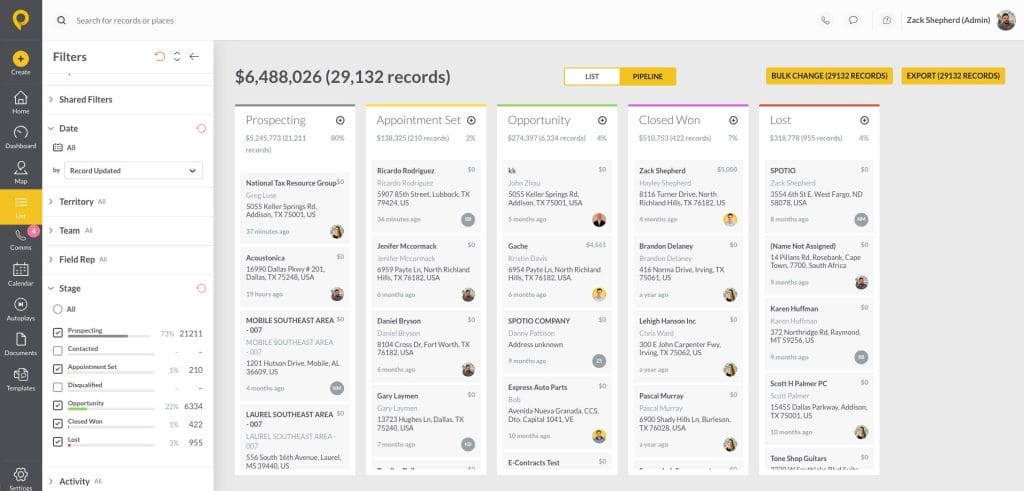
SPOTIO is purpose-built for field sales execution — which means the data feeding your forecast actually reflects how your reps sell. Reps log activities with one tap, check-ins are location-verified, and pipeline data rolls up by rep, team, territory, and organization. Managers get a real-time view of where the team stands without chasing down updates.
The My Reports feature lets admins and managers build custom reporting dashboards with the specific KPIs that matter most — pipeline stage by territory, activity rates by rep, visit-to-close conversion by zone. That territory-level granularity is what separates SPOTIO from CRM-native forecasting tools that aggregate everything at the rep or team level and lose the geographic picture.
SPOTIO integrates with Salesforce, HubSpot, and other leading CRMs. The DASH AI co-pilot helps reps get a quick 10-second brief on any account before a stop and update records using text chat or voice between appointments — every DASH action shows a confirmation preview before writing to SPOTIO, keeping humans in the loop on every data point that eventually feeds your forecast.
Pricing: Contact SPOTIO for custom pricing based on team size and features.
Key Capabilities:
- Territory-level reporting: Pipeline and activity data segmented by territory, not just by rep
- One-tap activity logging: Reps log visits, outcomes, and next steps from the mobile app — no desktop required
- My Reports: Custom dashboards for managers to track the metrics that actually move their number
- CRM integration: Real-time, bi-directional sync with native Salesforce and HubSpot; additional CRMs connect via Zapier (sync frequency depends on Zap configuration)
- DASH AI co-pilot: Answers rep questions from SPOTIO records and your knowledge base, drafts personalized emails and texts for rep review, logs and updates records via chat, and captures data from photos — every change requires rep confirmation before writing to SPOTIO
✅ What we like: Territory-level forecasting that reflects how field teams are actually structured; mobile-first design that drives rep adoption; activity-based pipeline visibility built for D2D and B2B field teams alike
⚠️ Watch out for: SPOTIO is designed for teams of 5 or more reps; smaller teams are unlikely to benefit from its management and reporting capabilities.
User review: “As a sales manager overseeing a B2B sales team, finding a tool that enhances productivity while providing clear insights into team performance is critical. SPOTIO, a leading field sales software, has proven to be an exceptional solution for our needs.” Read the full review on Google.
2. Agentforce Sales (formerly Salesforce Sales Cloud)
Best for: Enterprise B2B field sales teams already operating on Salesforce who need deep forecast customization and CRM-native AI
G2 Rating: 4.4/5 (25,775 reviews)
Agentforce Sales is Salesforce’s flagship CRM — rebranded in 2025 to reflect its AI-first repositioning — and for enterprise field sales teams already running their operations on Salesforce, it remains the most customizable forecasting setup in the category. Einstein AI produces probability-weighted projections based on historical close rates, deal characteristics, and rep performance. Agentforce-layer capabilities add autonomous agent actions for prospect research, follow-up drafting, and record updates.
The tradeoff is complexity. Territory management in Salesforce requires administrator setup, and forecasting hierarchy configuration is not self-serve for most teams. For a 20-rep commercial field team with a dedicated RevOps resource, it’s powerful. For a 15-rep roofing company without a Salesforce admin, it’s likely overkill.
Pricing: Starts at $25/user/month (Starter Suite); Professional at $80/user/month; Einstein AI features on Enterprise tier and above
Key Capabilities:
- Einstein AI forecasting: ML-powered projections based on historical deal data and rep performance patterns
- Forecast categories: Segment pipeline into commit, best case, and upside buckets with custom definitions
- Territory hierarchy: Multi-level territory assignment and rollup reporting across complex org structures
- Agentforce agents: AI agents that can research prospects, draft follow-ups, and update records — with human-in-the-loop oversight
✅ What we like: Most customizable forecasting hierarchy in the category; AI predictions train on your own CRM history; scales to thousands of users without degrading
⚠️ Watch out for: Mobile experience lags behind purpose-built field apps; implementation complexity and cost are real barriers for teams without dedicated Salesforce admins; full AI forecasting requires Enterprise tier or above
G2 Review Summary: Users consistently praise the powerful automation and centralized data management of Agentforce Sales, which significantly enhances efficiency and organization in sales processes. The integration of AI features allows for proactive task management, helping teams focus on building relationships rather than administrative tasks. However, many note a common limitation in the steep learning curve and complexity of setup, particularly for new users.
3. HubSpot Sales Hub
Best for: Mid-market B2B field teams that want CRM-native forecasting tied to inbound marketing data and need fast onboarding
G2 Rating: 4.4/5 (13,781 reviews)
HubSpot’s forecasting is clean, visual, and connected to the same contact and deal data your marketing team is already using. For field sales teams that generate inbound leads alongside outbound territory coverage, the combined picture of marketing-influenced deals and field-sourced deals in one dashboard is genuinely useful.
The forecasting tool itself is simple — deal stage probability, pipeline rollup, goal tracking — rather than sophisticated AI modeling. That’s fine for teams at the “we need to stop forecasting from spreadsheets” stage. It becomes limiting for teams that need rep-level regression modeling or territory-level geographic rollups.
Pricing: Starter from $20/user/month; Professional from $100/user/month; advanced forecasting features on Professional and above
Key Capabilities:
- Pipeline velocity tracking: Monitor how fast deals move through stages to project close timing
- Forecast submission: Reps and managers submit predictions that roll up to a team view
- Deal health scoring: AI flags deals that have stalled or are at risk based on engagement activity
- Marketing-sales alignment: Connect field rep activity to inbound lead attribution in one platform
✅ What we like: Fast onboarding; clean visual dashboards that managers actually use; strong for teams combining inbound marketing with field outreach
⚠️ Watch out for: Key forecasting features sit behind Professional tier ($100/user/month); mobile app doesn’t always match desktop functionality in speed; limited territory-level geographic reporting for pure field teams
User Review: “What I like best about HubSpot Sales Hub is how it brings the entire sales process into one clean and intuitive platform. The pipeline management is extremely user-friendly, and the drag-and-drop deal stages make it easy for our team to track opportunities and stay organized without wasting time on manual updates.” Read the full review on G2.com.
4. Clari
Best for: Enterprise revenue leaders who need AI-powered pipeline inspection across complex sales hierarchies
G2 Rating: 4.6/5 (5,600 reviews)
Clari is the enterprise standard for revenue forecasting. It pulls data from CRM, email, calendar, and call systems to build a forecast based on actual engagement signals rather than rep-submitted pipeline estimates. For organizations where reps routinely over-forecast, Clari’s AI-adjusted model surfaces a more realistic commit number.
The field sales fit is honest: Clari is built for inside sales and complex B2B deal cycles. It doesn’t have territory-level geographic reporting or mobile-first rep workflows. But for the manager layer of a large field sales organization — the directors and VPs who need a forecast they can take to the board — Clari does the job at scale. A CRO at an enterprise software company, who had used Clari across three companies, described it as “a critical tool for forecasting our business” (Gartner Peer Insights, Dec 2025).
Pricing: Contact Clari for custom enterprise pricing.
Key Capabilities:
- AI forecast adjustment: Machine learning models produce probability-weighted projections independent of rep-submitted numbers
- Deal inspection: Drill into individual opportunities with engagement signals — last contact, next step, competitor mentioned
- Pipeline risk alerts: Flags deals that are statistically unlikely to close in the committed period before it’s too late to adjust
- Multi-level rollup: Forecast hierarchies that aggregate from rep to manager to region to organization
✅ What we like: Most accurate AI forecasting in the enterprise category; the separation between rep-submitted forecasts and AI-modeled projections is genuinely valuable for pipeline discipline
⚠️ Watch out for: UI receives consistent criticism in G2 reviews for complexity; not designed for field rep workflows; pricing reflects enterprise positioning
User Review: “Clari delivers excellent revenue forecasting and clear pipeline visibility, helping teams predict deals more accurately. Its AI-driven insights automatically capture sales activities from emails, calls, and CRM data, so key updates don’t get missed. The platform also strengthens sales team accountability and makes deal tracking easier, all within one centralized dashboard.” Read the full review on G2.com.
5. Gong
Best for: B2B field sales teams with meaningful phone and video selling activity alongside in-person meetings
G2 Rating: 4.7/5 (6,616 reviews)
Gong’s forecasting advantage is its input: it captures and analyzes every call, email, and meeting, then factors those engagement signals into deal probability scoring. For field reps who do a mix of in-person visits and phone/video follow-ups, the deal intelligence Gong surfaces — next steps discussed, decision-maker engaged, competitor mentioned — creates a more accurate picture than CRM stage alone.
For pure D2D or canvassing teams where the sales motion is in-person with no meaningful call volume to analyze, Gong’s core differentiator doesn’t apply. The field sales fit improves as team selling complexity increases.
Pricing: Contact Gong for custom pricing
Key Capabilities:
- Conversation intelligence: Records and analyzes calls and video meetings to surface deal risks and coaching opportunities
- Deal signals: 300+ signals feed into AI forecast models — decision-maker engagement, talk track adherence, competitor mentions
- Pipeline inspection: Deal-level risk scoring with suggested next actions
- Forecast categories: Commit, best case, and upside buckets with AI confidence scoring
✅ What we like: Highest G2 rating in the category; conversation data makes the forecast meaningfully more accurate for teams with significant remote selling; strong coaching integration
⚠️ Watch out for: Enterprise pricing; conversation intelligence doesn’t benefit pure in-person field teams; requires consistent call logging discipline to realize the forecasting advantage. Some user reviews mention that the forecasting capabilities need refinement.
User review: “I find Gong incredibly useful for call recordings, summarization, and preparation. The summarization and creation of follow-up emails saves me at least 30 minutes per call, which is essential for me as a CSM…I think the Forecasting could be better, we tried it for a little while for renewals and it still needs improvement.” Read the full review on G2.
6. Pipedrive
Best for: Small-to-mid field sales teams that need clean pipeline visibility and simple forecasting without enterprise complexity
G2 Rating: 4.3/5 (3,038 reviews)
Pipedrive does one thing very well: it makes your pipeline visible. The drag-and-drop interface is the easiest in the category to adopt, and most reps are productive within hours. Revenue forecasting is available on Professional tier and above, built on deal-stage probability weighting.
The honest limitation for field teams: Pipedrive is optimized for deal-based B2B selling, not territory management or activity-based forecasting. There’s no geographic pipeline rollup, and AI forecasting is basic compared to Clari or Gong. For a small commercial field team that needs to stop forecasting in spreadsheets and get organized fast, it’s a strong starting point.
Pricing: Essential from $14/user/month; Advanced $39; Professional $49; revenue forecasting available on Professional and above
Key Capabilities:
- Visual pipeline management: Drag-and-drop deal tracking across customizable stages
- Revenue forecasting: Deal-stage probability weighting with projected revenue reports
- Sales goals tracking: Set rep and team targets and track progress in real time
- Mobile app: Functional field rep app for logging visits and updating deals on the go
✅ What we like: Easiest onboarding in the category; clean pipeline visibility that managers and reps actually use; transparent pricing with no surprises at small team scale
⚠️ Watch out for: Revenue forecasting requires Professional tier; no territory-level geographic reporting; AI forecasting is probability-based only, not predictive modeling; no native calling
7. Aviso
Best for: Sales leaders who want AI-driven forecast accuracy as their primary metric and are willing to invest in a dedicated platform
G2 Rating: 4.4/5 (968 reviews)
Aviso is one of the few platforms that leads with forecast accuracy as its core value proposition. Its AI combines deal scoring, pipeline health, and rep behavior signals to produce multi-scenario forecasts. The WinScore model provides deal-by-deal probability ratings independent of rep-submitted estimates.
The field sales fit is limited — Aviso is built for complex B2B enterprise selling, not territory-based or D2D field operations. For a VP of Sales at a large B2B field organization who has lost confidence in their team’s ability to self-report forecast accurately, it’s worth evaluating.
Pricing: Contact Aviso for custom pricing
Key Capabilities:
- WinScore AI: Deal-level probability scoring that operates independently of rep estimates
- Multi-scenario modeling: Conservative, base case, and optimistic forecasts with confidence intervals
- Pipeline risk detection: Flags at-risk deals before they slip the quarter
- CRM integration: Pulls from Salesforce and other major CRMs; stores data separately for multiple forecast views
✅ What we like: AI forecast accuracy focus is genuine differentiation; multi-scenario modeling helps finance planning conversations
⚠️ Watch out for: Built for enterprise inside/complex sales, not field reps; limited mobile functionality; overkill for mid-market field teams
8. Workday Adaptive Planning
Best for: Finance-led organizations where the VP of Sales and CFO need to align on a single forecast model
G2 Rating: 4.3/5 (307 reviews)
Workday Adaptive Planning comes at forecasting from the finance side. It’s not a sales tool — it’s a planning tool that happens to include sales forecasting as one input among several. For organizations where the board and finance team drive the forecasting process, it fits well. You’ll know it’s time to add a planning layer like this when your CRO starts getting pulled into budget meetings to reconcile three different versions of the same forecast.
For field sales teams, it’s rarely the right primary choice. It has no rep-facing mobile experience, no territory management, and no activity-based forecasting. It belongs in this list because large enterprise field organizations often need a finance-grade planning layer on top of their sales tools — and Workday Adaptive Planning is frequently what that layer looks like.
Pricing: Contact Workday for custom pricing
Key Capabilities:
- Cross-functional modeling: Connect sales forecasts to finance, HR, and operations planning in one model
- Scenario planning: What-if modeling to simulate revenue outcomes under different assumptions
- Data integration: Pulls from CRM, ERP, accounting tools, and external data sources
- Automated reporting: Eliminates version-control issues common in spreadsheet-based planning
✅ What we like: Best-in-class for finance-sales alignment; eliminates the “which spreadsheet is current” problem at scale; trusted by enterprise boards
⚠️ Watch out for: Not a sales tool — no rep-facing interface; no field sales or territory management capability; significant implementation complexity and cost
Quick Comparison
| Tool | Best For | Field Sales Fit | Mobile | AI Capability | Pricing Tier |
|---|---|---|---|---|---|
| SPOTIO | Field sales execution + territory forecasting | ⭐⭐⭐⭐⭐ | ✅ First-class | ✅ DASH AI co-pilot (execution) | Mid-market |
| Agentforce Sales | Enterprise CRM-native forecasting | ⭐⭐⭐ | ⚠️ Functional | ✅ Einstein AI + Agentforce agents | Enterprise |
| HubSpot Sales Hub | Mid-market with inbound + field mix | ⭐⭐⭐ | ⚠️ Improving | ✅ Deal health scoring | SMB–Mid-market |
| Clari | Enterprise AI revenue intelligence | ⭐⭐ | ❌ Desktop-first | ✅ Best-in-class AI forecasting | Enterprise |
| Gong | Teams with meaningful call + field mix | ⭐⭐⭐ | ⚠️ Functional | ✅ Conversation AI | Enterprise |
| Pipedrive | Small teams needing pipeline clarity | ⭐⭐ | ✅ Solid | ⚠️ Basic probability | SMB |
| Aviso | AI forecast accuracy priority | ⭐ | ❌ Limited | ✅ WinScore AI | Enterprise |
| Workday Adaptive | Finance-led planning alignment | ⭐ | ❌ None | ✅ Scenario modeling | Enterprise |
A note on “revenue intelligence” tools: several platforms in this space — including Clari, Gong, and Outreach — lead with that label. For this list, we evaluated tools where sales forecasting is a primary capability, not a module attached to a sales engagement platform.
How AI Is Changing Sales Forecasting
According to Salesforce’s State of Sales, 39% of sales reps say poor data quality is their primary obstacle to forecast accuracy. That number is even more consequential for field teams — because the data quality problem in field sales is a logging problem, not a data structure problem.
According to Forrester research, 79% of sales organizations miss their forecast by more than 10%. The cause is rarely a bad forecasting model. It’s usually incomplete data feeding a decent one.
Before you evaluate AI forecasting tools, check your data. Pull the last 90 days of CRM activity and ask: what percentage of closed deals have complete stage history? If the answer is under 70%, fix the logging problem first. An AI model trained on incomplete data will produce confident-looking projections that are wrong in the same systematic ways as the underlying data.
For teams with strong data discipline, AI forecasting delivers two real advantages:
1. It removes rep optimism from the equation. Reps push deals forward in the pipeline because they’re optimistic, under pressure, or both. AI models flag when engagement signals don’t support a rep’s forecast category — surfacing slippage risk before the quarter closes.
2. It surfaces patterns humans miss. Multi-rep, multi-territory field operations generate more signal than any manager can manually analyze. AI tools find the patterns — the territory that closes 20% faster in Q1, the rep whose close rate drops when average deal size exceeds $15K — and surface them before they become problems.
SPOTIO’s DASH AI co-pilot works differently from standalone AI forecasting tools. Rather than replacing human judgment with ML projections, DASH helps reps keep their activity and pipeline data current — answering questions about accounts from SPOTIO records and your knowledge base, delivering a 10-second brief before any stop, and enabling quick record updates between appointments, with a human-confirmation step before any change is written. Clean, consistent rep data is what makes your downstream forecast worth trusting — whether you’re running regression analysis, pipeline-stage weighting, or a dedicated AI forecasting platform on top.
How to Choose the Right Tool
Before committing to a platform, answer four questions:
1. What’s your sales motion? Pure D2D and canvassing teams need mobile-first activity logging above everything else. Complex B2B field teams with longer deal cycles need stage-based forecasting with rep-level modeling. Enterprise organizations managing both need a layered stack.
2. What size is your team? Under 20 reps: Pipedrive or SPOTIO. 20–100 reps in field sales: SPOTIO or HubSpot. 100+ reps in complex B2B: evaluate Agentforce Sales, Clari, or Gong depending on your existing CRM investment.
3. How good is your current data? If reps aren’t consistently logging, fix the tool they log in before buying a forecasting layer. SPOTIO’s one-tap logging and mobile-first design solves this problem at the source. The best AI forecast is useless if it trains on incomplete activity data.
4. Who owns the forecast? If it’s the VP of Sales: pipeline-stage tools work. If it’s the CFO or board: add a planning layer (Workday Adaptive). If it’s a combination: build the stack in that order — execution first, planning layer second.
Frequently Asked Questions
For small field sales teams (5 to 20 reps), SPOTIO and Pipedrive are the strongest starting points. SPOTIO is the better fit if territory management and activity-based forecasting matter — it’s built specifically for field operations. Pipedrive is the right call if your primary need is pipeline visibility and deal tracking without territory complexity. Both have lower implementation overhead than enterprise platforms like Clari or Agentforce Sales.
AI forecasting accuracy depends almost entirely on the quality of input data. Platforms like Clari and Aviso routinely outperform human-submitted forecasts — but only when underlying CRM data is clean and consistently logged. For field teams with variable rep logging discipline, the accuracy advantage narrows significantly. Fix data quality before evaluating AI platforms.
Technically yes — regression analysis from a spreadsheet is forecasting. But you’ll hit the ceiling fast. A spreadsheet can’t alert you to at-risk deals in real time, model rep-level variance, or roll up territory-level projections automatically. If you’re managing more than five reps, a purpose-built tool pays for itself quickly in time saved on manual forecast compilation.
Pipeline forecasting projects revenue from your current open deals, weighted by stage probability and rep conversion rates. Historical forecasting projects revenue from your past performance, adjusted for growth trends and seasonality. Pipeline forecasting is more responsive to current conditions; historical forecasting is more stable but blind to sudden changes in your pipeline. Most mature teams run both and triangulate between them.
Regression analysis identifies the statistical relationship between a leading indicator (like weekly qualified visits) and a lagging outcome (like monthly revenue). Once the relationship is quantified, you can project future revenue from current activity data — before pipeline stage reflects it. For field sales teams with strong activity logging, regression is often more accurate than stage-based forecasting because activity data updates daily while pipeline stage updates lag by weeks.
Territory-level forecasting rolls up pipeline and activity data by geographic assignment rather than just by rep or team. It lets managers ask: which territories are producing, which are underperforming relative to potential, and where should we add or redistribute coverage? Tools like SPOTIO that capture territory assignment alongside activity data can produce this view natively. Traditional CRM tools typically require custom configuration to replicate it.
Get the Forecasting Accuracy Your Team Deserves
The most common field sales forecasting problem isn’t a bad model — it’s incomplete data feeding a decent one. When reps log consistently and activity data flows cleanly into the pipeline view, the forecast picture sharpens dramatically.
SPOTIO customers see an average 23% increase in sales revenue and a 46% boost in rep productivity — outcomes that start with clean field data and territory-level visibility, not with a more sophisticated forecasting algorithm.
If your team runs in the field and your current forecasting tool was built for desk-bound sales, you already know what that gap costs. See how SPOTIO gives field sales managers the territory-level pipeline visibility and rep activity data that produce forecasts worth trusting — request a demo here.

Krystal brings a rare combination of direct sales, TV/media, and B2B SaaS marketing expertise to her writing. With 10+ years leading integrated marketing campaigns for global organizations, she knows how to build scalable marketing engines that drive real revenue — not just impressions. Her background in direct sales gives her a grounded, practical perspective on what it actually takes to close deals and connect with customers.