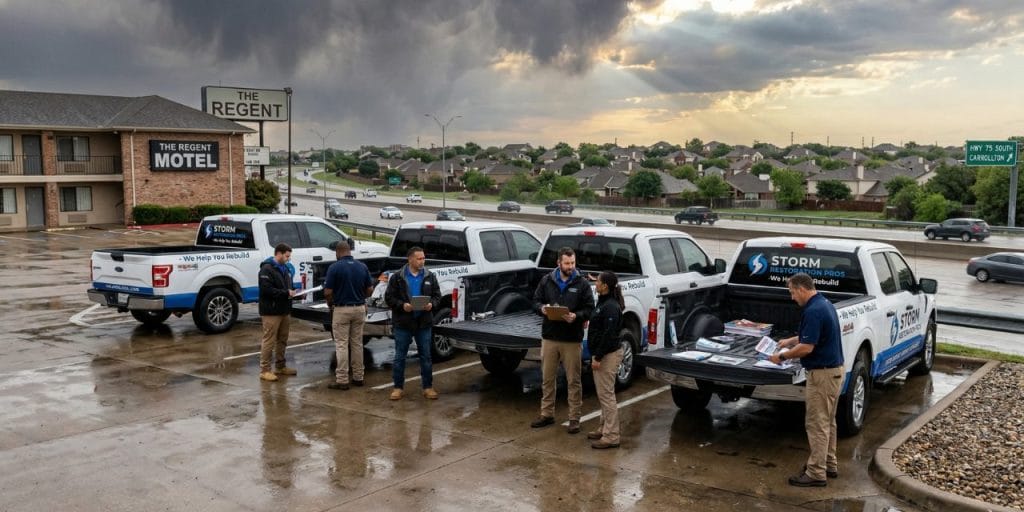

Your team just rolled into a new storm market. Fifteen reps, a hotel parking lot, and a hail swath that stretches across three zip codes. The question isn’t whether there’s opportunity. It’s whether your team will be knocking doors in the hardest-hit neighborhoods by tomorrow morning, or still driving around “scouting” while a competitor signs their fifth contract.
The difference between those two outcomes is storm territory management. Not the general “balance your workloads” kind, but the kind where you go from a hail map to deployed sales teams in under 48 hours.
This is the playbook. It’s built from how top-performing roofing and storm restoration teams actually operate, including the mistakes that cost them deals before they figured it out.
Why Territory Management Wins Storm Season
In storm restoration, there’s no “next quarter.” The bulk of signed contracts come from teams that are knocking doors within the first 48–72 hours after a storm event. Wait a week, and you’re competing against every contractor in the state for homeowners who’ve already had three inspections.
That reality makes storm territory management a completely different discipline than retail roofing. In retail, you can take a quarter to build and rebalance your coverage plan. In storm, you need territories carved, assigned, and visible on your reps’ phones before they’ve finished their morning coffee.
The 48-Hour Window That Decides Your Season
The math is simple. The first team to a storm-damaged neighborhood gets the first-mover advantage: the homeowner hasn’t talked to anyone else, there’s no “let me get a few more quotes” objection, and the social proof from working their neighbor’s house compounds fast.
SPOTIO’s 2026 State of Field Sales data quantifies the operational gap behind this. Among B2C field sales teams, 43% of underperforming organizations still plan territories using spreadsheets or paper. Only 17% of top-performing teams do. That 26-point gap in digital territory adoption is the difference between carving territories from a live hail map in minutes and printing a spreadsheet in a hotel business center.
When you’re chasing a storm, every hour spent on manual territory planning is an hour your competitors are spending at the door.
What Happens Without a Territory Plan
Here’s what we see when storm restoration teams skip territory management — and these are real examples from companies that eventually fixed the problem:
Reps knocking the same doors. One mid-size roofing company discovered their reps were canvassing the same streets without knowing it. No defined boundaries, no visibility into who’d been where. Two reps would show up at the same house in the same week — confusing the homeowner and wasting everyone’s time.
Paralysis by analysis in new markets. I saw this pattern repeatedly when I was managing D2D sales teams. You get to a new market, the storm swath is 20 miles long, and you tell the team “let’s go sell.” Two weeks later, they’re still driving around looking for the perfect neighborhood. They never just start knocking.
No way to report what happened. A telecom company working with multiple vendors had no territory naming conventions and no hierarchy. When leadership asked for performance by territory, they couldn’t produce a report. If you can’t measure territory performance, you can’t manage it — and in storm, you can’t afford that delay.
Doors knocked once and never again. This is the biggest one. Without a territory plan, reps knock a door, nobody’s home, and they move on to a fresh street — forever. They never come back. Our data shows it takes 4–5 passes through a neighborhood to reach a 75% contact rate. That means the rep who knocks every door once and moves on is leaving three-quarters of the conversations on the table. In storm, where every homeowner contact is a potential contract, single-pass coverage is the most expensive mistake you can make.
The fix for all four problems is the same: assign territories before reps hit the street, make them visible, and track coverage in real time.
Build Your Storm Territory Playbook
The best storm teams don’t start planning when the hail starts falling. They have a pre-season playbook ready to activate — a set of templates, naming conventions, and workflows that let them go from storm alert to deployed teams with minimal setup.
Pre-Season Territory Templates
Before storm season starts, set up your territory infrastructure:
Naming conventions matter more than you think. Your territory hierarchy lives on the web platform, but reps see their assigned territories as a list on mobile. If your territories are named “Territory 1,” “Territory 2,” “Territory 3,” your reps have no idea where they’re going without opening each one. Use a consistent format like [Storm Name]–[City/Neighborhood]–[Rep Initials] so the list view is immediately scannable.
Build parent-child territory structures in advance. Create a parent territory for each metro area your company typically works. When a storm hits, you create child territories underneath it for specific neighborhoods. This lets you report revenue and activity at the storm level, the neighborhood level, or the rep level.
Pre-define your territory sizing rules. How many homes per territory? That depends on your team’s capacity and your target contact rate. A good starting point for storm canvassing: 300–500 homes per rep, with the expectation that they’ll make three passes through the territory over the first two weeks.
Storm Intelligence Sources
You can’t carve effective storm territories without knowing where the damage actually is. Hail maps are the foundation.
HailTrace is the industry standard for storm intelligence in the restoration space. It provides meteorologist-produced hail maps with severity grading, wind speed data, and verified impact reports — down to the street level. The data tells you not just where it hailed, but how hard, which directly affects which neighborhoods have the highest concentration of actionable damage.
The key for territory management: you’re not just looking at the hail swath as a whole. You’re looking at severity zones within the swath. A neighborhood that took 2-inch hail is a very different territory than one that got pebble-sized stones. Your best reps should be in the highest-severity zones where claim approval rates are highest and homeowner urgency is greatest.
For a complete breakdown of how SPOTIO fits alongside measurement, proposal, and project management tools, see our roofing software stack guide.
Storm Season Prep Checklist:
- Territory naming convention documented and shared with all managers
- Parent territories created for your top 5–10 metro areas
- Territory sizing rules defined (homes per rep, pass cadence)
- HailTrace subscription active and tested in SPOTIO
- Rep assignment criteria documented (experience tiers, proximity rules)
Deploy Territories After a Storm
This is the core workflow — the part this article exists to walk you through. Here’s how to go from storm alert to reps on the street.
Carve Territories from the Damage Swath
Step 1: Overlay the storm data. If you’re using a tool like SPOTIO with the HailTrace integration, toggle the storm layer on your map. You’ll see the damage swath with severity grading overlaid directly on your territory view.
Step 2: Identify your priority zones. Focus on the highest-severity areas first. These neighborhoods have the most visible damage, the most urgent homeowners, and the highest probability of insurance approval. Don’t spread your team thin across the entire swath on day one.
Step 3: Find the “good enough” zones before your competitors do. Once the center of the storm gets crowded — and it will — the real opportunity shifts to the edges. Look for neighborhoods slightly off the main path that still have enough damage to get approved by insurance. These areas are less competitive, easier to own outright, and your reps can work them without tripping over three other companies on every block. Some of our best-performing storm customers build their entire second-wave strategy around these fringe territories.
Step 4: Draw your territories. Draw territory boundaries around specific neighborhoods within the priority zones. Size each territory based on your pre-defined rules (300–500 homes per rep is a solid starting point for storm canvassing). Bulk-select prospects within those boundaries and assign them to the territory using a tool like SPOTIO’s Lasso. One roofing company takes this a step further: they use the HailTrace integration to create territories around individual storm events, pre-populate pins in the affected zones, and later report revenue by storm — not just by rep or region.
Step 5: Assign and push to mobile. Assign each territory to a rep. The territory boundaries sync to their mobile app — they open it and see exactly where their area starts and stops, with color-coded pins showing which doors have been visited and which haven’t.
The whole process — overlay, carve, assign, deploy — can happen in an hour or two. That’s the difference between a team that’s knocking at 8 AM and a team that’s still figuring out neighborhoods at noon.
Assign Reps and Hit the Streets
Territory assignment in storm isn’t random. Match reps to territories based on:
- Experience level. Your strongest closers go to the highest-severity zones where deal values are largest and homeowner conversations are most complex (insurance processes, supplemental claims, etc.).
- Proximity and logistics. If your team is split across two hotels, assign territories that minimize drive time from each staging point.
- New hire onboarding. Storm season is often when you’re ramping new reps fastest. Give new hires smaller, well-defined territories adjacent to a veteran so they can shadow and then work independently with clear boundaries.
Here’s what I’ve learned about territory ownership: when a rep can see their area shaded on a map, it becomes real. It’s theirs. There’s no bouncing around from lead to lead across town. You own it — and there’s no excuse why any stone is left unturned.
The top storm producers I’ve worked with — people consistently putting up $1.5M to $2M a year — share one trait: they lived in their territory. Sunup to sundown, they knew every street, every homeowner, every piece of damage. They hit it hard for the first couple of weeks, built social proof through visible neighbor-to-neighbor work, and then ran on referrals.
That level of ownership only happens when territories are clearly defined and visibly assigned.
Set Coverage Goals and Track Density
Carving territories and assigning reps is the beginning, not the end. You need to track whether your team is actually working their areas to full density.
Set a contact rate target. In storm canvassing, you’re aiming for a 25–33% conversation rate across your doors. If reps are below 20%, look at their timing — they may be knocking when homeowners aren’t home.
Track with mobile app activity logging. Every door should generate data, even the ones where nobody answers. Reps should use a mobile app to log each visit with a disposition status — “not home,” “interested,” “follow-up,” “no damage”. This builds a coverage map that shows managers exactly which streets have been worked and which haven’t.
Enforce the re-knock. The best storm teams don’t let a “not home” door die. One home services company has an explicit policy: a rep’s territory only expands after their current area has been knocked and re-knocked to a target density. That discipline prevents cherry-picking and ensures every neighborhood is fully worked before resources move on. For a deeper walkthrough, see our complete guide to door-to-door sales.
Use location-verified activities for accountability. Each logged activity includes GPS coordinates, so managers can verify coverage without micromanaging. If a rep’s pins are clustered on two streets while six streets sit untouched, that’s a coaching conversation — and you have the data to back it up.
Measure Storm Territory Performance
Territory management doesn’t end at deployment. The teams that win storm season are the ones that measure, adjust, and know when to move on.
Revenue by Storm, Not Just by Rep
Most roofing companies track revenue by rep or by month. The best storm operators track revenue by storm territory — which lets them answer questions like:
- Which storm events produced the most revenue per door knocked?
- Which neighborhoods within a storm had the highest close rates?
- How does our team’s performance on this storm compare to the last one?
One roofing company does exactly this: they create territories around individual storm events using HailTrace data, run their canvassing and pipeline through those territories, and report revenue per storm at the end of each season. That data informs where they deploy next — and how quickly.
This is the kind of operational maturity that separates serious storm restoration businesses from companies that are just chasing hail.
When to Re-Carve or Close a Market
Not every storm territory stays productive forever. Watch for these signals:
- Diminishing contact rates. If your team has made three passes and conversation rates are dropping below 15%, the territory is approaching saturation.
- Pipeline stalls. Plenty of inspections scheduled but few moving to signed contingencies could mean the damage in that area isn’t as severe as the hail map suggested — or a competitor got there first.
- Cost-to-serve creep. If reps are driving 45 minutes to reach a storm territory that’s producing one deal a week, the math may not work anymore.
One large contractor regularly reviews territory performance data and makes the call to close saturated markets and redirect resources to fresher opportunities. That willingness to pivot — backed by territory-level data — is what keeps them productive across an entire storm season rather than grinding on depleted neighborhoods.
See our guide to sales territory management for strategies to size and balance territories and conduct quarterly reviews.
Frequently Asked Questions
Within 48 hours. The first team to a storm-damaged neighborhood captures the majority of early-intent homeowners — before they’ve collected multiple bids or had time to procrastinate. Pre-built territory templates and integrated storm data let you carve and assign territories the same day a storm hits, so reps are knocking the next morning.
At minimum, you need a hail map with severity grading (HailTrace is the industry standard), your team’s capacity numbers, and a territory management tool that lets you draw boundaries and assign them to reps with mobile sync. Property-level data — roof age, home value, homeowner status — helps prioritize within a territory but isn’t required to get started.
For dedicated storm canvassing, 250 homes per rep is a strong starting point. This gives enough density for three full passes over two weeks while keeping the territory small enough that reps build neighborhood familiarity and social proof. Adjust based on territory density (urban vs. suburban) and your team’s daily door target.
Usually not. Storm territories are carved around damage swaths and are temporary — they exist for the duration of a storm event’s selling window. Retail territories are long-term coverage areas based on market potential and account density. Some companies run both in parallel, with storm territories overlaying their permanent retail boundaries during active storm events. Tools like SPOTIO’s parent-child territory hierarchy make this manageable without creating confusion.
Storm restoration is a speed game, but speed without structure is just chaos. The teams that dominate storm season don’t just get to the market fast — they get to the right neighborhoods fast, with reps who know exactly where their boundaries are and managers who can see coverage in real time.
SPOTIO gives roofing and storm restoration teams the territory management, HailTrace storm data, and field activity tracking to go from storm alert to signed contracts faster — with the data to prove it. Field sales teams using SPOTIO have driven an average 23% revenue increase. See how it works →

Trey Gibson is the founder and CEO of SPOTIO, where he helps sales leaders build more efficient, high-performing field sales teams. With a background in entrepreneurship and as the founder of a roofing company, Trey brings hands-on experience leading door-to-door and B2B sales organizations. He combines real-world sales leadership with a passion for technology and operational efficiency to help teams scale, perform, and win more deals.