I sold my roofing company. Not theoretically. Not as a case study someone else wrote up. I built Hero Roofing from nothing, scaled it to $12 million in revenue, and completed a private equity acquisition for $8 million.
The experience taught me things about what buyers actually care about that I couldn’t have learned from reading articles written by M&A advisers who’ve never sat in the seller’s chair. This is what I wish I had known before I started the process.
Not All PE Deals Are the Same
Before I sold, I assumed “private equity” meant one thing: a firm buys your company, writes you a check, and you move on. The reality is much more nuanced, and the structure of the deal matters as much as the price.
I evaluated several options. Here are the three models I saw:
The rebrand model. One firm wanted to buy Hero Roofing, use our brand as the platform, and then acquire smaller companies and rebrand them all as Hero Roofing. That sounded exciting at first, but it also meant I would be responsible for finding those businesses, convincing them to join, and managing their transition. That’s a lot of work on top of running the company. And rebranding established local businesses under one name almost always destroys the brand equity they’ve built in their own communities.
The random portfolio. I saw firms buying companies with no integration strategy. They’d acquire five or six roofing companies and put them under an umbrella, but nothing worked together. No shared systems, no unified processes. If you’re a future investor looking at that portfolio, you just see a bunch of disconnected companies. There’s nothing to scale.
The platform model. This is what I chose. The firm had experience in home services. They had a chairman from a $200 million residential roofing company who knew the industry. They were acquiring strong local brands, keeping the brand names and logos intact, but unifying all the back-end systems: same CRM, same accounting software, same processes. It’s one company that works together, with different brands in different markets. The brands are strong in their communities, but the systems underneath are standardized.
That’s the model I’d recommend evaluating. It protects your brand, protects your team, and gives you the operational infrastructure of a much larger company. Storm Guard is a good example of what that scale looks like — 39 locations across 17 states running on unified field operations.
The Two Things That Drive Your Valuation
After going through this process, I believe the two biggest drivers of valuation for a roofing company are clean financials and community reputation.
On financials: buyers don’t care about your revenue number as much as you think. What they care about is a clean and healthy EBITDA with systems and processes that are repeatable. I’ve seen companies doing $20 to $30 million get under due diligence and the deal falls apart because their books aren’t clean. Personal expenses mixed in. Revenue not segmented. No clear P&L by period.
Your EBITDA has to tell a real story. A $3 million company with clean books and 15% margins is more attractive than a $10 million company with messy financials and 5% margins. I know guys doing $3 million who take home as much as guys doing $10 million. The number that matters is the one at the bottom, not the top.
On reputation: when buyers were researching us, we showed up at the top of local search. We had strong Google reviews. We were known in Newnan. We had almost a buyer a day reaching out to us before we even formally engaged. That doesn’t happen without a brand people trust and recognize.
The combination of those two things, financial health and market reputation, is what creates competition among buyers. And competition is what drives your multiple up.
What Due Diligence Actually Feels Like
Nobody warns you about this part.
I did the transaction with a legal team but no M&A adviser. I handled the due diligence myself with help from my GM. It took almost six months, and it nearly took me out of the business.
Buyers will ask for the same document five different times in six different formats. P&L statements by month, by quarter, by year. Cash and accrual. Marketing ROI by lead source. Revenue broken down by trade: how much came from roofing versus gutters versus chimney caps versus siding. Commission structures and how they scale. Employee tenure. Production throughput. Insurance claims history.
If you don’t have this pre-organized, you’re building it on the fly while trying to run your company. And here’s the worst part: you can’t tell your staff why you’re distracted. They see you unfocused. They’re not getting the best version of you. You can’t explain why until the deal closes, in case it falls through.
I wish I had built a data room before the first conversation. Every report, every P&L, every lead source analysis, organized in folders, ready to hand over. If I did it again, that would be the first thing I’d build.
What I Would Do Differently
Get an adviser. This is the biggest one. An experienced M&A adviser in the roofing or home services space would have managed the due diligence process, negotiated harder on the multiple, and kept me focused on running the company. I left money on the table because I didn’t know what I didn’t know. An adviser could have also gotten the deal done faster than six months.
Pre-build the data room. Accrual and cash P&L by month, quarter, and year. Marketing spend and ROI by lead source with actual reports showing what each channel produced. Revenue segmented by trade. Commission payout history. Employee roster with tenure. Production metrics. Have all of it in organized folders before anyone asks. A roofing CRM that captures this data in real time makes the data room almost self-building.
Negotiate more. Hindsight is what it is. People I’ve talked to since have told me I could have pushed harder on certain terms. When you’re doing it yourself for the first time, you don’t know the leverage points. An adviser does.
Track everything earlier. We did a good job tracking some lead sources, but I wish we’d been more rigorous from the start. When a buyer asks, “What did that ad spend produce?” and you can pull up a clean report, that builds confidence. When you have to estimate, it erodes it.
Know Why You’re Scaling
Before you start chasing a PE exit, ask yourself why you’re scaling in the first place.
I have friends who run $3 million roofing companies and take home as much profit as owners doing $10 million. More revenue doesn’t automatically mean more freedom or more money. Sometimes it means more complexity, more risk, and thinner margins.
Are you scaling because you want financial freedom? Because you want to employ more people and give back to your community? Because you want to build something you can sell? Each answer leads to a different strategy, and they’re not all the same strategy.
For me, the answer changed around 2022 when I started learning about PE in the roofing space. That’s when I started chasing specific revenue and EBITDA targets to make Hero attractive to buyers. But I was deliberate about it. I wasn’t just chasing a number; I was building toward a specific outcome.
PE firms generally aren’t looking at $3 to $5 million companies. They’re targeting $10 million and above. We were the smallest company in our platform’s portfolio; every other company was roughly twice our revenue. If a PE exit is the goal, that revenue threshold and the EBITDA to support it need to be part of your plan from the start.
What to Look for in a Buyer
If you decide to sell, do your due diligence on the buyer just as hard as they do on you. I can’t stress this enough.
There are a lot of unhappy sellers in the roofing industry right now. Some PE firms have gone the wrong direction. Some have gutted the companies they acquired. If your business was your baby, it’s not going to be your baby anymore, and you need to be comfortable with who’s holding it.
Here’s what to evaluate:
What’s their plan for your staff? One firm I talked to told me on the initial call they would replace all the management. I go to church with my employees. I didn’t want to sell to a company that fires everyone I built the business with. That was a dealbreaker for me, and it should be a question you ask early.
What’s their two-year, five-year plan for the business? Are they growing it or stripping it? Are they keeping your brand or rebranding everything? What role do you play after the sale?
Be prepared to become an employee. If you stay on, the things you used to decide on your own now go through a chain of command. You might need approval before pulling a trigger on a spend that would have been routine when you owned the company. That’s not a bad thing, but you have to be ready for the shift.
Making Your Field Operations Buyer-Ready
Everything I’ve described, the flowcharts, the CRM integration, the revenue tracking, the lead source analysis, depends on having clean, reliable field data. And in roofing, that data comes from what your reps do every day between stops.
If your sales team is logging activity consistently, if your territories are mapped and balanced, and if your pipeline is visible from first contact through signed contract, you can answer every buyer question with data. If it’s all in your head or in a stack of spreadsheets, you’re going to spend six months producing documents from scratch like I did.
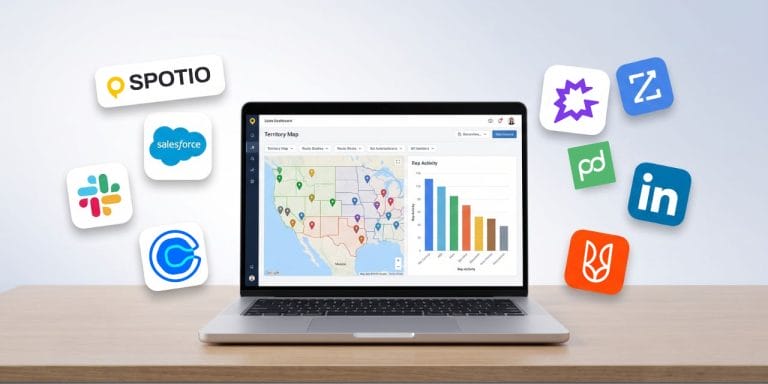
SPOTIO builds this data layer into your daily field operations. One-tap activity logging or voice-to-CRM with GPS verification gives you the field activity data that buyers want to see without burdening your reps. Territory management proves your market coverage is systematic, not ad hoc. And the reporting that comes out of consistent platform usage over months and years is exactly the kind of operational proof that moves a PE firm from interested to confident.
Start building this data layer now, not when a buyer is already in the room. The companies that sell at premium multiples are the ones that can prove how the business works, not just claim it. For a deeper look at how PE firms evaluate field sales infrastructure across their portfolios, see PE-backed field sales value creation strategies.
If you want to see how SPOTIO builds the field visibility that makes a roofing company buyer-ready, get a SPOTIO demo.
Frequently Asked Questions
It varies, but roofing companies in the current market generally sell for 4 to 7 times EBITDA, depending on revenue size, growth trajectory, systems maturity, and revenue mix. Companies with clean financials, strong brands, and retail-heavy revenue tend to command the higher end of that range.
My process took six months. It would have been faster with an adviser managing the document flow. Expect the buyer to ask for financial records, operational documentation, marketing ROI data, employee information, insurance history, and production metrics, often in multiple formats.
Yes. I did the transaction with only a legal team and no adviser, and I believe it cost me both time and money. An adviser who specializes in roofing or home services M&A will manage the due diligence process, negotiate harder on your terms, and help you avoid the mistakes first-time sellers don’t see coming.
Retail. Insurance-based revenue is unpredictable because it depends on storm activity. PE buyers want consistent, growing revenue that isn’t tied to weather events. A strong retail mix, where homeowners are choosing you and paying out of pocket, signals brand strength and revenue predictability.
Thinking their revenue number is what sells the business. Buyers care about clean EBITDA, documented systems, a team that runs without the owner, and a strong community reputation. A $10 million company with messy books and owner-dependent operations will struggle in due diligence.
Nick Branon is co-founder and CEO of Hero Roofing in Newnan, Georgia. He started the company in 2018 with his father Todd, and joined the private-equity-backed Omnia Exterior Solutions platform in 2024. He remains CEO. Through his consulting practice, The CEO Hero, he now coaches roofing and contractor owners on the leadership problems that come with growth.