
Your reps are heading out for the day in 20 minutes. You’ve got a whiteboard, a room full of people who’d rather be talking to prospects, and a half-finished agenda. Sound familiar?
According to research from Atlassian, 72% of meetings are considered ineffective — and that’s in desk-based environments where at least nobody’s losing windshield time to sit through them. For field sales managers, a bloated or aimless meeting doesn’t just waste 45 minutes. It eats into the hours your reps are actually paid to spend in front of prospects. According to SPOTIO’s 2026 State of Field Sales survey, reps already spend 8% of their week in internal meetings and training — on top of an 18–25% admin tax before they ever leave the office. That time needs to earn its keep.
A well-built sales meeting agenda fixes most of this. This guide covers what to include, how to run it, and when to hold each meeting type — plus ready-to-use templates for daily huddles, weekly syncs, and monthly reviews.
What Is a Sales Meeting Agenda?
A sales meeting agenda is a structured list of topics, time allocations, and expected outcomes shared with your team before the meeting starts. For a field sales manager, it’s the difference between a meeting that fires up your reps and one that makes them wish they’d called in sick.
A good agenda does three things: it tells reps what to prepare, it keeps the meeting on track, and it ensures every minute maps to something that improves performance in the field. If an agenda item doesn’t directly help reps close more deals, reduce rejection, or run better territory — cut it.
Top-performing managers — those with 75% or more of their team hitting quota — are 42% more likely to excel at leading valuable team meetings than their peers. The meeting isn’t a formality. It’s a performance lever.
Huddle vs. weekly sync vs. monthly review
Not all sales meetings are the same, and treating them as if they are is one of the most common mistakes field sales managers make. Here’s how to think about each format:
- Daily huddle (10–15 min): Quick standup before reps hit the road. Energy, one focus, and go. Not the place for metrics deep-dives.
- Weekly sync (30–45 min): The workhorse meeting. Metrics review, pipeline check-in, short training segment, action items. Runs on a consistent repeatable format every week.
- Monthly review (60 min): Bigger picture. Territory performance, rep development, competitive landscape, longer training block. Reps should come prepared.
Essential Elements of a Sales Meeting Agenda
Every effective field sales team meeting agenda — regardless of cadence — is built from the same core components. The difference is how deep you go on each one.
1. A clear purpose and single takeaway: Before you build the agenda, answer this: what is the one thing you need every rep to walk out of this meeting knowing or doing differently? One central message. Not five. When you try to cover everything, you land nothing.
2. An energizer: For D2D teams especially, the energy in your meeting is the energy your reps bring to the first door. Start with something that gets the room engaged — a quick contest update, a rep shouting out a win, a team trivia question, or a 60-second pitch challenge. It doesn’t need to be elaborate. It needs to work.
3. A metrics review: A focused look at the 4–5 numbers that actually matter: visits completed, contact rate, appointments set, close rate, and follow-up completion. The goal isn’t to call anyone out — it’s to surface patterns. If three reps’ sales activity tracking numbers dropped this week, that’s a coaching conversation. If one rep’s close rate jumped, that’s a learning moment for the whole team.
4. A training segment: This is the most skipped item on most sales meeting agendas — and the most important one. Too many sales training programs run new-hire sessions once and call it done. The managers who build consistently top-performing teams treat every meeting as a development opportunity. Even five minutes of focused skill-building equals more than four hours of rep development per year — without adding a single training event to the calendar.
5. Pipeline and territory updates A quick read on what’s moving, what’s stuck, and whether any territories need attention. In the weekly sync this is brief. In the monthly review it gets more time.
6. Action items with owners Every meeting ends with specific next steps assigned to specific people. Not “let’s all work on contact rate.” Instead: “Marcus — you’re pulling your re-knock list by Thursday. Sarah — you’re shadowing two of Marcus’s closes this week.” Named. Dated. Done.
The one thing most field sales managers skip
Training. Every time. Managers know it matters, but when the meeting runs long or something urgent comes up, the training block gets cut first. The fix is to put it earlier in the agenda — not at the end where it’s always at risk. If your meeting is 30 minutes, training gets minutes 15–25. Not minutes 28–30.
A simple format that works: the pitch roundtable. Pick one common objection. Give every rep 60 seconds to handle it their way. Debrief as a group on what worked. You’ve just run a training session in under 10 minutes, and your reps will remember it because they said it out loud themselves.
Field Sales Meeting Agenda Templates
Use these as your starting point. Copy them, adjust the time blocks for your team size, and run the same format every time. Consistency matters — when reps know what to expect, they come prepared.
Daily huddle agenda (10–15 minutes)
Best for: High-volume D2D teams, canvassing crews, or any team where reps go straight from the meeting to the field.
| Time | Item | Notes |
|---|---|---|
| 0:00–2:00 | Energizer / quick win | Contest standings, shoutout, or 60-sec trivia |
| 2:00–5:00 | Today’s focus | One skill, one target, one message |
| 5:00–10:00 | Territory or route notes | New intel, re-knock priorities, weather/event flags |
| 10:00–12:00 | Questions + send-off | Fast, high-energy close |
Key rule: No metrics review in a huddle. Save the numbers for the weekly sync. The huddle is about mindset and direction — keep it fast and keep it positive.
Weekly field sales team meeting agenda (30–45 minutes)
Best for: All field sales teams. This is your core recurring meeting.
| Time | Item | Notes |
|---|---|---|
| 0:00–3:00 | Energizer / wins | Contest update, rep shoutout, quick win |
| 3:00–12:00 | Metrics review | Door knocks, contact rate, appointments, close rate — team and individual |
| 12:00–22:00 | Training segment | Pitch roundtable, objection workshop, role play, or guest topic |
| 22:00–30:00 | Pipeline + territory | What’s moving, what’s stuck, any territory changes |
| 30:00–40:00 | Company updates | New product or pricing info, marketing campaigns, process changes |
| 40:00–45:00 | Action items + close | Named owners, specific deadlines, high-energy close |
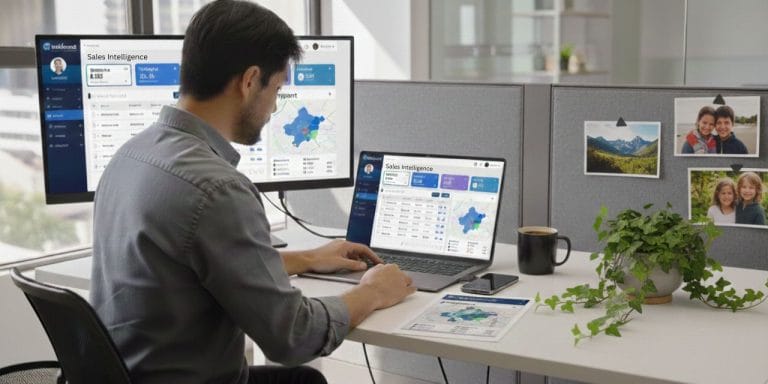
SPOTIO prep tip: Before this meeting, run your team’s 7-day activity report in SPOTIO — door knocks, contact rate, and appointments set by rep. My Reports lets you build this view once, save it, and re-run it in seconds before every meeting. Your metrics review becomes data-driven instead of memory-based, and you’ll spot coaching conversations before they walk into the room.
Monthly field sales meeting agenda (60 minutes)
Best for: Deeper performance reviews, rep development conversations, and sales territory management strategy.
| Time | Item | Notes |
|---|---|---|
| 0:00–5:00 | Energizer / recognition | Month’s top performer, team milestone, or award |
| 5:00–20:00 | Performance review | Full metrics by rep, trend analysis vs. prior month, quota attainment |
| 20:00–35:00 | Extended training block | Longer role play, external guest, video + debrief, or skill module |
| 35:00–45:00 | Territory performance | Which territories are saturating, which need re-prioritization, new lead sources |
| 45:00–55:00 | Strategy + competitive intel | What competitors are doing in your market, any offer or messaging adjustments |
| 55:00–60:00 | Goals + action items | Individual goals for the coming month, named owners, specific metrics |
Note on rep preparation: For monthly reviews, send the agenda 48 hours in advance and ask reps to come with one thing they want to work on and one win they want to share. This turns a top-down presentation into a two-way conversation — and reps who prepare engage more.
How to Run Your Field Sales Team Meeting Effectively
Having an agenda is table stakes. Running it well is where most managers separate from the pack.
Before the meeting: prep in under 10 minutes
Pull your field sales metrics for the relevant time window. You want door knocks, contact rate, appointments set, and close rate by rep. Identify one rep who’s trending down and one who’s trending up — both will be talking points. Set your single central takeaway for the meeting and make sure your training segment is prepped and timed. That’s it. Ten minutes of prep produces a meeting that feels intentional from the first 30 seconds.
If you’re going into a monthly review, also pull your territory performance report in SPOTIO. Look for any territories where contact rates have dropped significantly — this is often the first sign of saturation and a natural strategy discussion point.
During the meeting: fast, focused, field-ready
Start on time. In a D2D environment, every minute your meeting runs late is a minute your reps aren’t at doors. That cost is immediate and measurable — unlike a desk-based team where a late start just delays email.
Before you add anything to your agenda, run it through the KISS test: does this item need to be in the room, or could it be an email? If it’s informational-only, send it ahead of time. Use meeting time for discussion, training, and decisions — not for reading reports aloud.
Move at a brisk pace. A meeting that feels fast and dense is one your reps will walk out of energized. A meeting that drags is one they’ll find excuses to skip next week. If you’re running over on a topic, table it and follow up 1:1.
After the meeting: close the loop
Action items kill momentum if nobody follows through. Assign every action item by name and date before the meeting ends. Don’t leave it as a verbal agreement — write it down, log it as a task or follow-up in your system of record, or drop it in your team’s preferred channel. At the start of your next meeting, spend two minutes reviewing last week’s action items before moving on. Consistently closing the loop on action items is one of the fastest ways to build a culture of accountability on your team.
How Often Should Field Sales Teams Meet?
Cadence depends on your team size, sales cycle, and how much changes week to week. Here’s a practical framework for most field sales teams:
- Daily huddle: Best for high-volume D2D teams with short sales cycles (security, telecom, home services). If your reps are knocking 50+ doors a day, a 10-minute standup keeps everyone aligned without eating into selling time.
- Weekly sync: The baseline for every field sales team regardless of vertical. Consistency matters more than perfection — same day, same time, same format every week.
- Monthly review: Run this instead of a longer weekly meeting once a month. Swap the 45-minute weekly format for the 60-minute monthly format so reps don’t feel the calendar is getting heavier.
- Annual kickoff: Separate from your regular cadence entirely. For planning a sales kickoff meeting, the format, preparation, and goals are fundamentally different — see our full guide.
More meetings rarely fix a performance problem — better meetings do. If your weekly sync isn’t working, fix the format before adding a second meeting to the calendar.
Frequently Asked Questions
The six non-negotiables are: a clear single purpose, an energizer to open, a metrics review, a training segment, pipeline and territory updates, and named action items to close. For field sales teams, the training segment is the most commonly skipped and highest-ROI item. Even five focused minutes of skill-building per week adds up to more than four hours of development per rep per year — without scheduling a single additional training event.
It depends on the format. Daily huddles should run 10–15 minutes — any longer and you’re eating into field time. Weekly syncs should run 30–45 minutes with a hard stop. Monthly reviews can run up to 60 minutes when the agenda is properly structured. If your weekly meeting consistently runs over 45 minutes, the agenda has too many items — not too little time.
Don’t start without an agenda. Don’t use meeting time to share information that could be an email. Don’t single out underperformers publicly without a separate coaching conversation happening. Don’t skip the training segment when you’re running short on time — cut company updates instead. And don’t end without named action items. A meeting with no follow-through is just a conversation.
A huddle is a brief daily standup — 10–15 minutes, focused on energy and direction for the day. A sales meeting is a structured weekly or monthly session covering metrics, training, pipeline, and strategy. Huddles keep the team aligned day-to-day. Meetings drive development and accountability over time. High-performing D2D teams often run both: a daily huddle before reps hit the road and a weekly sync for deeper work.
Three things work consistently: start with energy (a win, a contest update, or a challenge), make the training segment interactive rather than lecture-style (pitch roundtables and objection workshops beat slide decks every time), and keep the pace fast. Reps disengage when meetings drag or feel like a performance review rather than a team conversation. The more your reps talk and the less you talk, the more engaged the room will be.
A well-run sales meeting agenda is one of the most underutilized performance levers in field sales management. The managers who build consistently top-performing teams run tight, structured, high-energy meetings on a repeatable cadence — not because they love meetings, but because they understand that what happens in the room directly affects what happens at the door.
SPOTIO gives field sales managers the activity data they need to prep and run sharper meetings — contact rates, door knocks, appointment conversions, and territory performance — all reportable through My Reports in minutes. See how field sales teams use SPOTIO to run tighter meetings and close more in the field. Request a demo →