
Running the same “highest revenue wins” contest month after month kills motivation for 80% of your team. Your top three reps battle it out while everyone else stops trying by day three.
Multiple contest types create multiple paths to win. Your rookie can compete for “Most Improved Conversion Rate” while your veteran chases the revenue crown. Your struggling rep in a tough territory can win “Most Doors Knocked” even if closings are down. Suddenly, 15 reps have a realistic shot instead of just three.
This guide covers 25 contest formats that engage entire teams, plus tactical implementation advice on duration, budgets, tracking, and common mistakes that kill engagement.
Contest Quick Reference Guide
The contests below work across different team structures, sales cycles, and skill levels. Each creates opportunities for different reps to win based on activity, improvement, collaboration, or creativity—not just raw revenue numbers.
| # | Contest Name | Best For | Duration |
|---|---|---|---|
| 1 | Daily Prize | All Teams | 1 day |
| 2 | Most Nos | Inside Sales | 5-7 days |
| 3 | Sales Bingo | All Teams | 2-4 weeks |
| 4 | Customer Reviews | Field Teams | Ongoing |
| 5 | Lead Conversion | Inside Sales | 1-2 weeks |
| 6 | The Whopper | All Teams | 1-4 weeks |
| 7 | Most Wanted | All Teams | 1-3 months |
| 8 | Upsell Contest | All Teams | 1 month |
| 9 | Retention-Based | All Teams | 1-3 months |
| 10 | Salesperson of the Month | All Teams | 1 month |
| 11 | Buddy Up | All Teams | 1 month |
| 12 | Scavenger Hunt | All Teams | 1-2 weeks |
| 13 | Fantasy Sales Teams | All Teams | 1 month |
| 14 | Enterprise-Level | Multi-location | 1 month |
| 15 | Surprise Appreciation | All Teams | 1 day |
| 16 | Sales Poker | All Teams | 2-3 weeks |
| 17 | Brackets | All Teams | 3-4 weeks |
| 18 | Raffle | All Teams | 1-3 months |
| 19 | Pitch Contest | All Teams | 1-2 weeks |
| 20 | Traveling Trophy | All Teams | Weekly/Monthly |
| 21 | Winner’s Choice | All Teams | Varies |
| 22 | I OWE U | All Teams | 1-4 weeks |
| 23 | Boss for the Day | All Teams | 1-4 weeks |
| 24 | Time-Reward | All Teams | 1 month |
| 25 | The Loser | All Teams | 1 week-1 month |
Activity-Based Contests
These contests reward effort and consistency rather than closing ability. They work especially well for newer reps still building skills and for teams in long sales cycles where revenue results lag months behind activity.
1. Daily Prize
Reset the leaderboard every 24 hours so yesterday’s loser gets a fresh start today. Track a high-frequency metric like calls made, doors knocked, or appointments set—activities reps can control regardless of deal velocity. Award small prizes ($50-$100 gift cards) to maintain daily momentum without breaking your budget.
2. Most Nos (in a single week)
Whoever racks up the most rejections wins. Counterintuitive, but it crushes call reluctance and drives up activity volume—more attempts mean more eventual wins, even if your close rate stays constant. Keep this contest to 5-7 days maximum since the gap between highest and lowest rejection counts widens beyond that, making it less competitive.
3. Sales Bingo
Create bingo cards where each square represents a different sales goal: “Close deal over $5K,” “Book 3 demos in one day,” “Get referral from existing customer,” “Visit 5 new neighborhoods.” Reps need skill to complete squares and luck to get them in the right sequence. Award prizes for any completed line ($50), four corners ($100), or full blackout ($250)—this creates multiple winning tiers so more than one rep gets recognized.
4. Customer Reviews
Whoever collects the most customer reviews (positive or negative) wins. Set up an easy survey process—QR codes, text-to-review links, or automated email requests—so reps can request feedback on the spot without friction. This contest rewards reps who consistently ask for reviews, improving your online reputation while recognizing quality service beyond just closed deals.
5. Lead Conversion
Hand out leads randomly and evenly to all reps. Whoever converts the most within the timeframe wins. Some luck involved since lead quality varies, but randomization keeps it fair—everyone gets the same quantity, and you prevent cherry-picking of the best prospects. Track conversion rate alongside raw conversions to reward efficiency, not just volume.
Revenue & Performance Contests
These focus on outcomes rather than activities. They favor experienced reps with established territories but can be structured to give everyone a fair shot through improvement metrics or category-specific goals.
6. The Whopper (or Top This)
Whoever closes the single biggest deal during the contest period wins. Works well in industries with variable deal sizes—enterprise software, commercial real estate, equipment sales—where landing one whale beats closing ten minnows. This rewards reps who pursue strategic accounts instead of just churning through high-volume, low-value deals.
7. Most Wanted
Identify your dream accounts—the biggest leads in your industry—and distribute them evenly to reps. Whoever lands the largest whale wins. These aren’t random leads; they’re strategic targets you’ve been pursuing, possibly for months or years. Give reps dedicated time to work these accounts without pressure to hit daily activity quotas on smaller prospects.
8. Upsell Contest
Reward reps for growing revenue from existing customers. Score by largest upsell dollar amount, highest upsell percentage relative to the client’s prior spending, or most clients successfully upsold. This shifts focus from new business to account expansion—often easier to close than cold prospects and more profitable long-term since customer acquisition costs are already sunk.
9. Retention-Based Contest
In most industries, repeat customers drive profitability more than one-time sales. Reward the highest number of renewals, best retention percentage, or most reactivated dormant accounts. Display progress on an office whiteboard or digital dashboard so reps visualize their individual contribution to building a loyal customer base that compounds revenue over time.
10. Salesperson of the Month
The classic contest. Traditionally awards highest revenue, but rotate what you measure each month to give different reps a chance: most individual sales, most “Nos” (rejection contest), most customer reviews, or best peer coaching score. Winner gets their name and photo displayed prominently for 30 days—add a rotating trophy or plaque to make recognition tangible and visible.
Team Collaboration Contests
These contests reduce individual competition in favor of team goals. They work well when hyper-competition is creating toxic dynamics or when you need to spread expertise from top performers to the rest of the team.
11. Buddy Up
Pair top performers with struggling reps and score the team based on the lower performer’s improvement rate—not absolute numbers. This incentivizes real mentoring since the top rep can’t just carry the team; they need to coach their partner to improve. Track percentage gain over the partner’s baseline to reward growth, making it competitive for pairs at any performance level.
12. Sales Team Scavenger Hunt
Set objectives that require collaboration: hit a combined revenue goal, sell specific products across different categories, complete a certain number of upsells from different team members. Team members with specialized skills (prospecting expert, closer, account manager) must work together to check off items. This builds cross-functional appreciation and breaks down silos between different sales roles.
13. Fantasy Sales Teams
Break your team into groups through a random draft, just like fantasy football. Assign points for each “player’s” sales activities and results—calls made, demos booked, deals closed. The manager or team that earns the most fantasy points at period-end wins. This borrows the water cooler excitement of fantasy sports and redirects competitive energy toward sales outcomes while building team camaraderie.
14. Enterprise-Level Contest
Pit offices against offices or managers against managers. Award bragging rights—recognition in company meetings, trophy display, team lunch funded by the losing office. This builds team cohesion within each office and shifts focus from individual rankings to collective achievement, which can reduce unhealthy internal competition while maintaining competitive energy.
15. Surprise Salesperson Appreciation
Choose a mid-tier performer who consistently shows up but never tops the leaderboard. Have the entire team bring small gifts or appreciation letters on a surprise recognition day. Sales teams often lose sight of morale in favor of competition—this reminds everyone that steady contributors matter even when they’re not winning contests, building psychological safety alongside performance pressure.
Creative & Gamified Contests
These contests add game mechanics—chance, luck, brackets, tournaments—that level the playing field between top and bottom performers. Pre-built sales gamification platforms make these easier to run than manual tracking.
16. Sales Poker
Reps draw five cards from a standard deck by achieving specific goals—each milestone earns a card. At period-end, best poker hand wins the prize. Everyone has a chance regardless of sales ability since luck determines card quality, though skill still matters to earn enough cards for a complete hand. Modern gamification platforms can automate this digitally, with reps “drawing cards” when they hit milestones.
17. Brackets
Run a tournament-style competition like March Madness. Each rep competes head-to-head against another rep for the week based on a specific metric. Winner advances; loser is eliminated. As weeks progress, intensity increases as the field narrows and remaining competitors know they’re close to the prize. Gamification platforms offer pre-built bracket templates that auto-populate based on your team size and auto-update standings as results come in.
18. Raffle
Distribute raffle tickets when reps hit specific goals—daily activity targets, milestone achievements, or performance thresholds. Draw for a larger prize ($500-$1,000) at period-end. This rewards consistency over time since even lower performers accumulate tickets throughout the contest, giving everyone a realistic shot at the big prize regardless of where they rank on the leaderboard at any given moment.
19. Pitch Contest
Top producers submit their best sales pitch anonymously. The team votes on the best pitch after trying to guess who wrote each one. Winner gets recognition; everyone gets copies of the winning pitches to learn from and adapt. This doubles as training—spreading best practices across the team while recognizing excellence in a skill beyond just closing ability.
20. Traveling Trophy
Award a physical trophy—make it substantial, 18-24 inches tall—to whoever leads in sales each week or month. As long as they stay on top, the trophy sits on their desk. When someone overtakes them, the trophy moves to the new leader’s desk. A gleaming trophy visible to the entire office creates the competitive fire you want, and posting weekly photos of the current holder in your team Slack or break room amplifies the recognition.
Non-Cash Reward Contests
Not every prize needs to be money or gift cards. Time off, experiences, and recognition often motivate as effectively as cash—sometimes more effectively—at lower cost to the company.
21. Winner’s Choice
Let the winner pick their own prize from a pre-approved menu. Options might include $300 cash, concert tickets, team lunch at their favorite restaurant, or a day of PTO. This eliminates prize complaints since the winner literally chose what they wanted, and you learn what your team actually values for future contests.
22. I OWE U (from the boss)
Winner earns a favor from management—cook them lunch, wash their car, give them a dedicated coaching session, or perform karaoke to their chosen song in front of the team. Set a structured timeline and goal well in advance, and make clear the prize options since you’ll be fulfilling the debt. Have reps submit prize requests before the contest launches, then pick one that fits your comfort level and time availability.
23. Boss for the Day
Winner runs a meeting, picks the location for the next team lunch, sits at your desk for the day, or assigns territories. They get to hear “Yes, boss!” all day long. This works best with teams that have strong rapport and can handle role reversal with humor—don’t run this if your culture is too formal or hierarchical for playful power dynamics.
24. Time-Reward Contest
Reward winners with time off—leave early Friday, arrive late Monday, or take a PTO day. This motivates strongly because time is universally valued across all demographics and compensation levels. Run these near the end of a sales cycle since reps sometimes hold deals to start the next period strong, and timing matters to avoid gaming the system.
25. The Loser
Flip the script—whoever finishes last pays $20 toward a team party, company lunch, or charity chosen by the team. Make the amount small enough that losing doesn’t sting financially, but meaningful enough to spur effort. Direct the money toward holiday parties, picnics, team lunches, happy hours, or a team-chosen charity so even the “penalty” contributes to team bonding or good causes.
Why Sales Contests Work
Humans compete naturally. Sales contests channel competitive energy toward specific business goals while creating multiple recognition paths that keep entire teams engaged—not just top performers.
Research from Michigan State University found that purpose-driven motivation correlates more strongly with sustained sales performance than purely financial incentives. Sales contests work because they combine extrinsic rewards (prizes, recognition) with intrinsic motivation (achievement, status, progress toward mastery).
The key is structuring contests so they feel achievable. When only 25% of B2B sales reps hit quota, contests that create multiple winning paths keep the other 75% engaged instead of checked out.
Gamification amplifies contest impact. Basic leaderboards show rankings. Full gamification adds competition formats, achievement systems, recognition feeds, and reward structures that engage entire teams. Companies using gamification platforms see measurable performance lifts within six months. Insurance and financial services companies report significant increases in call volume and daily activity consistency, with some teams seeing double-digit improvements in key metrics within the first quarter.
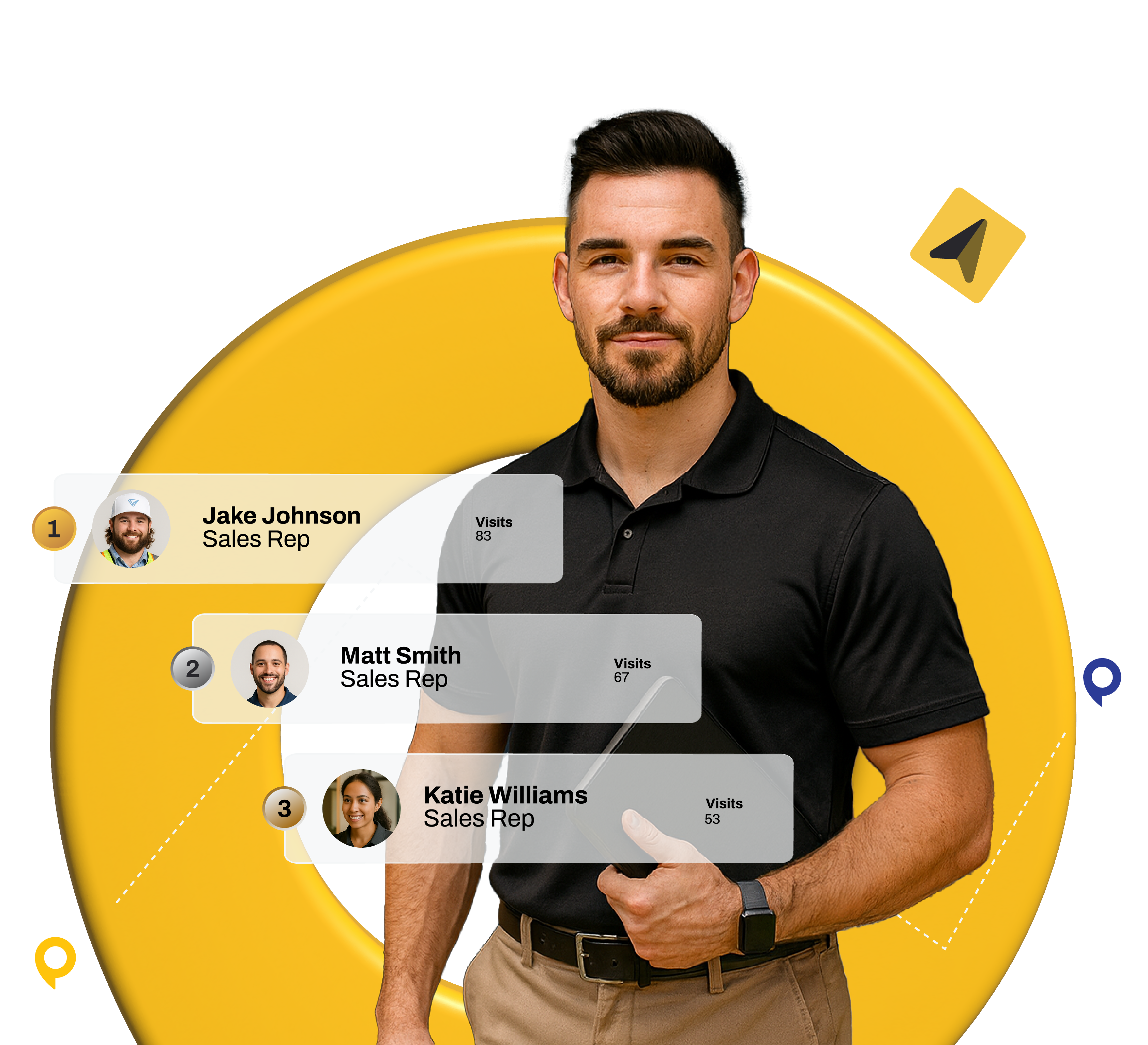
Modern tools eliminate tracking friction. Loacation-verified field activities, CRM-synced deal data, and automated dashboards solve manual scorekeeping problems. Reps log activities with one tap, and data syncs automatically to dashboards and your CRM. Leaderboards update every few minutes. For field teams specifically, this means door knocks, route completions, and location-verified check-ins logged with one tap feed directly into contest scoring—no spreadsheets or manual scorekeeping required.
Planning Sales Contests That Work
Level the Playing Field
Chance-based mechanics prevent top reps from dominating. Sales poker, raffles, and lottery-style contests introduce luck so normal sales strategies become less relevant.
Activity-based scoring rewards effort over outcomes. Top sellers can’t coast when you’re measuring doors knocked, appointments set, or follow-up calls completed.
For field teams, consider territory adjustments. Urban reps averaging 80 doors per day can’t be compared directly to rural reps at 25 per day. Score based on percentage of personal average, not raw numbers.
Choose the Right Duration
| Contest Type | Recommended Duration | Why |
|---|---|---|
| Activity contests (calls, doors knocked) | 5-7 days | High-frequency metrics need short timeframes |
| Conversion contests (deals closed, demos) | Match your sales cycle | Give reps time to move prospects through |
| Revenue contests | 30-60 days | Allow time for deals to close |
| Long-term initiatives | 90 days maximum | Beyond 90 days, engagement drops significantly |
Daily prize contests maintain momentum throughout a week. Multi-round tournaments work well at 3-4 weeks. Anything longer than a quarter loses competitive intensity.
Set Realistic Goals
Base targets on your top 25% performers, then add 10-15%. If your top quartile averages 25 doors per day, set the contest goal at 27-29 doors.
For improvement-based contests, score on percentage gain. A rep improving from 10 to 15 doors per day (50% increase) beats a rep going from 30 to 33 doors (10% increase), rewarding growth regardless of starting point.
Match Prize Value to Effort
| Contest Duration | Recommended Prize Range* | Prize Type Ideas |
|---|---|---|
| Daily (1 day) | $50-$100 | Gift cards, lunch delivery |
| Weekly (5-7 days) | $100-$200 | Experience tickets, premium parking |
| Monthly (30 days) | $300-$500 | Significant cash, extra PTO day |
| Quarterly (90 days) | $1,000+ | Substantial cash, travel vouchers |
*Budget ranges based on typical incentive programs for mid-market sales teams. Adjust based on your team size, industry, and compensation structure.
Mix cash prizes with experiences and recognition. Concert tickets create stories reps tell for months. Public recognition matters to many reps as much as monetary rewards.
Automate Contest Tracking
Automated tracking solves manual scorekeeping problems. CRM integration syncs deals closed and activities logged to contest dashboards. Field sales teams using the SPOTIO + SalesScreen integration an automate contest tracking entirely—doors knocked, appointments set, and deals closed feed directly into gamification scoring without manual input. Real-time dashboards update every 5-10 minutes. Mobile access lets field reps check live rankings from their phones.
For field teams, GPS verification eliminates disputes. Location coordinates attached to every logged activity make “I knocked 50 doors” verifiable data, not just a claim.
Common Sales Contest Mistakes
Only Rewarding Top Performers
The problem: When the same rep wins eight months straight, the rest of the team stops trying.
The solution: Run five simultaneous contests with different criteria—highest revenue, most improved, best follow-up rate, most doors knocked, best customer reviews. Five different reps can win recognition instead of just one.
Complicated Tracking Systems
The problem: If reps manually log activity or wait days for score updates, engagement dies.
The solution: Use tools that auto-capture activity and display live standings. Modern platforms pull data directly from your CRM and field sales tools, automatically updating contest standings every 5-10 minutes.
Running the Same Contest Repeatedly
The problem: Your top revenue rep will win every revenue contest. By the third month, it’s predictable and boring.
The solution: Rotate contest types monthly—activity-based one month, conversion-focused the next, team collaboration the third. Different formats highlight different strengths.
Unrealistic Goals
The problem: Setting goals that require doubling normal performance shows you don’t understand what’s achievable. Reps see the target, recognize it’s impossible, and don’t try.
The solution: Base goals on your top 25% performers, then add 10-15%. If your best reps average 25 doors per day, set the contest goal at 27-29 doors—ambitious but achievable.
Territory Inequity
The problem: Dense suburban territories can’t be compared directly to spread-out rural territories. Contests feel rigged when territory assignments determine winners.
The solution: Score based on percentage of personal average rather than raw numbers. Create territory tiers with separate leaderboards (urban, suburban, rural). Or focus on metrics less impacted by geography like conversion rate or customer satisfaction.
Running Contests for Field Sales Teams
Field-Specific Contest Metrics
Inside sales tracks calls and emails. Field sales needs different metrics: door knocks, route completion percentage, territory coverage, same-day follow-ups, GPS-verified check-ins, and new business discovery. These metrics work well for activity-based contests since they reward effort regardless of closing ability.
Technology Requirements
Mobile-first dashboards: Field reps check live standings, see achievement unlocks, and receive broadcast celebrations on their phones.
Location verification: GPS coordinates attached to every logged activity eliminate disputes about completed work.
Real-time sync: Integration with field sales platforms means door knocks, route completions, and check-ins feed directly into contest scoring.
SPOTIO lets reps log location-verified field activities with one tap—door knocks, check-ins, route completions—and displays real-time sales leaderboards. Your reps see where they rank from their phones. You get live dashboards showing who’s engaged and who needs coaching.
Frequently Asked Questions
How long should a sales contest last?
Activity contests (calls, door knocks, meetings) work best at 5-7 days. Revenue contests should match your sales cycle—if deals typically close in 30 days, run monthly contests. Anything longer than 90 days sees significant engagement drop-off as the gap between leaders and laggards widens.
What’s a good prize budget for sales contests?
Daily contests: $50-$100 per winner. Weekly: $100-$200. Monthly: $300-$500. Quarterly: $1,000+. Match prize value to effort required—a $25 gift card won’t motivate a month of extra work. Mix cash with experiences like concert tickets or extra PTO since these often motivate as strongly at lower cost.
How do you prevent top performers from winning every contest?
Rotate contest types monthly. Run activity-based contests where effort matters more than closing skill. Run improvement contests where biggest percentage gain wins. Run team contests where collaboration determines outcomes. Different formats highlight different strengths, so the same person doesn’t dominate.
Can you run sales contests for remote and field teams together?
Yes, but focus on comparable metrics. Don’t pit field reps against inside sales on “calls made” since the work is too different. Track meetings booked, proposals sent, or conversion rates—metrics both teams can influence. Modern sales tools with GPS tracking verify field activity automatically, making it easy to include location-verified activities in the same contests as office-based work.
Do sales contests actually improve performance long-term?
When designed correctly, yes. Contests that reward quality activities (thorough discovery, detailed proposals, consistent follow-up) help build better habits that persist after contests end. The key is following up to share what winners did differently—spreading learning across the team makes improvements stick. Research shows purpose-driven motivation correlates more strongly with sustained performance than purely financial incentives.
What’s the difference between sales leaderboards and sales gamification?
Sales leaderboards show rankings—who’s #1, #2, #3. They track performance. Sales gamification adds competition formats (bracket tournaments, multi-round challenges), achievement systems (badges for specific behaviors), recognition feeds (broadcast announcements), and reward structures (points redeemable in team shops).
Keep Your Entire Team Engaged
Sales contests work when they create multiple paths to win. Run five simultaneous contests instead of one. Track improvement percentages alongside absolute performance. Rotate contest types monthly so different skills get recognized.
Modern field sales platforms capture GPS-verified activities and display real-time leaderboards without manual scorekeeping. Gamification layers add pre-built competition templates, achievement systems, and broadcast recognition that keep entire teams engaged—not just your top three reps.
SPOTIO makes tracking field sales activity effortless—reps log door knocks, route completion, check-ins, and meeting notes with one tap, and contest standings update in real time. Your reps see where they rank from their phones. You get live dashboards showing who’s engaged and who needs coaching. Through our SalesScreen integration, layer full gamification on top with tournament brackets, achievement badges, and reward systems that turn activity tracking into competitive energy.
Running contests with manual tracking? Request a demo and see how SPOTIO can automate contest execution from activity capture to winner celebration.