

If you’re running a field sales team, quota is the number everyone feels but few reps fully understand.
We surveyed 452 field sales professionals for our 2026 State of Field Sales report. Only about a third told us that 70% or more of their reps consistently hit quota. Another third said fewer than half of their reps are making it.
The gap between the quota on the spreadsheet and what reps can realistically achieve on the road is what this guide is designed to close.
We’ll walk through how high-performing field teams design quotas, translate them into daily activity plans, coach around the real blockers, and use tools like SPOTIO to keep everyone honest in the field.
What Is Sales Quota Attainment?
Sales quota is the target number assigned to a rep or team over a period (month, quarter, year), usually in revenue, units, or profit. Sales quota attainment is the percentage of that target they actually hit (for example, 90% attainment means they closed 90% of their assigned quota).
For frontline managers, quota attainment is the fastest way to see who is on track, who needs help, and whether quotas themselves are realistic. Consistently low attainment across multiple reps usually signals problems in territory design, quota setting, or your sales process, not just individual performance.
Sales Quota vs. Quota Attainment
- Sales quota: The target you give a rep—e.g., 100,000 in new revenue this quarter.
- Quota attainment: What percentage of that number they actually reach—e.g., 85,000 would be 85% attainment.
You can look at attainment at rep, team, region, or product level to see where you’re strong and where coaching or territory changes are needed.
Why Attainment Matters for Field Teams
For field reps, quota attainment ties directly to commission checks and career progression. For the business, it determines whether your forecast is reliable or full of surprises. Third-party research shows that only about half of sales reps consistently hit quota. This is often a sign of misaligned quotas or weak execution rhythms—rather than pure capability.
When most reps consistently hit 90–110% of quota, you get healthier pipelines, lower turnover, and more predictable revenue. When less than half of your reps are hitting quota over several periods, you likely have systemic problems with quota setting, territories, training, or process—not just a “bad batch” of reps.
Main Types of Sales Quotas Managers Use
Different quota types drive different behavior. As a field manager, you want quotas that push reps toward the right activities for your motion, not just bigger numbers on paper.
1. Volume-based sales quotas
Volume quotas focus on the number of units sold or deals closed in a period, regardless of deal size or margin.
Field example: A residential solar team gives each rep a quarterly quota of 45 closed installs in their territory, whether those installs are small townhomes or large multi‑family buildings.
Risk: Our latest State of Field Sales survey shows leaders rank ‘finding qualified prospects’ above ‘keeping organized,’ which means pure volume targets can push reps to chase any prospect who will say yes, even if they’re a poor fit. That’s how you end up with reps technically “hitting quota” but driving high churn and low LTV instead of healthy, sustainable growth.
2. Revenue-based sales quotas
Revenue quotas measure total dollar value closed in a period and are the most common type for account executives and senior reps.
Field example: A commercial field team assigns each territory rep a 350,000 quarterly revenue quota, combining new logo deals and expansion within existing accounts in their patch.
Risk: When revenue quotas are set by dividing a top‑down number across territories without checking account density and drive time, you almost guarantee thin territories live in the 30–49% attainment band.
3. Profit-based sales quotas
Profit (or margin) quotas track gross profit instead of top‑line revenue, rewarding reps for protecting margin and selling higher‑value mixes.
Field example: A home services company gives reps a quarterly gross‑margin quota of 90,000 and pays accelerators when they grow share of high‑margin service bundles in their territory.
Risk: Profit quotas are harder to manage in the field if reps can’t see margin in real time. Without clear pricing guardrails and mobile tools that show margin impact on the road, reps will default to discounting to “save the deal,” which erodes trust in the quota and hurts attainment quality even when targets are met.
Learn more about designing commission and quota-linked pay in SPOTIO’s guide to typical commission structures for sales reps.
4. Activity-based sales quotas
Activity quotas focus on the inputs that drive pipeline—visits, calls, meetings, demos—rather than the outputs
Field example: A mixed B2B/B2C team expects each rep to complete 20 qualified in‑person visits and log at least 10 follow‑up conversations per day in their territory.
Risk: In our State of Field Sales survey, leaders ranked “lack of activity” as the single biggest challenge holding reps back from targets, above skill or time management. That makes activity quotas a powerful lever—but if you don’t tie them to conversion data and use your own visit‑to‑meeting and meeting‑to‑close rates to set the right activity minimums, you’ll just get more doors knocked and more miles driven without a meaningful lift in the percentage of reps hitting quota.
5. Combination (hybrid) quotas
Combination quotas blend two or more types—typically revenue or volume plus activity or profit—to create a more balanced performance picture.
Field example: An enterprise field team sets a quarterly quota where 70% of the target is territory revenue and 30% is tied to a minimum number of new qualified accounts opened and advanced to a defined pipeline stage.
Risk: Hybrid quotas get messy fast. If you assign too many metrics or weightings, reps won’t know what to prioritize, and managers will struggle to coach, which shows up later as “not following the process” being cited as a top quota blocker in your data. Keep it to two core metrics and make the math visible in your CRM so reps can see how each visit and opportunity moves their overall attainment.
6. Cost-based or efficiency quotas
Cost-based quotas focus on controlling the cost of selling—often revenue (or profit) per visit, per mile, or per route—rather than just top‑line numbers.
Field example: A national service provider expects each rep to generate at least 1,200 in revenue per field visit and 4,000 per day on average, encouraging efficient routing and better pre‑qualification.
Risk: If you over‑optimize around efficiency, reps may start avoiding harder‑to‑reach yet strategically important accounts in their territory. That can hurt long‑term market penetration and you end up with an attainment pattern where reps sit in the 50–69% band instead of building a deep, durable book of business.
7. Territory volume quotas
Territory volume quotas measure total sales within a defined geography or segment—often as a team goal rather than individual rep targets.
Field example: A utility sales team assigns a 2.5M annual territory quota to a region, then has three field reps and a manager share responsibility for hitting that number across all accounts in the patch.
Risk: Territory volume quotas can hide individual underperformance, especially in large field teams. If you don’t pair them with rep‑level quotas and activity standards so you can see which individuals are actually driving territory performance, you may see territory numbers look healthy while only a minority of reps consistently meet their personal targets.
Once you’ve picked the right quota model for your motion, the next step is making sure those numbers are actually achievable in the field. That means backing into quotas from realistic visit and conversion capacity, aligning targets to territory potential, and then translating everything into daily activity standards your reps can see on their route plan. The sections that follow walk through that playbook step‑by‑step.
How to Set Realistic Quotas Your Reps Believe In
Even the best coaching won’t fix a fundamentally impossible number. Your first job is to make sure quotas are tough but fair for each territory and field rep.
Use data, not gut feel, to size quotas
Start by estimating what a fully ramped rep can realistically produce in their territory, then layer in historical performance and territory potential. Use five core inputs:
- Average qualified visits per day
- Working days in the field per month
- Visit‑to‑meeting rate
- Meeting‑to‑close rate
- Average deal size
A simple way to estimate a rep’s monthly quota capacity is:
Quota Capacity≈(Visits per day×Working days)×Visit‑to‑meeting rate×Meeting‑to‑close rate×Average deal size
Then sanity‑check that number against:
- Historical performance: what this rep or territory has produced over the last 12–24 months
- Territory potential: how many qualified accounts or households actually exist in the patch
High-performing organizations increasingly rely on data‑driven quota management and forecasting to align quotas with realistic territory potential and market demand, which improves attainment and forecast accuracy.
Align quotas with territory potential
Two reps with the same quota but very different territory potential will not feel equally motivated. If one has dense, ideal customers and the other has long drives and fewer prospects, they’ll hit very different ceilings.
Before finalizing quota, sanity‑check:
- Account density and ideal customer fit by territory.
- Average deal size and close rates by region.
- Typical travel time and number of daily visits each territory supports.
If the quota you calculated from your capacity model is materially higher than what a territory’s density and travel time can support, fix the territory before you raise the number. In most field teams we see, only a minority of reps consistently hit quota—often because territory potential and targets don’t line up.
Communicate the “why” behind the number
Once you’ve sized quotas using real visit and conversion capacity and checked them against territory potential, walk your reps through how you got there.
Show:
- The revenue goal you’re aiming for
- The expected average deal size and win rate
- The weekly activity targets that support it (for example, visits, meetings, and proposals per week)
When managers walk reps through the math and weekly plan behind their number, buy‑in and discretionary effort tend to increase, because the quota feels like a path, not just a demand. Over time, that transparency is what separates teams where most reps live in the 50–69% attainment band from those where the majority consistently land in the 90–110% range.
Turn Quotas into Weekly Field Activity Plans
Frontline reps don’t think in annual quota. They think in today’s route, this week’s meetings, and this month’s paycheck. Your job is to turn quota into simple weekly activity standards that fit the realities of their territories.
Back into activity from your funnel
Take a typical monthly quota and work backward using your funnel conversion rates—a reverse goal-setting approach that many modern quota frameworks recommend.
For example:
- Monthly revenue quota: 40,000
- Average deal size: 2,000
- Deals needed: 20
- Win rate from proposal to close: 40% → need 50 proposals
- Meeting-to-proposal rate: 50% → need 100 meetings
- Visit-to-meeting rate: 25% → need 400 qualified visits
Dividing 400 visits across 20 working days gives 20 qualified visits per day. That’s a clear, concrete number your reps can aim for on their routes.
Define minimum daily field activities
Use that math to set minimum daily standards, not just “do your best”:
- X qualified visits per day
- Y follow-ups or callbacks
- Z new opportunities added to pipeline each week
These should be realistic for your territories and travel patterns, but non-negotiable once agreed. Fiels sales leaders consistently tell us ‘lack of activity’ is the single biggest challenge impacting reps’ ability to hit targets, which is exactly what these minimums are designed to address.
Create clear weekly scorecards for reps
Give every rep a simple weekly scorecard that shows:
- Quota attainment to date
- Key activities completed vs. target
- New opportunities created and pipeline coverage
Sales organizations that give reps and managers clear visibility into these metrics are more likely to spot problems early—like a territory stuck in the 30–49% attainment band—and adjust routes, coaching, or quotas before the end of the month.
Why your field reps really miss quota
When we asked field sales leaders to rank the biggest challenges impacting their reps’ ability to hit targets, the top issues weren’t abstract “market conditions”—they were controllable execution gaps. In SPOTIO’s 2026 State of Field Sales survey, “lack of activity” was ranked as the single biggest challenge, followed by “lack of sales skill” and “not following process.” Challenges like “keeping organized” and “time management” came in much lower on average, which tells us most quota misses start with pipeline volume and sales rigor, not calendar chaos.
That’s why the most effective coaching moves focus first on building consistent field activity, tightening qualification and sales skills, and reinforcing a clear, repeatable process. The plays below are designed to attack those exact failure points in a structured way.
Coaching Moves to Improve Quota Attainment
Once the numbers and activity plans are set, quota attainment becomes a coaching game. The three biggest levers—based on what field leaders told us—are fixing low activity, closing skill gaps, and enforcing a clear, repeatable process.
Run daily huddles around leading indicators
(Primarily tackles: lack of activity and weak process)
Short, focused huddles (10–15 minutes) keep the team aligned without taking them off the street. In a daily huddle, cover:
- Yesterday’s key numbers: visits, meetings, new opps
- Today’s focus: specific neighborhoods, segments, or products
- One quick win or lesson from the field
By centering huddles on leading indicators,you coach the behaviors that drive quota—especially consistent activity and following the plan—instead of only talking about closed deals after it’s too late. For a deeper dive on coaching frameworks and cadences, see SPOTIO’s field sales coaching features.
Use ride-alongs to fix what’s actually broken
(Primarily tackles: lack of sales skill and not following process)
If multiple reps are missing quota simultaneously, that pattern usually points to a systemic issue — our 30-day team re-engagement playbook covers how to diagnose and fix it. Either way, spend regular time in the field with both top and struggling reps:
- Listen to how they open conversations and qualify
- Watch how they manage time between stops
- Review how they handle objections and close
Here’s a simple pattern you can use with a rep stuck around 70% of quota:
- Week 1: Ride along and observe two full routes, then agree on one behavior to change (for example, tightening qualification questions).
- Weeks 2–3: Track that specific behavior and related leading metric (e.g., qualified meetings per day) in your huddles.
- Week 4: Review impact on pipeline and reset the next focus area.
Multiple industry studies show that dynamic, ongoing sales coaching is correlated with higher win rates and quota attainment than sporadic or informal coaching (overview). Benchmarks also point out that teams with weekly coaching see much higher attainment than those coaching only monthly or quarterly (example discussion).
Handle “happy-ears” and sandbagging behavior
(Primarily tackles: not following process and misaligned effort)
Not every miss is about effort. Some reps have happy ears—big pipelines that never close—while others quietly sandbag, easing off once they hit 100%.
- For happy-ears reps, tighten stage definitions and exit criteria so only real opportunities make it into late-stage pipeline, then coach hard on qualification and next steps
- For sandbaggers, use performance history and territory potential to reset expectations, and layer in accelerators or short-term contests so there’s upside in pushing past their comfort zone instead of coasting at “good enough”
Both patterns are essentially process problems: the first inflates pipeline quality, the second undermines consistent activity once quota is in sight.
Motivate with smart contests and recognition
(Primarily tackles: sustaining activity and reinforcing process)
Incentives still matter, but the structure is more important than the prize. Effective field contests usually:
- Focus on one or two specific behaviors (e.g., new opps created, proposals sent) that tie to quota
- Have clear, simple rules and short timeframes (1–4 weeks)
- Recognize progress publicly, not just final winners
When contests spotlight the exact leading indicators you care about—qualified visits, follow‑ups, proposals—you reinforce both the activity levels and the process adherence your data says are missing. Research on incentive programs shows that structured, transparent rewards can significantly lift sales performance and quota attainment. To bring this to life, SPOTIO offers sales gamification and sales leaderboards that turn key field metrics—knocks, meetings, opps, revenue—into live competitions and visible progress for the team.
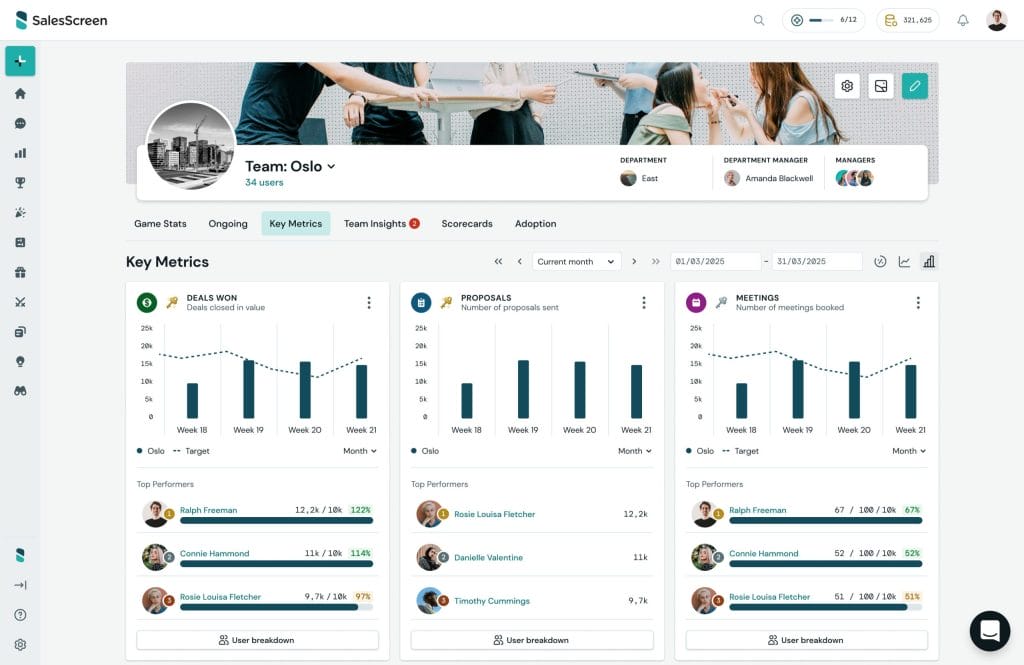
Example leaderboard view showing deals won, proposals, and meetings. We center contests on a small set of leading indicators like these because lack of activity and weak follow‑through are the top reasons reps miss quota.
Tools and Data to Track Quota Progress in the Field
You can’t coach what you can’t see. To improve quota attainment, you need clean activity data from the field and simple dashboards that show who is on pace, who needs help with skills, and where process is breaking down.
Track leading and lagging indicators
(See activity levels, skill issues, and process breakdowns early)
At minimum, you want visibility into:
- Lagging indicators: quota attainment %, revenue, closed deals.
- Leading indicators: visits, meetings, proposals, new opps, route coverage.
Sales performance software and dashboards make it easier for managers to monitor quota attainment and related metrics in one place, identify trends, and run “what‑if” scenarios. This helps you quickly see which reps are behind because of low activity, who has enough meetings but poor conversion (skill gap), and where opportunities stall at the same stage because the process isn’t being followed.
Use mobile tools for real-time field visibility
(Ensure activity is real, not just reported)
For field teams, tools must work where reps actually are—in neighborhoods, on job sites, and between appointments. Modern mobile sales tools designed for field reps typically offer:
- Fast, tap-based activity logging so reps record visits, outcomes, and follow-ups from the road
- Location-aware data (e.g., activities tied to addresses or territories) so managers see where work is actually happening
- Route planning and territory views that help reps hit daily activity targets without burning unnecessary windshield time
If logging feels like homework, reps won’t do it—and your “leading indicators” become fiction. Make activity capture as close to one‑tap as possible, review those numbers in huddles and one‑on‑ones, and coach directly from the data so reps see that the system is there to help them win, not just feed reports.
Use performance and compensation platforms to build trust in the numbers
(Align effort, pay, and process so reps stay engaged)
Organizations that use dedicated sales performance and compensation platforms gain better visibility into attainment, simplify coaching, and improve rep confidence in the process (example). These gains are especially valuable for distributed, field-based teams where in-person oversight is limited.
SPOTIO, for example, is a field sales execution platform designed around customer mapping, territory management, route planning, and and real-time visibility into field activities and performance. With location-verified activity data, route and territory views, and sales performance dashboards, managers can quickly see which reps are on pace for quota and where coaching or territory adjustments are needed—without waiting for end-of-month reports.
Frequently Asked Questions
In our State of Field Sales survey, only about one in three leaders say at least 70% of their reps consistently hit quota, which means if most of your team is in the 90–110% band you’re performing well above the median. If a few reps are far above target and many are far below, you may have quota or territory design issues more than a raw talent problem. When most of your team sits well under quota for multiple periods, treat it as a design problem first and a performance problem second (reference).
You shouldn’t change quotas so often that reps feel the goalposts keep moving, but you also can’t ignore clear territory or market shifts. Most teams review quotas annually and make targeted mid-year adjustments when territories, product mix, or market conditions change significantly. Field teams with strong seasonality or heavy territory reshuffles may need mid‑year adjustments more often than inside teams, but changes should still be the exception, not the rule.
For new reps, start with reduced ramp quotas tied heavily to activity targets and basic conversion milestones rather than full revenue expectations. In new territories, use pilot periods to learn realistic conversion rates, then scale quotas as data comes in instead of copying mature-territory numbers.
Most field teams see the best results using a combination of revenue quota plus a few key activity standards. Revenue quota keeps the team focused on outcomes, while activity quotas ensure reps maintain the volume and quality of field work needed to get there, especially in longer or seasonal cycles.
Start by diagnosing whether the issue is activity (not enough visits), conversion (struggling at a specific stage), or territory (poor potential). Use your data and ride‑alongs to decide whether the root cause is low activity, weak skills at a specific stage, or a territory that simply can’t support the current targets, then pick one lever to work on for a full cycle. For additional ideas, you can reference these sales coaching benchmarks and best practices.
If you want clearer visibility into quota attainment, territory performance, and field activity—without chasing spreadsheets at the end of the month—SPOTIO can help you see exactly where your team stands and what to fix next.

Krystal brings a rare combination of direct sales, TV/media, and B2B SaaS marketing expertise to her writing. With 10+ years leading integrated marketing campaigns for global organizations, she knows how to build scalable marketing engines that drive real revenue — not just impressions. Her background in direct sales gives her a grounded, practical perspective on what it actually takes to close deals and connect with customers.