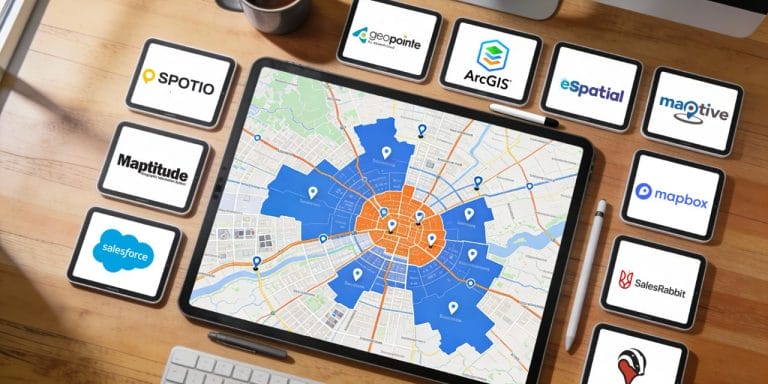

A roofing sales manager opens his laptop on Monday morning and sees a color-coded territory map. Green zones where reps logged visits last week. Yellow where coverage is thinning. A red cluster of 200+ homes in a neighborhood the team hasn’t touched since a hailstorm hit three weeks ago.
He doesn’t have to dig through a CRM report to find this. The map is built from the team’s own field activity — every door knock, every status update, every GPS-verified check-in — layered with prospect data and filtered by the signals that actually predict a sale.
That’s field sales intelligence. Not a dashboard someone checks once a quarter. Not a data warehouse collecting dust. It’s the layer between your CRM and your field team that turns raw activity into the next decision — which territory to prioritize, which door to knock, which rep needs help.
Nearly half of B2B field reps spend eight or more hours per week on CRM data entry alone. That’s a full workday every week that produces records, not revenue. Field sales intelligence exists to close that gap, giving managers visibility they can act on and giving reps the information they need before they walk through the door.
What Is Field Sales Intelligence?
Field sales intelligence is a category of software that combines location data, prospect information, activity history, and increasingly AI-driven predictions to help outside sales teams decide where to go, what to do when they get there, and how to capture what happened — without sitting down at a desk.
It’s not a CRM replacement. It’s the operational layer that sits on top of your CRM and handles the decisions your CRM was never built to make.
How It Differs From Your CRM
A CRM is a system of record. It stores contacts, tracks pipeline stages, and logs activities after they happen. It’s built for reporting — answering the question “what did we do last month?”
Field sales intelligence is a system of action. It answers a different question: “what should this rep do in the next hour?” It pulls from the CRM, enriches it with territory data and prospect signals, and pushes guidance back to the rep’s phone before they leave the truck.
The CRM stays your source of truth. The intelligence layer reads from it, writes back to it, and runs the field-level decisions the CRM can’t.
How It Differs From Inside Sales Intelligence
When most people say “sales intelligence,” they mean platforms like ZoomInfo, Cognism, or Apollo — sales intelligence tools that provide contact databases, buyer intent signals, and email engagement tracking for inside sales teams prospecting from a desk.
Field sales intelligence solves a fundamentally different problem. Your reps aren’t sending email sequences — they’re driving between stops, knocking on doors, and running face-to-face meetings. The intelligence they need is spatial (which territory, which neighborhood, which block), physical (what does this property look like, who lives here, is this business still open), and time-sensitive (what happened at this account last visit, when should I come back).
A contact database doesn’t answer those questions. A map-based intelligence layer does.
The Four Pillars of Field Intelligence
Every field sales intelligence platform worth evaluating covers four core capabilities. The depth varies, but the pillars don’t.
Prospect Discovery
Before a rep can sell, they need to know who to sell to — and that looks different depending on whether your team runs a B2B or B2C motion.
For B2C and door-to-door teams (roofing, home services, telecom, home improvement), prospect discovery means filtering residential data by signals that predict a sale: home age, property value, household income, roof age, neighborhood density. A storm restoration crew doesn’t knock every door on the block — they filter for homes with 15-year-old roofs in a hail zone and work that list.
For B2B field teams (medical devices, distribution, business services), discovery means identifying businesses in a territory by industry, company size, and establishment date — then layering in signals like whether the account is in your CRM already, when they were last visited, and what stage they’re in.
Both motions need the same thing: a way to find qualified prospects on a map and filter out the noise before the rep leaves the office.
POS sales teams are a good example of this in practice — they work dense merchant clusters where a single commercial block holds a dozen prospects, and the rep who maps those clusters systematically outsells the one driving across town chasing scattered leads. Our POS sales playbook breaks down how field teams build territories around merchant density.
Territory Intelligence
Territory intelligence is where most field teams discover how much they’ve been flying blind.
One distribution company imported its accounts into a mapping platform and realized 60–80% of its West Coast territory was uninhabited land — reps had been assigned to cover empty desert. A medical sales team discovered that every one of its clinic accounts was clustered in Northern California; the operations leader hadn’t realized the geographic concentration until the pins appeared on a map.
Territory intelligence means seeing your coverage on a map: which zones are producing, which are ignored, where reps overlap, and where accounts are falling through the cracks. It includes hierarchy — regions broken into territories broken into zones — with naming conventions that let managers report on performance at every level.
This isn’t a one-time setup exercise. Territories need ongoing adjustment as reps join or leave, markets shift, and performance data reveals which areas deserve more attention.
Predictive Prioritization
Discovery tells you who to sell to. Territory intelligence tells you where. Predictive prioritization tells you which accounts to visit first — and what to do when you get there.
This is the fastest-moving part of the category. Research from Gartner found that sales organizations providing AI-enabled next-best-action recommendations are 2.6 times more likely to achieve commercial growth. The reason is straightforward: when a rep opens their phone in the morning and sees a ranked list of accounts — weighted by predicted value, urgency, and churn risk — they make better decisions about how to spend their day than when they work from memory and gut feel.
Predictive prioritization isn’t just lead scoring. It’s a recommended action: visit this account, call this contact, send this follow-up. And it has to learn from your team’s own data — your territories, your conversion patterns, your deal cycles — not from a generic industry model.
Field-to-CRM Capture
None of the first three pillars work if the field activity never makes it back into the system.
This is the oldest problem in outside sales. A rep finishes a strong meeting, learns three things that should change the account plan, then puts off logging it because entering notes on a phone takes ten minutes they’d rather spend driving to the next stop. The insight dies in the parking lot.
Field-to-CRM capture means making the input effortless. One-tap activity logging or voice-to-CRM with GPS verification so the record is timestamped and location-confirmed. Voice input between stops so the rep can narrate what happened without typing. Photo capture for business cards, site conditions, or competitor signage — the AI pulls the details into a clean record the rep confirms and saves with a tap.
The results when teams close this loop are dramatic. One telecom field organization saw a 309% increase in logged visits after switching to a mobile-first capture tool. A medical sales team lifted per-rep activity volume by 68%, going from 38 to 64 logged activities per rep. In both cases, the reps weren’t working harder. They were just actually recording what they were already doing.
What AI Changes About Field Intelligence
The four pillars above existed before AI. What AI changes is the connection between them — turning disconnected data into predictions and turning predictions into specific actions.
Pre-Visit Prep and Record Briefs
Before AI, a rep preparing for a visit had to open the CRM, scroll through activity history, check notes from the last visit, and try to piece together context. Ten minutes of homework per account, if they did it at all.
AI-powered record briefs compress that into a ten-second summary: here’s the account history, here’s what happened last visit, here’s what’s changed since then, here’s what to lead with. The rep opens the account on their phone while sitting in the parking lot and gets caught up before they open the car door.
Next Best Action Scoring
This is where AI moves from helpful to transformative.
A predictive Value Score analyzes 42+ signals across every record in your system — visit frequency, pipeline stage, time since last contact, territory performance patterns, conversion history — and produces two outputs: a score telling the rep how likely this account is to convert (and how urgent it is), and a recommended next action: visit, call, text, or email.
This isn’t a static lead score that gets set once and forgotten. It refreshes throughout the day as new activity data comes in — a logged visit updates the score, a missed follow-up changes the urgency ranking, and new pipeline data shifts the recommended action.
The manager sees these scores across the entire team, territory by territory. The rep sees them as a prioritized daily action list. Both are working from the same intelligence.
Voice-to-CRM Between Stops
Field reps spend hours every week in the car. Voice-to-CRM turns that dead time into data capture time.
Between stops, a rep speaks a voice note — “Just left Acme Roofing, met with the owner, they’re interested in the full replacement package, wants a quote by Friday.” The AI turns the voice note into a clean visit record on the right account and presents it for the rep to review and confirm with a tap. The record is logged, accurate, and synced to the CRM before the rep reaches the next stop.
The key is the confirmation step. The rep always reviews and approves before anything writes to the system. This keeps the data clean and the rep in control — it’s an AI co-pilot, not autopilot.
How Field Teams Use Intelligence Day-to-Day
The Manager’s View
Monday morning. The VP of Sales opens the territory dashboard and sees performance by zone: visits logged, pipeline created, conversion rates by territory, activity trends over the last 30 days. One territory in the southeast is producing twice the pipeline per visit as the rest — worth replicating whatever that rep is doing. Another territory shows visits up but conversions flat — a coaching signal.
She drills into the team view: which reps are covering their territories evenly, which are clustering in familiar areas and ignoring assigned zones. She spots a rep who hasn’t visited the new accounts imported last week and sends a note.
None of this required pulling a report. The intelligence layer built it from the team’s own activity data.
The Rep’s View
7:45 AM. A home services rep opens his phone and sees a prioritized list of today’s accounts, ranked by predicted value. The first three are follow-ups from last week — all flagged as high urgency because they requested quotes and haven’t heard back. The next four are new prospects in a neighborhood he’s been assigned, filtered by property value and home age.
He taps to build a route, the app hands off to Google Maps, and he’s driving by 8:00. At each stop, he logs the visit with one tap — GPS confirms he was on-site, the status updates, and the next account on the list moves to the top. Between stops, he records a voice note about the last conversation. By noon, he’s completed seven verified visits, every one logged, and his manager can see the progress without a single check-in call.
What to Look for in a Platform
Not every platform that calls itself “field sales intelligence” delivers on all four pillars. When evaluating, focus on these five questions.
Five Questions to Ask in a Demo
Does it serve both B2B and B2C? Some platforms only support one motion. If your organization runs both — or might in the future — you need a platform with residential prospect data (homeowner demographics, property data) and business data (industry, company size, Google Places integration) in the same system.
How does it handle territory hierarchy? Ask to see territories built at multiple levels — region, territory, zone — with assigned reps and defined boundaries. Ask how naming conventions work and whether managers can report on performance at each level.
Is the AI predictive or just descriptive? Plenty of platforms offer dashboards and reports (descriptive intelligence). Fewer offer predictive scoring that tells a rep which account to visit next and what action to take. Ask whether the system learns from your team’s own data or uses a generic model.
What does CRM integration actually look like? “Integrates with Salesforce” could mean a one-way data push or a true two-way sync where activity in the field platform updates the CRM in both directions. Ask which CRMs have native integrations and which require third-party connectors like Zapier.
Can a rep use it without sitting down? Open the mobile app. Try logging a visit. Try recording a voice note. Try building a route. If any of these take more than two taps, reps won’t adopt it — and intelligence without adoption is just software.
Want to see how these pillars work inside a single platform? Request a SPOTIO demo →
Three Metrics That Prove It’s Working
If you’ve invested in a field sales intelligence platform, these three numbers tell you whether it’s earning its seat.
Data capture rate. What percentage of actual field visits are logged in the system? Below 50%, your pipeline forecast is built on half the picture. The telecom team mentioned earlier went from partial capture to full adoption in under a month — and the quality of their pipeline data transformed overnight.
Territory coverage completeness. What percentage of assigned territory zones received at least one visit this month? Unvisited zones are invisible revenue. The distribution company that discovered its uninhabited-territory problem saw immediate pipeline improvement once reps were reassigned to zones with actual prospects.
Visits-to-pipeline conversion rate. Not just volume of visits — the conversion. How many visits does it take to create a qualified opportunity? This number, tracked by territory and by rep, reveals whether your intelligence layer is actually pointing reps at the right doors.
Frequently Asked Questions
Field sales intelligence is software that combines location data, prospect information, territory analytics, and AI predictions to help outside sales teams decide where to go, what to do, and how to capture what happened — all from a mobile device. It sits on top of your CRM as an operational layer, not a replacement.
A CRM stores records and tracks pipeline stages. Field sales intelligence adds the decision layer: which territory to prioritize, which account to visit next, what action to take, and how to log the result without manual data entry. The CRM stays your system of record; the intelligence layer drives daily field execution.
Yes, if the platform supports both motions. B2C teams need residential prospect data — property values, home age, household demographics. B2B teams need business data — industry, company size, establishment date. The best platforms provide both data sources and let managers run mixed territories.
A next best action is an AI-generated recommendation — visit, call, text, or email — for a specific account, based on predictive scoring. The score analyzes signals like visit frequency, pipeline stage, conversion history, and territory patterns to rank which accounts deserve attention first and what kind of outreach is most likely to move them forward.
Teams with mobile-first capture tools often see measurable adoption within 30 days — one telecom organization saw a 309% increase in logged visits in the first month. Pipeline impact typically follows within one to two quarters as data quality improves and managers begin making territory and coaching decisions from complete field activity data.
Adoption depends entirely on whether the tool reduces work or adds it. Platforms that require desktop data entry or complex workflows get abandoned. Platforms with one-tap logging, voice-to-CRM, and GPS-verified check-ins get adopted because the rep’s job gets easier, not harder.
Most platforms offer CRM integration, but depth varies. Look for two-way sync with your CRM (Salesforce and HubSpot are the most common native integrations) so that activity logged in the field platform syncs to the CRM through a two-way integration, and CRM changes flow back to the field tool.
Get Started With Field Sales Intelligence
Field sales intelligence is moving fast — and the teams that adopt it first are pulling ahead. SPOTIO’s field sales execution platform combines territory mapping, prospect discovery, one-tap activity logging, and AI-powered Next Best Action scoring in a single mobile-first system built for outside sales teams. One telecom field organization saw a 309% increase in logged visits. See how SPOTIO delivers field sales intelligence →