
Canvassing a neighborhood means systematically going door to door in a defined area to introduce your product or service, qualify prospects, and generate leads. If you want to know how to canvass a neighborhood effectively, it starts with one truth: D2D teams convert at 2–5% compared to just 1% for digital channels, because nothing builds trust like a face-to-face conversation on someone’s doorstep.
The problem? Too many reps canvass randomly. They pick an area, start knocking, and hope for the best. That burns hours, kills morale, and leaves leads scattered across neighborhoods with no system to follow up.
This guide gives you the field-tested neighborhood canvassing playbook — what we call The 3-Pass System — covering how to pick the right neighborhood, map your territory, work every door (even the ones where nobody answers), and track the metrics that actually matter. Whether you’re a new rep figuring out where to start or a manager deploying a team of 15, you’ll walk away with scripts, tactics, and a system you can use tomorrow.
Pick the Right Neighborhood First
Random canvassing is the fastest way to burn out a rep. Before anyone leaves the office, you need a system for choosing where to knock. Here are four approaches, ranked from strongest to easiest.
Start Where You Already Have Customers
If your company has existing customers in an area, start there. It’s simple logic — if some households bought, others nearby probably have similar needs. But the real advantage is social proof. Mentioning a neighbor by name at the door changes the entire dynamic.
Use a territory mapping tool to pull up a map of existing customer pins, then work outward from those clusters. You’ll see exactly which doors have been worked and which are open territory — no stepping on another rep’s turf.
Your opener sounds like this:
“Good afternoon, I’m Trey with Amazing Company. You might have seen us at Bob’s house next door last month installing that new system — I wanted to stop by and let you know about a special we’re running through Friday…”
Compare that to a cold opener with no reference point. Night and day.
Use Prospect Data to Pre-Qualify
No existing customers in the area? Use data to find neighborhoods worth your time. A too like SPOTIO’s Lead Machine for B2C lets you filter residential prospects by 15 data points — homeownership, estimated income, property age, credit capacity, and more. For B2B, tap Google Places integration to pull contact info from businesses directly on the map.
The goal is to narrow 10,000 potential doors down to the 2,000 most likely to convert before you burn a gallon of gas.
Re-Hash Old Leads
Every company has a graveyard of leads that went cold. Your manager probably has hundreds of prospects from ex-reps sitting in the CRM. Ask for them. Go back to those doors — maybe you’ve got the touch to convert them, maybe not. Either way, you now have a reason to knock every door around that old lead using the neighbor-reference opener.
“Hi Mr. Jones, I’m Trey with Amazing Company. I’m sure you remember us from when we were out here in April? Great — I was in the area and wanted to let you know about a new special we’re running this month…”
Shadow a Top Performer
No company history, no leads, brand new territory? Find the best rep on your team and offer to set appointments for them for three days in exchange for showing you a productive neighborhood and how they work it.
Yes, you’ll give up some short-term income. What you’ll gain — territory knowledge, opener techniques, route habits — is worth far more than whatever commissions you’d have earned stumbling through an unfamiliar area alone.
Map Your Neighborhood Before You Walk It
Picking the right neighborhood is step one. Step two is knowing what’s already happened there before you lace up your shoes.
Use Customer Mapping to See the Full Picture
Before you start walking a neighborhood, pull it up in a map view. Customer mapping gives you a visual snapshot of everything that matters: where existing customers are, which doors have been knocked, what the dispositions look like (lead, not home, not interested), and which streets haven’t been touched yet. Knowing how to canvass a neighborhood starts with knowing what’s already happened there.
This is the difference between walking blind and walking with a plan. When you can see that the south side of a street has three existing customers and the north side is untouched, you know exactly where to start and which opener to use.
Know Your Territory Boundaries
Canvassing gets messy fast when two reps walk the same block. Use a field sales mobile app to see your assigned area before you head out — clear boundaries mean no overlap, no wasted doors, and no awkward conversations with a homeowner who talked to your colleague yesterday.
Time Your Knocks for Contact Rate
When you knock matters almost as much as where. Here are general benchmarks by industry based on field experience:
| Industry | Best Time to Canvass | What to Look For at the Door |
|---|---|---|
| Roofing/Storm Restoration | 3–6 PM weekdays, Saturday AM | Missing shingles, hail damage, aging materials |
| Home Services (pest, lawn, HVAC, security) | 9–11 AM weekdays | Overgrown landscaping, aging exterior systems |
| Telecom/Fiber | 5–7 PM weekdays | New construction, serviceable addresses |
| Home Improvement (windows, doors, blinds) | Saturday 9 AM–12 PM; weekday evenings 4–6 PM | Foggy windows, outdated doors, old frames, single-pane glass, peeling caulk |
| Solar | 3–6 PM weekdays, Saturday AM | South-facing roof, open plane, minimal shade |
The best canvassers don’t knock a neighborhood once and move on. We call this The 3-Pass System: hit the same area across three different time blocks (morning, midday, late afternoon) to reach 90% of homeowners. One pass only catches whoever happens to be home at that moment.
Work Every Door — Even No-Answers
Here’s what separates great canvassers from average ones: what they do at doors where nobody answers. If you’re learning how to canvass a neighborhood, this is the part that matters most — because on any given pass, half your doors will be silent. Walking away empty-handed is a wasted visit. Every door should generate data, even silent ones.
Survey the Property for Clues
Think of yourself as a detective, not just a salesperson. When nobody answers, take 30 seconds to observe:
- Roof condition: Missing shingles, aging materials, storm damage — gold for roofing reps
- Lawn and exterior: Overgrown landscaping, peeling paint, aging gutters — signals for home services
- Windows and doors: Foggy glass, visible drafts, outdated frames — opportunities for home improvement reps
- Vehicles: Multiple cars suggests a family (higher utility bills, more interest in home upgrades); no cars likely means nobody’s home
- Competitor products: A competitor’s yard sign or equipment tells you the homeowner already buys this category
- Signs of kids/pets: Toys in the yard, dog bowls — useful context for your pitch when you return
Roofing-specific: After a major storm, canvass the hardest-hit neighborhoods first. Look for visible hail damage on siding, dents on gutters, and missing shingles. These homeowners have the most urgency.
Home improvement-specific: Older neighborhoods with homes built before 2000 are prime territory for window and door replacements. Look for original single-pane windows, dated entry doors, aluminum frames, or peeling caulk around window seals — signs the homeowner hasn’t upgraded yet. Also check for mismatched replacements (one new window among several old ones), which signal a homeowner who’s already buying but hasn’t finished the project. That’s one of the strongest buying signals in home improvement canvassing.
Solar note: If your team sells solar, look for south-facing roofs with a big, open plane and minimal shade. Tree-covered roofs aren’t candidates no matter how good your pitch.
Log Notes Right Away
Don’t trust to your memory later on. Log your activity before knocking the next door. Set the disposition status — “not home,” “not interested,” “follow-up,” “lead” — and add a quick note about what you observed. This takes 10 seconds and compounds over time. When you or another rep returns to that door next week, all the context is right there.
Build a Follow-Up System
A “not home” isn’t a dead end — it’s a future opportunity. Here’s how to work them:
- Leave a door hanger at every not-home door so the homeowner sees evidence of your visit
- Enroll the prospect in follow-up steps — Use an automated tool to schedule next actions (return visit, mailer, text).
- Schedule return visits at different times using The 3-Pass System. If you knocked at 10 AM and nobody answered, come back at 5 PM.
The reps who work their not-home list consistently outperform the ones who only count live conversations. Most of your competitors walk away from a silent door and never come back. That’s your edge.
Canvassing Scripts That Open Doors
What you say in the first 7 seconds determines whether the homeowner keeps listening or starts closing the door. Here are three scripts for different situations.
The Neighbor Reference Opener
Use this when you’ve done work (or had a conversation) nearby. Social proof is the most powerful opener in D2D.
“Good afternoon, I’m [Name] with [Company]. You might have seen us over at [Neighbor’s name]’s house — we just [installed/serviced/completed] their [product]. I wanted to stop by and make sure you knew about a special we’re running through [date]…”
The Data-Driven Opener
Use this when you have no neighbor reference but you’ve pre-qualified the prospect using Lead Machine or Google Places data.
“Hi, I’m [Name] with [Company]. We’ve been working with homeowners in [neighborhood name] who have [specific characteristic — e.g., homes built before 2005, older HVAC systems, south-facing roofs]. I noticed your home might be a fit for [specific benefit] — do you have 60 seconds?”
For home improvement canvassers, swap the bracketed example for something the homeowner can see from their own doorstep: “We’ve been working with homeowners on [street name] who still have the original builder-grade windows. I noticed yours might be the same — most homeowners we talk to don’t realize how much energy they’re losing through single-pane glass. Do you have 60 seconds?” Referencing something visible on their home makes the opener feel personal rather than scripted.
Qualify at the Door in 60 Seconds
Once someone’s listening, you need to figure out quickly whether they’re a real prospect or a polite dead end. Ask 3–4 of these questions and log the answers in SPOTIO before you leave the doorstep:
- Do you currently have [product/service category]?
- How are you solving this problem now — and are you happy with it?
- If we could [specific benefit — cut your energy bill, fix the storm damage, upgrade your windows], is that something you’d want to hear more about?
- Are you the person who makes this kind of decision for the household?
- What would prevent you from moving forward?
If the answers check out, book the appointment on the spot. If they’re a soft “not now,” disposition them as a follow-up and enroll them in an AutoPlay sequence. Either way, you’ve gathered intel that makes the next contact — whether it’s you or a closer — far more productive.
The Return Visit Opener
Use this when circling back to a prospect you’ve already attempted.
“Hi, I’m [Name] with [Company]. I stopped by last 25 but missed you — I left a door hanger. I wanted to follow up because several of your neighbors have been taking advantage of [offer], and I didn’t want you to miss out before [deadline].”
Pro Tip: Park your branded vehicle somewhere visible on the street you’re canvassing. Homeowners who spot your truck or van before they open the door are already primed to see you as a legitimate business — not a random stranger. It’s a small move that makes your opener land better.
How to Canvass a Neighborhood by Role
Not everyone canvasses the same way. Here’s what matters most depending on your seat.
For New Sales Reps
Your first priority is contact rate, not close rate. If you’re only talking to 10% of the people behind the doors you knock, the problem isn’t your pitch — it’s your timing or your neighborhood selection. Focus on:
- Hitting the same streets at different times (The 3-Pass System)
- Logging every attempt so you build a data trail
- Shadowing a top performer for 2–3 days before going solo
- Reviewing a brief on any prospect record before you knock. SPOTIO’s DASH IQ is an AI summary of your SPOTIO data for that address, so you’re never walking in cold
If you’re canvassing for a home improvement company, bring a simple product sample — a window corner cut, a door finish swatch, or a material cross-section. Homeowners respond to something tangible they can hold, and it gives you a natural reason to stay on the doorstep an extra 30 seconds while they examine it.
For a breakdown of the tools that home improvement canvassing teams pair with their field workflow, see our guide to home improvement sales software.
For Sales Managers
Your job is to set your team up for daily wins and coach from real data. That means:
- Set clear daily benchmarks: 50–70 doors knocked, targeting a 30–40% contact rate. If a rep is knocking 100 doors with a 10% contact rate, they don’t need more hustle — they need better timing.
- Assign territories in SPOTIO using the Lasso tool to bulk-select and assign prospects. No overlap, no confusion.
- Pull performance reports weekly. Compare reps on knock-to-lead ratio, not just total sales. The rep with 10 sales from 30 presentations (33% close rate) is outperforming the rep with 15 sales from 100 presentations (15%).
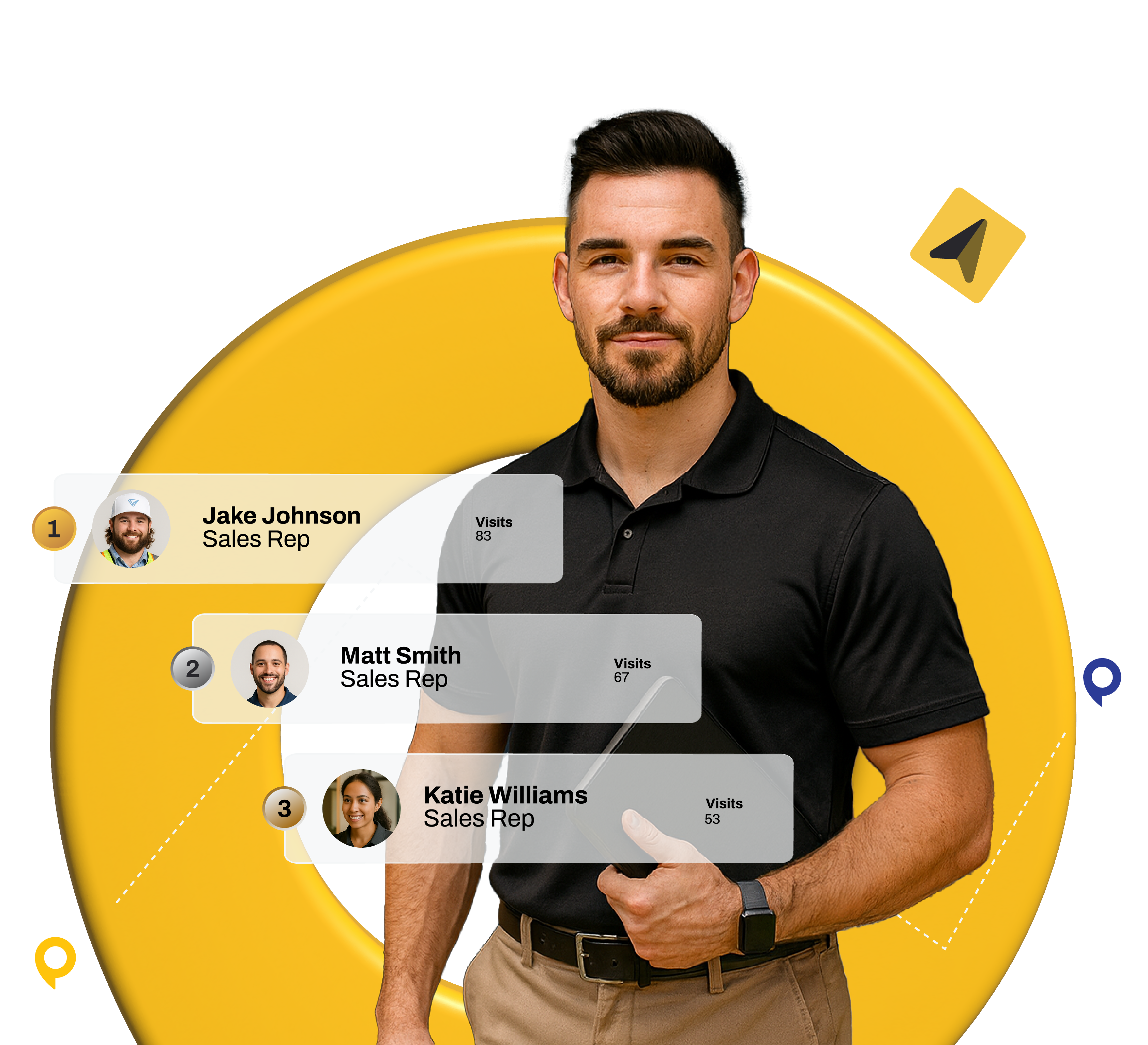
- Use leaderboards to drive healthy competition. Public accountability on daily knocks and contact rate motivates the middle of the pack.
- Nail the canvasser-to-closer handoff. If your team splits canvassing and closing roles, the transfer is where deals leak. Make sure every lead that moves from canvasser to closer includes the full activity history — notes from the door, qualifying answers, disposition status, and any callback commitments. When a closer walks into an appointment already knowing the homeowner’s situation, close rates jump.
For Business Owners Starting D2D
If you’re adding door-to-door for the first time, start small and prove the model before scaling:
- Canvass around your existing customer base first — you already have social proof in those neighborhoods
- Build a documented sales process (openers, qualification questions, objection responses) before hiring your second rep
- Track every metric from day one so you know your cost-per-lead and knock-to-close ratio before you invest in a bigger team
Track What Matters
You can’t improve what you don’t measure. Whether you’re learning to canvass a neighborhood for the first time or managing a team that does it daily, the best canvassing teams track these metrics daily and review them weekly.
Daily Metrics Every Canvasser Should Track
- Doors knocked — raw effort
- Contact rate — conversations ÷ doors knocked (target: 30–40%)
- Leads generated — qualified prospects from the day
- Appointments set — booked follow-ups
- Knock-to-lead ratio — how many doors it takes to produce one lead
Use Data to Find What’s Working
Pull conversion reports to spot patterns. Which neighborhoods produce the best contact rates? What time blocks generate the most leads? Which reps are converting at the highest rate — and what are they doing differently?
This is where canvassing goes from a grind to a system. Instead of guessing, you’re assigning reps to the neighborhoods and time blocks that your data says perform best. That’s how you scale from one good canvasser to a team that consistently hits quota.
Frequently Asked Questions
Canvassing a neighborhood means going door to door in a specific area to introduce a product or service, qualify prospects, and generate leads. It’s a core sales activity in industries like solar, roofing, home services, and telecom where face-to-face interaction drives higher conversion rates than digital outreach alone.
Most field sales organizations target 50–70 doors per day per rep. The exact number depends on territory density, appointment length, and whether reps are driving or walking between doors. Focus on contact rate (conversations per knock) rather than raw door count.
A healthy contact rate is 30–40%, meaning you’re having conversations at roughly one in three doors. If you’re below 20%, look at your timing — you may be knocking when most homeowners are at work. The 3-Pass System (hitting the same neighborhood at morning, midday, and evening) helps push contact rates higher.
It depends on who you’re trying to reach. Morning passes (9 AM–12 PM) catch stay-at-home parents and retirees. Afternoon passes (1–4 PM) reach night-shift workers who are up for the day. Evening passes (4 PM onward) typically have the highest contact rate because most households are home from work. The best approach is The 3-Pass System — hit the same neighborhood across all three time blocks to reach 90% of homeowners instead of whoever happens to be home on a single pass.
Log the attempt with a “not home” disposition, leave a door hanger, note any property observations (roof condition, lawn, vehicles), and schedule a return visit at a different time. Enroll the address in a follow-up sequence so it doesn’t fall through the cracks. The best canvassers work their not-home list consistently — that’s where hidden leads live.
Use prospect data to pre-qualify areas based on demographics (homeownership, income, property age). Ask your manager for old leads from previous reps. Or shadow a top-performing rep for 2–3 days to learn productive neighborhoods before going solo.
At minimum, you need a way to map territories, log activities at each door, and track follow-ups. A field sales execution platform like SPOTIO combines all of these into a single mobile platform — territory management, customer mapping, one-tap activity logging, and AutoPlays for follow-up sequences.
Start Canvassing Smarter
The gap between average canvassers and top performers isn’t talent — it’s systems. The 3-Pass System is simple: pick the right neighborhood using data, work every door (even the silent ones) across three time blocks, and track everything so you can improve next week.
SPOTIO customers built their field sales operations on exactly this approach — systematic canvassing backed by real-time data. If your team is still working off clipboards and gut feel, see how SPOTIO works for door-to-door teams.
Note: This article was originally published on November 19, 2020. It was updated on March 10, 2026.

Trey Gibson is the founder and CEO of SPOTIO, where he helps sales leaders build more efficient, high-performing field sales teams. With a background in entrepreneurship and as the founder of a roofing company, Trey brings hands-on experience leading door-to-door and B2B sales organizations. He combines real-world sales leadership with a passion for technology and operational efficiency to help teams scale, perform, and win more deals.